
Club welfare officer: role, who to appoint, what they see
The short answer
A club welfare officer is the club's first point of contact for welfare concerns: they listen, pass concerns on through the proper procedure and help with prevention, but they don't investigate. Pick someone who doesn't coach. In Koach Club the role, called Confidential adviser, sees names and teams, not contact details or finances.
Your club needs a club welfare officer, or a successor for the current one. So the committee wants to know what the role involves, who is a good fit and how members find them. And because the role ends up in your club software too: what should a welfare officer be able to see there, and what not?
What does a club welfare officer do?
A club welfare officer, often shortened to CWO and sometimes called a club safeguarding officer, is the person members turn to when something doesn't feel right: bullying, inappropriate behaviour by an adult, discrimination, a child who suddenly stops enjoying training. A player, a parent or a volunteer can go to them with something they would rather not raise with their own coach or the committee. The role comes down to three things:
- Listening. They are the first point of contact: they hear the story, ask questions to understand it and don't judge. The conversation is confidential, within the limits explained below.
- Passing concerns on. They know the route and follow it: a concern about a child goes to the governing body's lead safeguarding officer, and if someone is in immediate danger, straight to the police or children's social care.
- Prevention. They help the committee build a safe club: a code of conduct, the culture in the club, making sure coaches and parents know the rules.
Just as important is what the role is not. A welfare officer is not a counsellor and not an investigator, and does not decide what happened. Serious concerns go to the governing body and, where needed, to the statutory agencies, and the committee stays responsible for the club as a whole. And confidential does not mean secret. If a child is at risk, the welfare officer has to share what they know, and they say so at the start, before the conversation gets into detail.
The framework in England: what Volleyball England asks of a club welfare officer
Checked in October 2026 in Volleyball England's safeguarding reminder for clubs with junior members, in its safeguarding training requirements and in the club welfare officer role description it publishes (a 2016 template from the NSPCC Child Protection in Sport Unit). This is not legal advice.
For volleyball clubs in England, Volleyball England sets out what the role involves. The key points:
- Required if you have juniors. A club with junior members must have a club welfare officer, listed on VolleyZone, and a safeguarding policy, which the club uploads with its constitution when it affiliates.
- A DBS check. A welfare officer for under-18s needs a Basic DBS check, renewed online every three years.
- Training. The Safeguarding Children and Adults in Volleyball course and the Time to Listen workshop, for welfare officers of junior and adult sections alike, also renewed every three years.
- First point of contact. For coaches, volunteers, parents, children and young people with a concern about welfare, poor practice or abuse, and the club's link to the governing body's lead safeguarding officer.
- Procedures, not improvisation. The welfare officer follows the reporting and recording procedures, keeps contact details for local children's social care and the police to hand, and promotes the club's code of conduct.
- A seat on the committee. In the template role description, the welfare officer sits on the club's management committee.
Outside England the name and the rules differ. If your club plays in Scotland, Wales, Ireland, the US or elsewhere, ask your national governing body which framework applies to you.
Who should be your club welfare officer?
The most important quality doesn't appear on any CV: members have to feel they can talk to this person. Look for four things:
- Not one of the coaches. A committee seat is normal for this role, but a coach, or whoever picks the teams, is part of the very relationships a concern might be about. Anyone who comes to the welfare officer needs to know they have no stake in the outcome.
- Calm and discreet. Someone who listens without judging, and who doesn't repeat what they hear in the clubhouse after the match.
- Knows the club. Which teams there are, who coaches them, how the committee works. That can be someone with no other role but a real connection to the club: a parent, a former player, someone from a recreational team.
- Easy to reach. Someone who never comes to the gym and doesn't answer the phone is a point of contact on paper only. Agree how members reach them and how quickly they respond.
Appoint them for a fixed term, say a few seasons, and put the review in your annual planning alongside the other fixed points in the volleyball season checklist. If your club has a welfare or safeguarding subcommittee, record it the way you record your other committees; how that works is in recording committees.
Making the role known to members and parents
A welfare officer nobody knows about helps nobody. Members can only turn to someone whose name they know and whom they know how to reach, both online and at the club itself. In practice that means:
- a permanent spot on the club website, with name, photo and how to get in touch;
- a poster or card in the clubhouse and by the changing rooms;
- a short introduction at the AGM and to the parents of the junior teams;
- a message at the start of every season, so new members know too.
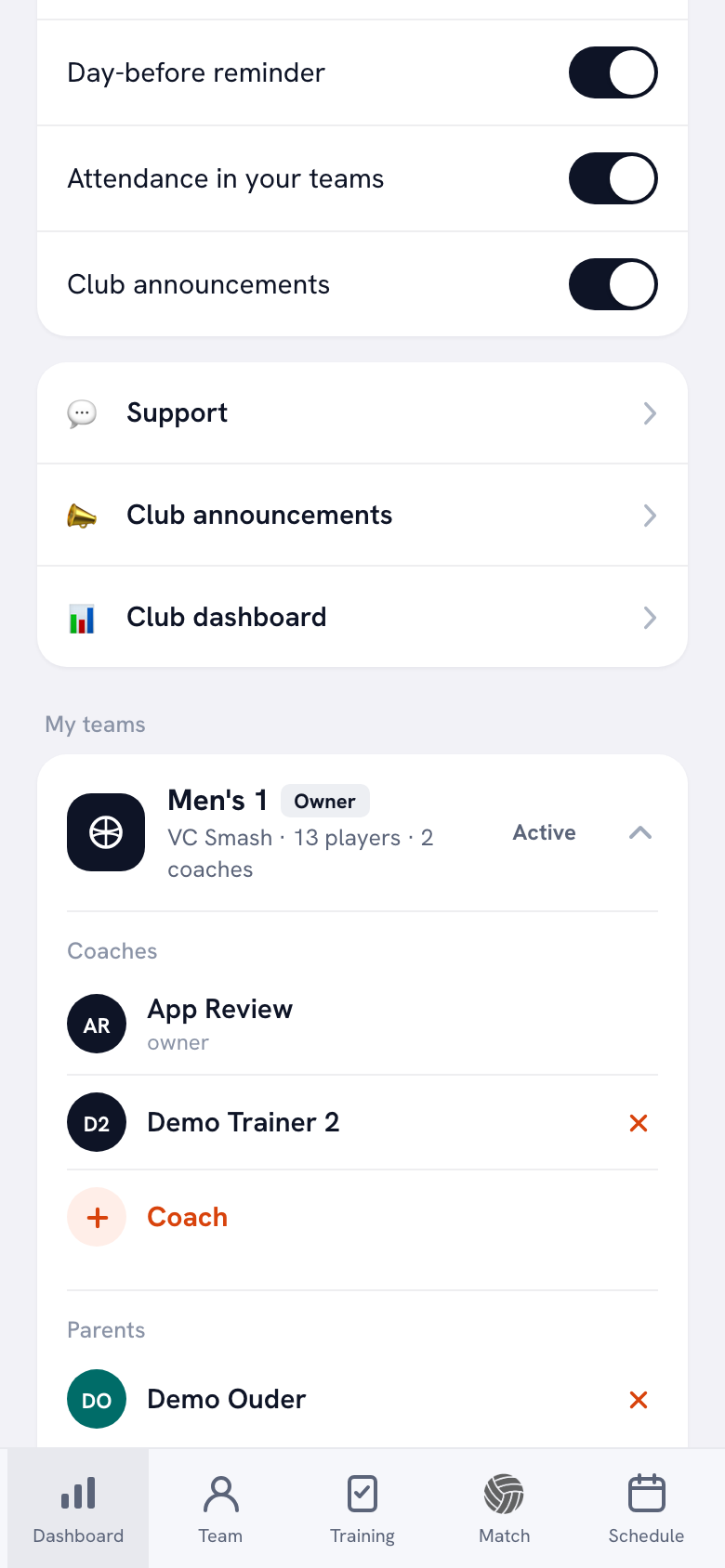
In Koach Club, that message can go out as a club announcement. Open Profile with the circle at the top right of the app, tap Club announcements and then the plus sign, write your message in New club announcement and tap Send to all members. Members with the iPhone or Android app get it as a push notification, unless they have turned off the Club announcements switch, and afterwards it stays in Profile under Club announcements. In Koach, the role you give your welfare officer is called Confidential adviser, and that role can send club announcements itself, without going through the committee. To do that, though, they need to be in one of the club's teams, for example as a player or parent, because Profile is only there for an account with a team. Members without a Koach account don't get the announcement, so the website and the noticeboard are still needed.
We set up Koach Club together with you. Club has no free trial: leave your details and we'll show you how the club roles work and set up your club with you. Want to see the app for yourself first? Try it free for 14 days with one team.
Book an intro call Try the app with one teamWhat should a club welfare officer see in your club software?
As soon as a club runs a membership system or a club app, the question comes up by itself: does the welfare officer get an account, and if so, what can they see? There are three answers.
No access. Safe, but awkward. They don't know which team someone plays in or who coaches it, and for every message to members they have to ask the committee. That makes them dependent on the very people a conversation might be about.
A standard admin account. Quick to arrange, because in a system without roles an account means seeing everything. The welfare officer then gets members' email addresses, the details of parents of minors, the finances and coaches' notes on players. They don't need any of that: anyone who wants to talk to them comes to them. And the more they see, the more their role blurs with the committee's or the coaching staff's.
A dedicated role with limited rights. They see what the job requires and nothing more: who is a member and in which team, plus a way to reach the whole club. That fits the principle of sharing personal data only with people who need it; more on that in what member data a sports club should keep.
The two right-hand columns are the Club manager and Confidential adviser roles in Koach Club, checked in October 2026.
| What the welfare officer gets | No account | Club manager | Confidential adviser role |
|---|---|---|---|
| Members' names and their team | No | Yes | Yes |
| Message to all members | Via the committee | Yes | Yes |
| Email addresses and linked parents | No | Yes | No |
| Contributions and who still has to pay | No | Yes | No |
| Coaches' notes on players | No | Yes | No |
| Export of the whole club in one file | No | Yes | No |
How to set up the role in Koach Club
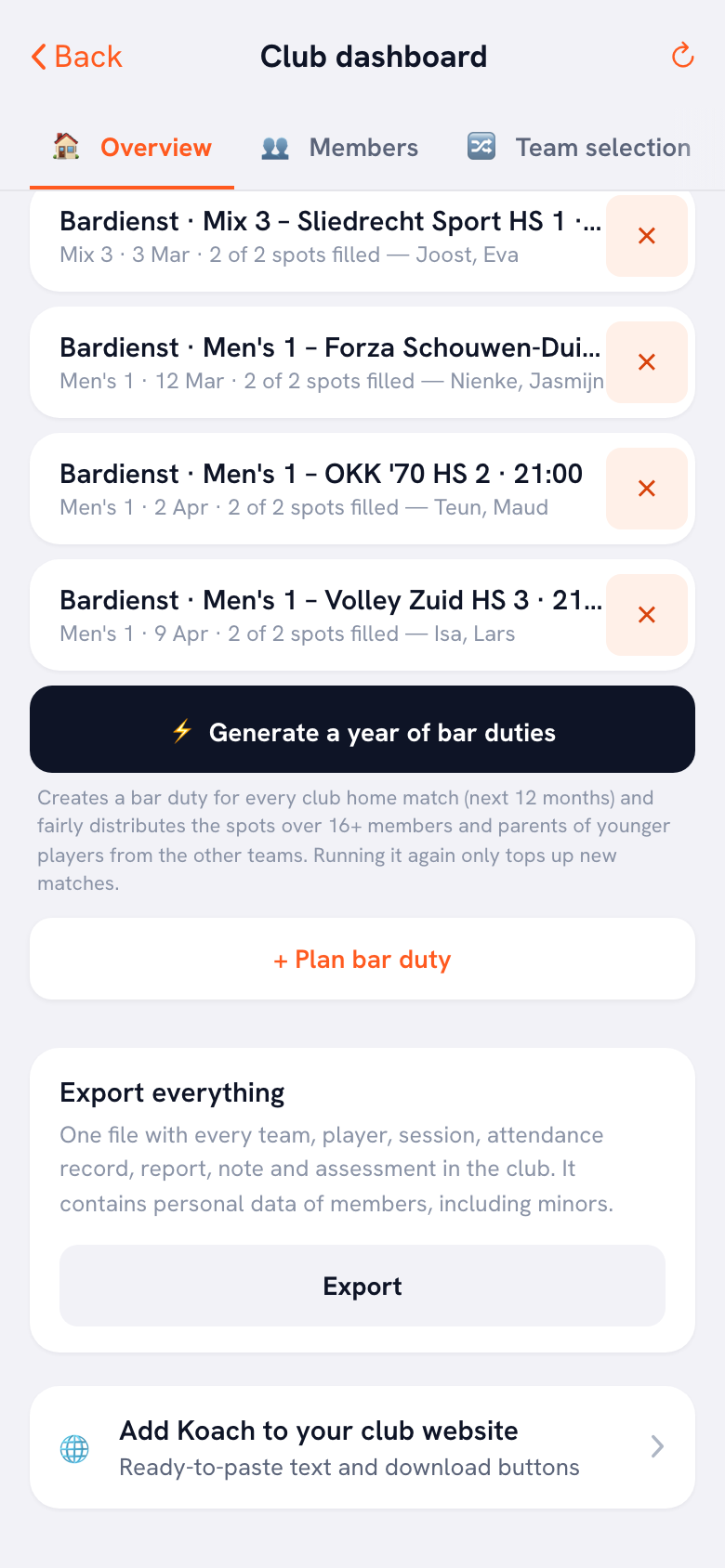
In Koach Club, Confidential adviser is one of the five club roles. A club manager opens Profile, taps Club dashboard and picks the Admins tab. There they enter the address your welfare officer used to sign up for Koach in the Email of an existing account field, choose Confidential adviser under Role and tap Add manager. So the welfare officer does need a Koach account, but not a subscription of their own: the role is covered by the club plan. If they aren't in any team, their home screen shows a button to the Club dashboard; they only need a team for club announcements. All the steps and the other four roles are in adding club managers.
With that role, they see the Overview of the teams and the Members with their names and teams in the Club dashboard, and they can send club announcements. They don't get email addresses, linked parents or members' ages, nor the contributions, the team log with coaches' notes or the export of the whole club. That lock sits on the server: what they aren't allowed to see is never even sent to their phone. When their term ends, they tap Step down from my club role at the bottom of the Overview themselves, or a club manager removes them from the list under Admins.
What Koach doesn't have: an incident form, a case file or anywhere to record conversations. If that's what you're looking for, Koach isn't the tool for it. In England the welfare officer does keep records, under the reporting and recording procedures of the governing body; those belong in that process, not in an app that coaches and parents also use. Ask Volleyball England's safeguarding team how they want concerns reported.
Team communication without private messages
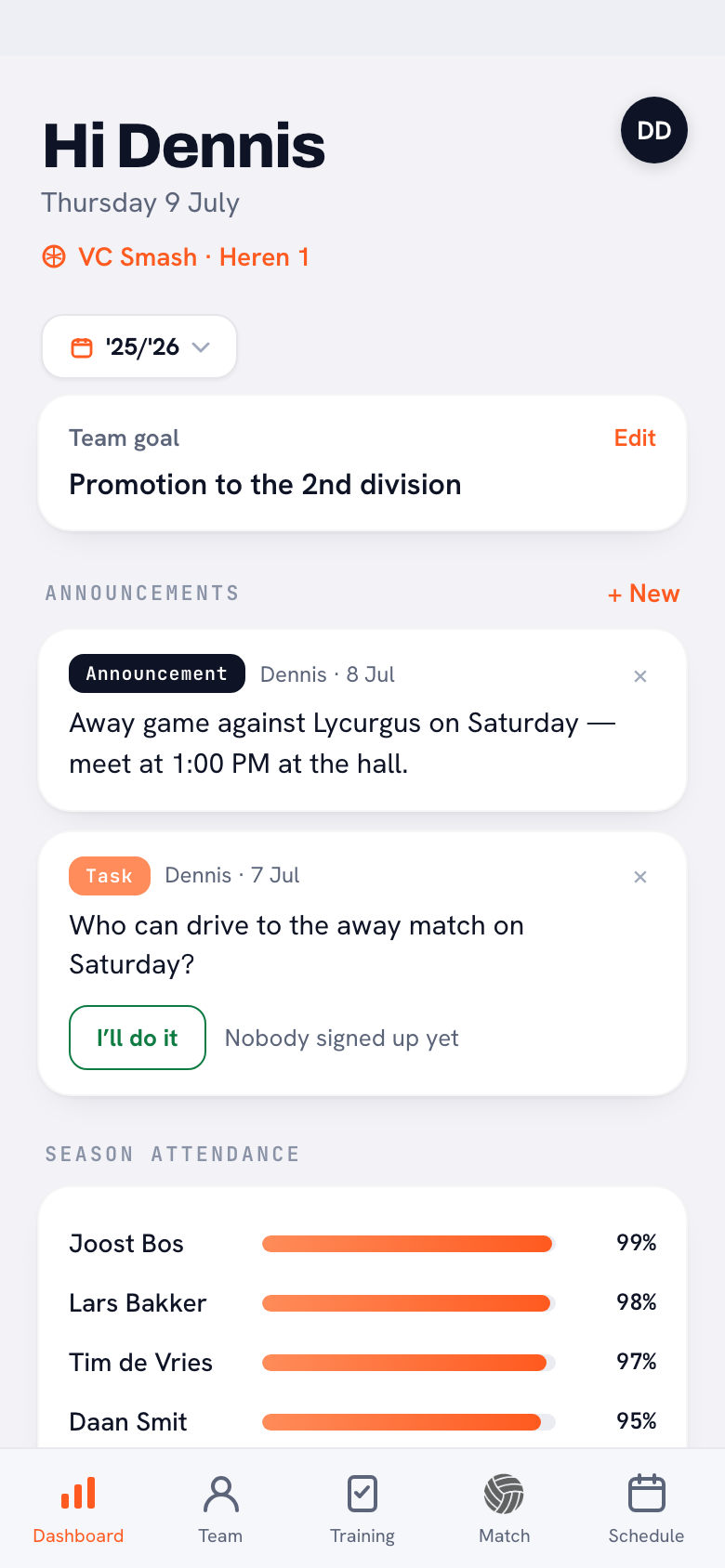
A safe club is also about the channels coaches and players use to reach each other. If your club agrees that messages to junior players go to the whole group, it helps when the team channel offers no other way. That's how Koach works: there is no chat and there are no private messages. A coach posts an Announcement, a Poll or a Task on the team's dashboard; for a task, someone volunteers with I’ll do it. Everyone in the team sees the same message. How the three work is in announcements, polls and tasks.
To be fair: an app can't stop someone from sending a private message outside it. The rule itself belongs in your club's code of conduct, and the welfare officer can help the committee make it known. How rules like these add up to a policy is in building a safe club culture.
Who Koach Club is for, and what it costs
Koach Club suits a volleyball club with several teams that wants to keep committee roles separate: the treasurer with the money, the technical manager with the training, the club welfare officer with names and teams but no contact details. It doesn't fit if you need a reporting system or case files, if you want one system for every sport in a multi-sport club (Koach is volleyball only) or if you want membership management with fee collection: Koach doesn't do that.
Club costs €9.99 per month for the whole club, or €8.33 per month billed yearly, with unlimited teams and coaches. The club roles are included, and players and parents use Koach for free. In the App Store and Google Play you see the price in your own currency. Club has no free trial: you leave your details on the clubs page and we set up the club with you. All prices are on the pricing page.
Let your welfare officer introduce themselves. One club announcement at the start of the season, in their own words: who they are, what members can come to them about and how to reach them. A message from the person themselves says more than a line in the club rules.
Frequently asked questions
What is the difference between a club welfare officer and a safeguarding lead?
The club welfare officer is the first point of contact inside your own club: they listen, follow the reporting procedure and help the committee with prevention. The lead safeguarding officer works at the governing body, and the welfare officer is the club's link to them; the role description Volleyball England publishes names that link explicitly. Outside England the titles and routes differ, so ask your national governing body which apply to your club.
Can a coach or committee member be the club welfare officer?
A committee member, yes: in the role description Volleyball England publishes, the welfare officer sits on the club's management committee. Combining the role with coaching is a different matter. A concern may be about a coach, or about how teams are picked, so members need a welfare officer with no stake in the outcome. Your governing body may set its own rules, so check with them. Our advice: choose someone who knows the club but doesn't coach in it.
Does a club welfare officer need a DBS check and training?
For volleyball in England, yes. Volleyball England's training requirements ask a welfare officer for under-18s to have a Basic DBS check, and every welfare officer to complete the Safeguarding Children and Adults in Volleyball course and the Time to Listen workshop, renewed online every three years. Other sports and other countries set their own requirements. This is not legal advice: check with your governing body what applies to your club.
Can a club welfare officer log concerns in Koach?
No. Koach has no incident form, no case file and nowhere to store conversations. The Confidential adviser role in Koach Club, the one you give your welfare officer, sees the overview of the teams and members' names and teams, and can send club announcements to all members. It doesn't get contact details, finances or coaches' notes. Concerns and records belong in your governing body's reporting procedure.
What does Koach Club cost with a role for your welfare officer, and can you try it first?
Koach Club costs €9.99 per month for the whole club, or €8.33 per month billed yearly, with unlimited teams and coaches and all five club roles. Your welfare officer gets the Confidential adviser role within that: they need a Koach account, but not a subscription of their own. In the App Store and Google Play you see the price in your own currency. Club has no free trial: leave your details on the clubs page, and we'll get in touch and set up the club with you. Players and parents use Koach for free.
Give your club welfare officer their own role
Club has no trial: book an intro call through the clubs page and we'll set up your club with you. Want to look around first? Start below with one team.
Get started with KoachOr read first what the volleyball coaching app does.