
Volleyball coach code of conduct: free Word and PDF template
The short answer
A volleyball coach code of conduct sets out how coaches treat players and parents, what extra rules apply to players under 18 and what happens after a breach. Below is a free template in Word and PDF. In Koach, announcements always go to the whole team, and with Club a technical manager can read what coaches record.
The best time to write a volleyball coach code of conduct is before anything goes wrong, not after. Below you can download a template for a volleyball club, in Word and PDF, that you adapt and ask every coach to sign. After that you can read which commitments from a code like this you can see in Koach, and which you cannot.
Volleyball coach code of conduct: download the template in Word and PDF
The template is free, with no account and no email address required. You are free to use, copy and adapt it for your club. It is written in the first person, from the coach's point of view, so every coach signs up to commitments about their own behaviour.
- Volleyball coach code of conduct (Word): to adapt. Delete what does not fit your club, fill in the blanks and add your own names.
- Volleyball coach code of conduct (PDF): to print, A4 portrait, four pages. Eight sections, a declaration to sign and a record for the club.
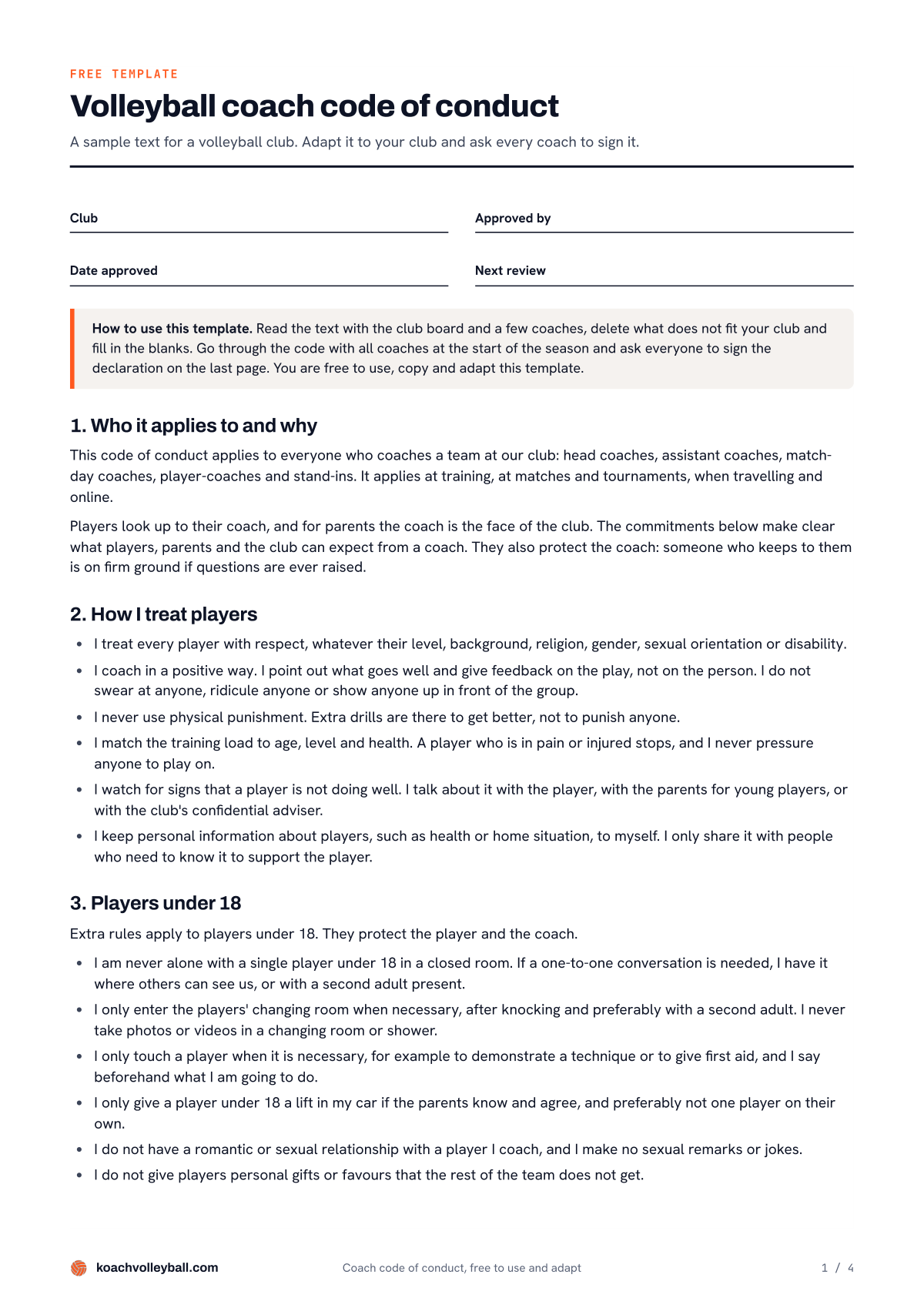
Page 1 of the PDF: the header with the fields to fill in, the tip on using the template and sections 1 to 3. The Word file has exactly the same text.
What should a coach code of conduct include?
At the top you fill in the club, who approved the code, on what date, and when you will review it again. Below that come eight numbered sections. Together they answer the question players, parents and the board ask of every coach: what can we expect from you?
- Who it applies to and why. The code applies to everyone who coaches a team, including assistant coaches, player-coaches and stand-ins, at training, at matches, when travelling and online. It protects the players, and it protects the coach too.
- How I treat players. Respect for everyone, positive coaching, no physical punishment, a training load that fits age and health, and keeping personal information to yourself.
- Players under 18. Never alone with a single minor in a closed room, the changing room only when necessary, never photos in a changing room or shower, touching only when needed, and lifts only when the parents know.
- Communication with players and parents. Team messages go to the whole team, no private messages to minors, no friend requests from private accounts, and difficult conversations not on the sideline or in a group message.
- Playing time and selection. Explain in advance how you choose, and a player who gets little playing time hears it in person. There are four options to tick, from everyone plays at youth level to selection on performance.
- Role model and integrity. Being on time, respecting the referee, no alcohol before or during training and matches, no betting, and telling the board about paid private sessions.
- Working with the club. Keeping track of who came and what you did, letting the technical manager look over your shoulder, reporting incidents on the same day. It also lists what the club offers the coach, because a code works both ways.
- Reporting and measures. Who to go to with a concern and what happens after a breach: from a conversation to the end of the collaboration, with a faster route for serious cases. It includes a table for three contacts.
The last page has a declaration for the coach and the club to sign, and a record where you keep track of who has signed and whether the coach has a copy.
How to fill in the template
- Read it with the board and a few coaches. A code that coaches helped write feels less like a rule handed down from above.
- Delete and add. In section 5, pick the playing time rule that fits your club. In section 4, fill in the channel your team messages go through, and in section 8, add the names and phone numbers of the contacts.
- Add what your country requires. If your national federation or local law asks for a background check, a safeguarding course or a set reporting procedure, add it yourself. Those rules differ from country to country, so they are not in the template.
- Go through it at the start of the season with all coaches and ask everyone to sign. New coaches sign before they run their first session.
- Set a review date. Reading it again once a season is usually enough; that is what the Next review field at the top is for.
Code of conduct for coaches or for members: what is the difference?
This code is only about coaches. A code of conduct for the whole sports club, for players, parents, volunteers and spectators, is a different document with different rules. An evaluation is something else again: the code says what you expect from a coach, while a coach evaluation form asks players and parents how it is going in practice. And who makes sure the code is followed? In the template that is the technical manager or the coaching committee, and the board decides on any measure. In Koach, the technical manager is also the role with read access to every team.
Which commitments from the code can you see in Koach?
We make Koach, an app for volleyball coaches. So read this part as an explanation of what an app can and cannot do for a code like this. A code of conduct is still an agreement between people. But a few rules become easier to keep when the tools already follow them.
Team messages go to the whole team
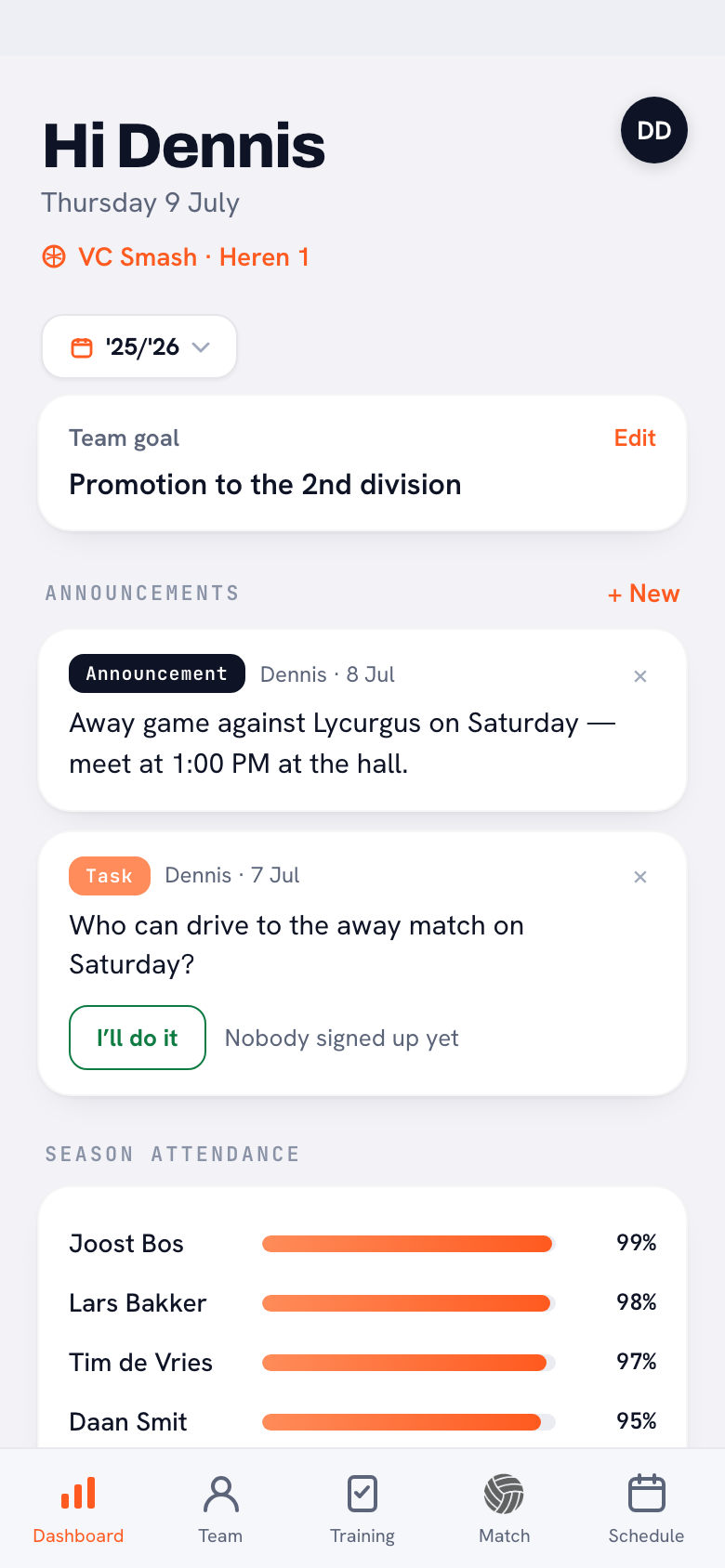
Section 4 asks coaches to send messages about the team to the whole team (for youth teams, to players and parents together) and not to send private messages to minors. In Koach the whole team is also the only recipient: under Announcements on the dashboard, the coach posts an Announcement, a Poll or a Task, and the coaches, players and linked parents of that team all see it. There is no chat and no private messaging. How those three kinds of messages work is explained in team communication with announcements, polls and tasks.
We set up Koach Club together with you. Club has no free trial: leave your details on the clubs page and we will get in touch to show you how the team log and the signals work for your club. Coaching a team yourself? Then you can start in the app straight away.
Book an intro call Start with your own teamKeeping track of what happens at training
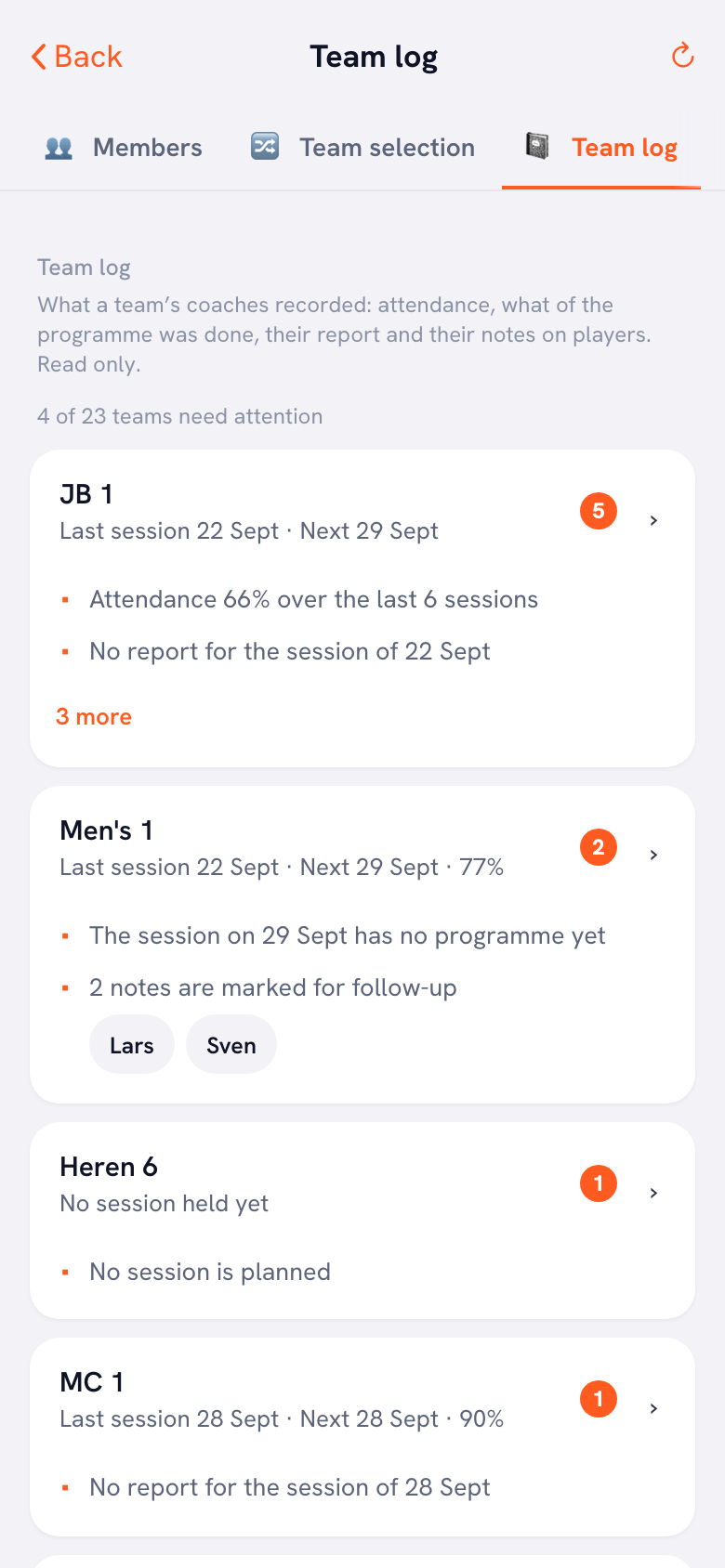
Section 7 asks coaches to keep track of who came and what they did. In Koach, the coach takes attendance after the session, marks each block of the plan as done or not, and writes a short report under After the session, with the Focus for the next session. Notes about a player can be marked Needs follow-up. Players and parents do not see that report or those notes.
The technical manager can read everything and changes nothing
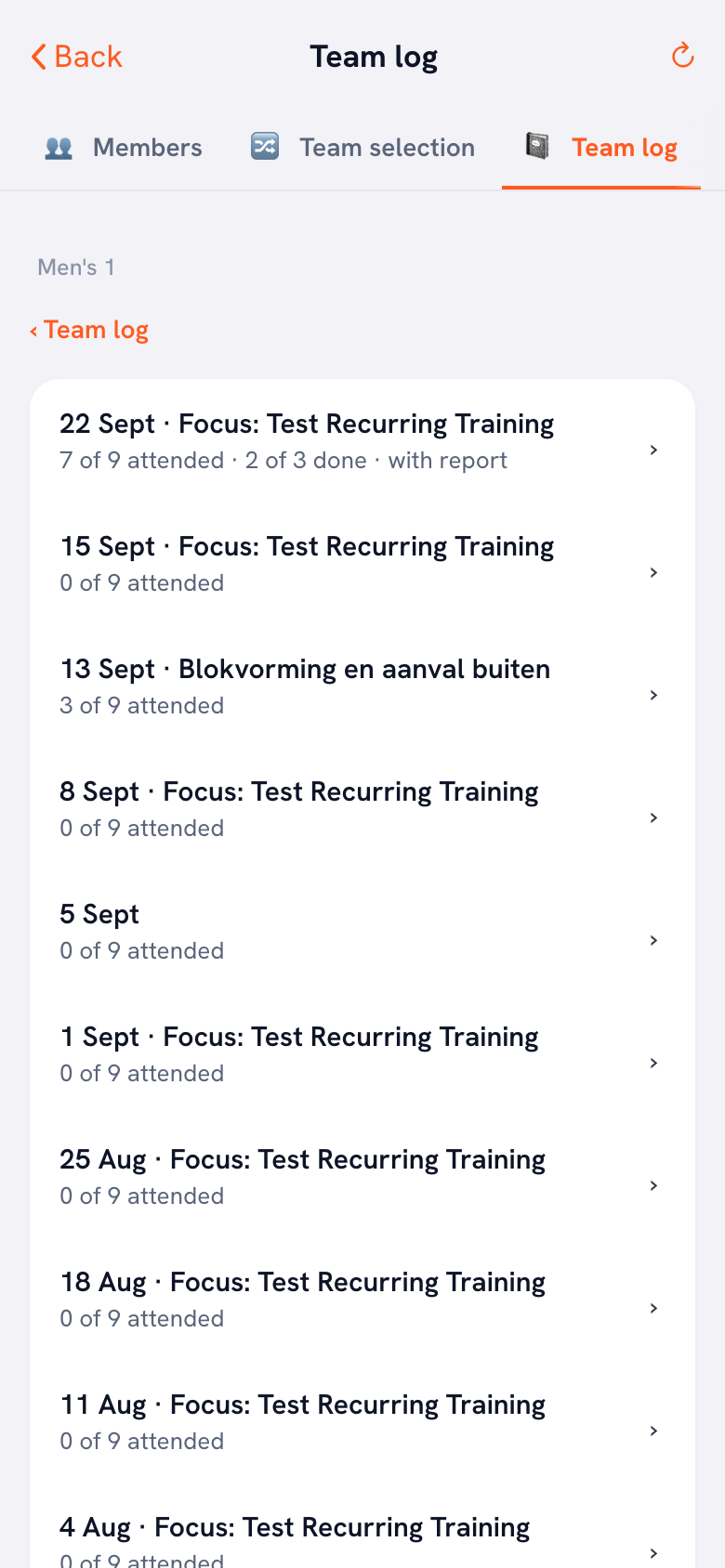
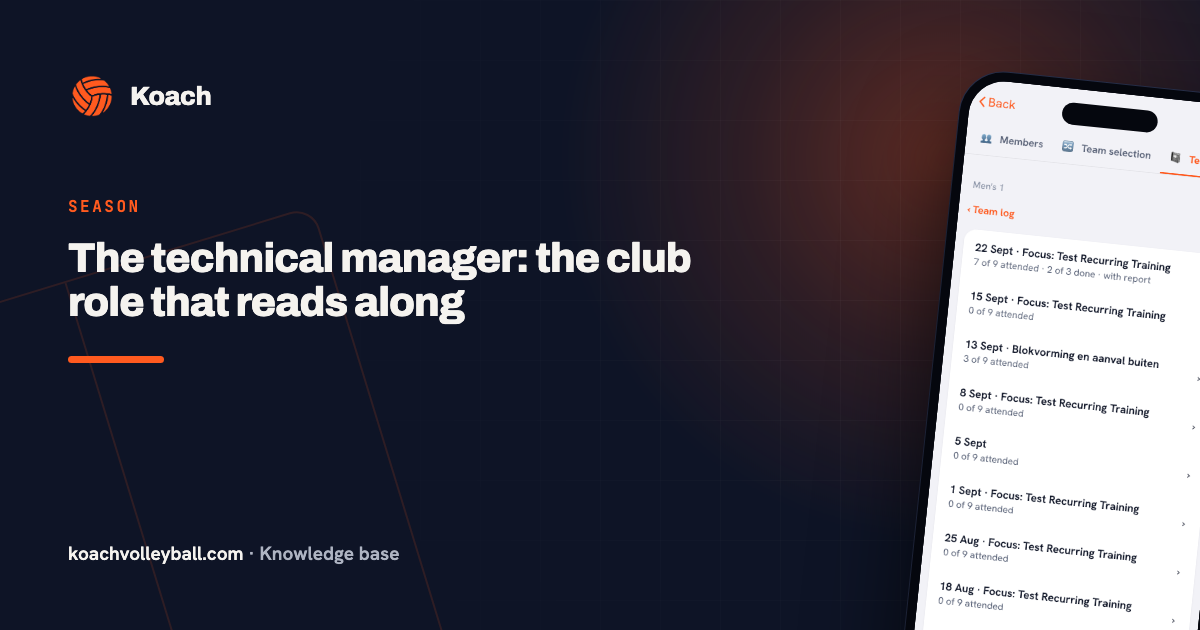
The same section says the technical manager or the coaching committee may read what the coach records. With the Club plan there is a role for that: the Technical manager. The app describes the role word for word: "Reads along in the sessions, reports and notes of every team. Changes nothing and sees no contact details." From the Club dashboard they open the Team log: for each team the last twelve sessions, with how many players came, what was done from the plan, the report and the notes about players. With Show older sessions they can look further back. Why that role exists and where its limits are is explained in the technical manager as a club role.
Signals for each team
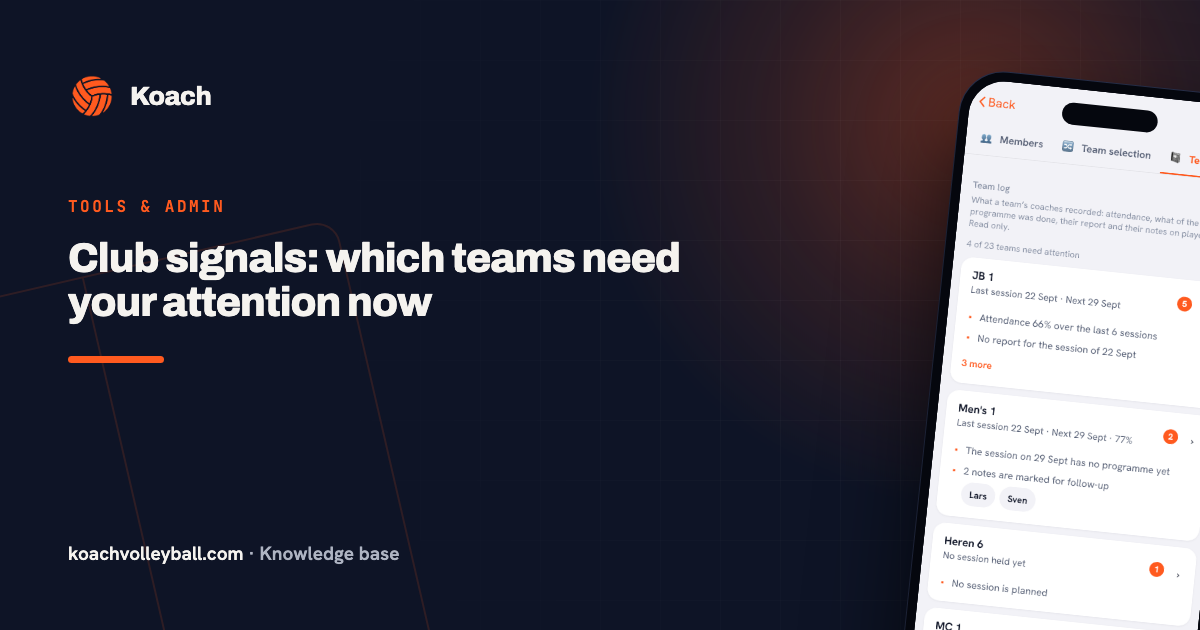
In the team log, the signals block sits above the teams, with a count such as "4 of 23 teams need attention". It counts, among other things, players who missed three sessions in a row, a session with no report or plan, and notes marked for follow-up. That ties in with two rules from the code: the coach keeps track of what happens, and watches for signs that a player is not doing well. Which signals there are and where their limits lie is covered in the signals block on the club dashboard.
Explaining playing time with numbers
The app helps with section 5 as well. If you score your matches live, Koach counts Playing time for each player in rallies played, so you can show a parent how playing time has been shared out across the season instead of going from memory.
A code on paper or in practice: what changes?
A code in a binder does nothing if nobody looks at it. The difference lies in how easy the commitments are to keep and who can see whether they are kept. The right-hand column describes Koach as checked in October 2026.
| Commitment in the code | Code on paper only | With Koach |
|---|---|---|
| Team messages to the whole team | Depends on the coach and the group chat | Yes, announcements always go to the whole team |
| No private messages to minors | An agreement nobody can see | Not possible in Koach; outside the app it stays an agreement |
| Keeping track of who came and what was done | A list, if the coach keeps one | Yes, attendance, plan and report for every session |
| Technical manager can read it | Only if they ask | Yes, with Club, in the team log |
| Seeing what stands out in each team | Only if someone reports it | Yes, with Club, in the signals block |
| Reporting a concern about behaviour | To the contacts in section 8 | No, that happens outside the app |
| Keeping signed declarations | In a binder or digitally at the club | No |
What Koach does not do
- No oversight outside the app. Koach cannot see what a coach sends in another messaging app, what happens in the changing room or who gives whom a lift. The coach can see the phone number a player enters themselves, though. There, the code is the only thing to hold on to.
- No proof of behaviour. The team log shows what coaches record, not how they treat players. A missing report is a question for the coach, not a breach.
- No reporting channel. There is no report form in Koach. A concern goes to the contacts in section 8. Your welfare or safeguarding contact can be given the club role Confidential adviser in Koach, but that role does not see the team log: the Club manager, a Board member and the Technical manager do.
- No signing. Have the declarations signed on paper or in your own documents, and keep them yourself.
Which clubs is this for, and what does it cost?
The team log and the signals suit a volleyball club with several teams, especially youth teams, where someone is willing to keep an eye across the teams and the coaches log their sessions in the app. They are less of a fit if you mainly want a place to handle reports or collect signatures: Koach does not do that. How to plan the fixed moments of the club year, from the coaches' meeting to the review, is covered in the volleyball season checklist.
Club costs €9.99 per month, or €8.33 per month on a yearly plan, for unlimited teams and coaches. Players and parents use the app for free. Club has no free trial: book an intro call through the clubs page. Announcements are also part of the Coach plan for one team (€2.99 per month), which a coach can try free for 14 days, with no credit card. All prices are on the pricing page; in the App Store and on Google Play you pay the store price in your own currency.
Go through the code at the first coaches' meeting of the season, not after an incident. Walk through the eight sections together, ask everyone to sign and agree right away which channel team messages go through. Then the rule on private messages is not a reproach after the fact, but an agreement made in advance.
Frequently asked questions
What is a coach code of conduct?
A coach code of conduct holds the agreements a club makes with all of its coaches: how they treat players, what extra rules apply to players under 18, how they communicate with players and parents, how they explain playing time and selection, and how they work with the club. It also says who to go to with a concern and what happens after a breach. The template on this page has eight sections, plus a declaration to sign.
Should every coach sign the code of conduct?
That is up to the club, but it works best when everyone signs: head coaches, assistants and stand-ins. A signature makes clear that the commitments have been discussed and are known. In the template, the coach and someone on behalf of the club both sign, the club keeps the original and the coach gets a copy. New coaches sign before they run their first session.
Can a coach text a player under 18 privately?
Not under the template: messages about the team go to the whole team (for youth teams, to players and parents together), and if something has to be personal, it goes to a parent as well. That protects the player and the coach. In Koach a coach cannot send a private message: announcements, polls and tasks reach the whole team and the linked parents. Outside the app it remains an agreement in the code.
What happens if a coach breaks the code of conduct?
The template works step by step: first a conversation with the technical manager or a board member, where the agreements are written down, then a written warning, then a temporary stop on coaching and finally the end of the collaboration. In a serious case, such as violence or sexual misconduct, the coach stops straight away while the matter is looked into.
How much does Koach cost for a club, and can you try it first?
Club costs €9.99 per month, or €8.33 per month on a yearly plan, for unlimited teams and coaches; players and parents pay nothing. Club has no free trial: use the form on the clubs page to book an intro call, and we set up the club together with you. A coach can start free for 14 days with one team, with no credit card.

Make the commitments in your code visible across your teams
Club has no trial: book an intro call on the clubs page and we will set up your club with you. Coaching a team yourself? Start below.
Get started with KoachOr read first what the volleyball coaching app does.