
What Does a Yellow Card Mean in Volleyball? Card Sanctions
In football everybody knows what a yellow card means. Most volleyball players think they know too — and get it wrong. Yellow costs no point here, red does, and the two cards together have two different meanings depending on how the referee holds them.
Two separate sanction scales
Volleyball has no one-to-one translation of football's cards. There are two separate scales that do not affect each other:
- The misconduct scale (rule 21) for behaviour towards referees, opponents, team-mates or spectators.
- The delay scale (rule 16.2) for holding up the game.
Both use yellow and red cards, but with different consequences — and delay sanctions apply to the team, not to an individual. The visible difference: on a delay sanction the referee holds the card against their wrist.
The misconduct scale, step by step
- Minor misconduct — not sanctioned. The first referee prevents escalation in two steps: first a verbal warning through the game captain, then a yellow card. That yellow card is a formal warning: it is recorded on the scoresheet, but costs no point and has no further consequences. It only marks that the team member has reached the sanction level.
- Rude conduct — penalty: red card. The team loses the rally: point and serve to the opponent.
- Offensive conduct — expulsion: yellow and red card together in one hand. The person concerned takes no further part in that set and sits in the penalty area. No point is awarded. If the player was on court, the team must replace them; if it cannot, the team is declared incomplete — see fewer than six players.
- Aggression — disqualification: yellow and red card in two separate hands. The person concerned must leave the competition-control area for the rest of the match. Again, no point.
Two things are worth knowing. Sanctions are personal and apply for the whole match: a player who picked up a yellow card in set 1 does not start set 3 with a clean slate. And for offensive conduct or aggression no prior warning is required — the referee may go straight to the heaviest sanction.
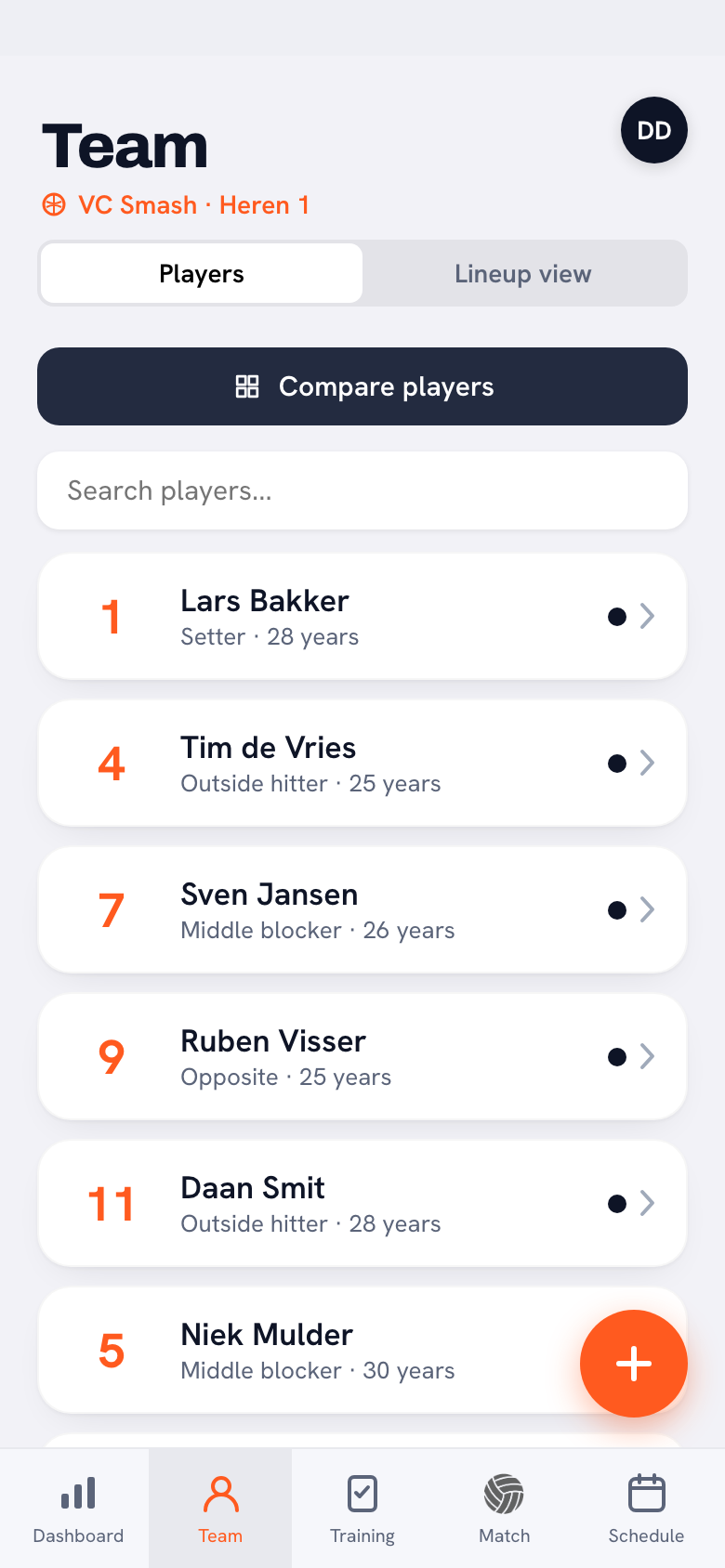
What you expect from your players towards the referee is worth putting in writing once — the team announcements in Koach are a practical place for it.
The delay scale
Delay covers: repeating an improper request, dragging out a substitution, stretching an interruption, or holding up the game in any other way. The scale is shorter:
- First delay in the match: delay warning — yellow card at the wrist. No penalty, but it is recorded.
- Every subsequent delay by any team member: delay penalty — red card at the wrist. Point and serve to the opponent.
This scale applies per team and runs for the whole match. Anyone who needs a breather uses one of their two time-outs instead of dawdling over the serve — the eight-second rule is separate from this.
Who can be carded?
Any team member: players, substitutes, the libero, the coach and the assistants. The coach who keeps commenting on decisions from the bench is in practice one of the most heavily carded figures in the sport. A coach who is expelled may not involve themselves with the team for the rest of the set and takes a seat behind the end line; on disqualification they leave the competition-control area entirely.
Only the game captain may speak to the referee, and then only about the application or interpretation of a rule — not about judgement calls. More on that in the captaincy rules, and the matching signals in the referee hand signals explained.
Youth and recreational leagues
The sanction scale is identical everywhere — there is no milder youth version in the rules. What does differ is the practice: at youth matches the referee is often a junior player who will warn verbally long before reaching for a card. That makes the coach's responsibility greater, not smaller. The same goes for the sideline: the behaviour of parents falls formally outside the sanction scale, but a referee can still stop play — see parents on the sideline.
How to keep your team out of it
Cards are rarely a surprise; they follow a pattern. So agree three things before the season: only the captain speaks to the referee, nobody reacts to a whistle with gestures, and the bench says nothing about line calls. Put those agreements down once in your team agreements instead of shouting them again every match — then they are open to discussion rather than a reproach after the fact.
Frequently asked questions
What does a yellow card mean in volleyball?
A formal warning. It is recorded on the scoresheet, but costs no point and has no further consequences. It marks that the team member has reached the sanction level.
What does a red card cost?
A red card is a penalty: the team loses the rally, so the point and the serve go to the opponent. That applies both to rude conduct and to a second or subsequent delay in the match.
What do yellow and red together mean?
That depends on how the referee holds them. In one hand: expulsion for the rest of the set. In two separate hands: disqualification for the rest of the match. In both cases no point is awarded.
Can a coach be carded too?
Yes, any team member can be sanctioned: players, substitutes, the libero, the coach and the assistants. An expelled coach may not involve themselves with the team for the rest of the set and sits behind the end line.



Try it yourself in Koach
Less admin, more coaching.
Get started with KoachOr read first what the volleyball coaching app does.