
Can a Libero Be Team Captain? How That Rule Works Now
Your most experienced player is your libero, is on court for almost the whole match and is the only one who talks calmly to the referee. The obvious captain, you would think. For years it was not allowed; now it is — with one practical catch that teams keep overlooking.
Two captains: on paper and on the court
Volleyball has two kinds of captain, and that distinction is the foundation of this whole rule:
- The team captain is listed on the scoresheet, takes part in the toss, signs the sheet afterwards and can lodge a protest.
- The game captain is whoever is wearing the captaincy on court at that moment. They are the only player allowed to speak to the referee during the match (rule 5.1.2).
As long as the team captain is on court, they are also the game captain. The moment they leave — substituted, or replaced as a back-row player by the libero — somebody else has to be designated. That player stays game captain until the team captain returns.
What changed
The older FIVB rules said it explicitly in article 19.1.3: the libero could be neither team captain nor game captain. The reasoning was practical: the libero leaves the court constantly, and a captain who keeps disappearing makes communication with the referee messy.
The 2021 rule revision deleted that provision. Under the current FIVB rules — which national federations adopt almost one-to-one — the libero may indeed be captain, both on the sheet and on the court. If you play in a competition that still works from an older rulebook (which happens in some recreational and corporate leagues), check that league's own regulations; only there can the ban still apply.
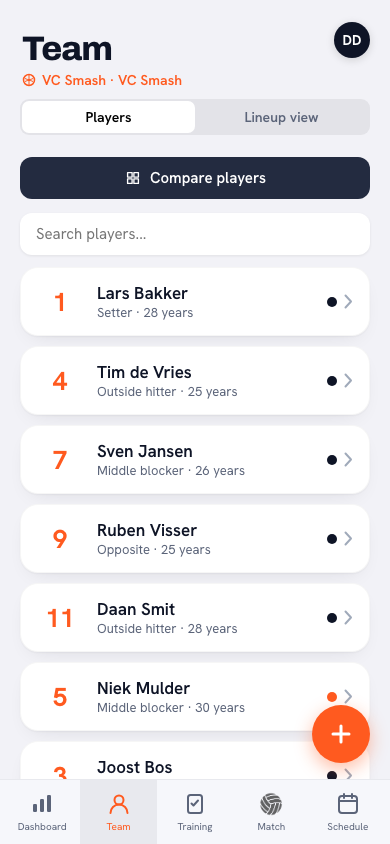
Once you have decided, you can mark your captain — and a vice-captain — in your squad in Koach, so it is on record for everyone who speaks for the team.
The catch: the libero is always coming off
The rule has been relaxed; the practical reality has not. A libero leaves the court every time the player they replace rotates to position 1 and has to serve — see the libero replacement rules. At that moment your captain is off the court and you have no game captain, in precisely the rotation where you are serving and where arguments about the serving order tend to start.
If you do pick your libero as captain, designate a fixed stand-in in advance who takes the role over every single time — not whoever happens to be closest. That saves a referee who does not know who to look at, and it saves your libero the feeling that they should keep talking from the sideline. Which, by the way, they may not: off the court they are an ordinary player.
What the captain is actually allowed to do
Plenty of teams overrate the role. The game captain may:
- ask for an explanation of the application or interpretation of a rule — not about a judgement call such as a ball held;
- ask permission to change shirt or shoes, or to have the line-up or the net tension checked;
- request a time-out or a substitution if the team has no coach;
- thank the referees afterwards and sign the sheet — and, if they disagree with how a rule was applied, have a protest recorded.
What they may not do: keep talking about every decision. Pushing on earns a warning first and a card after that. The signals the referee uses for it are set out in the referee hand signals.
How you record it on the scoresheet
The team captain is indicated on the scoresheet before the match with a capital C after their shirt number; listed players without that mark are not captain. If you change captain between sets, you tell the second referee, who notes it. A captain who goes off injured or is sanctioned out of the match is replaced by a player the coach designates — again through the referee, not by an arrangement among themselves. In leagues that use a digital scoresheet the same administration applies, and a libero with a C beside their name does stand out there: it is entirely legal, but expect a referee to ask about it at some point.
Is the libero a good choice?
It is allowed, but it is rarely the smartest pick. The libero is on court the most — good — but misses their own team's service turns and, as a defensive specialist, is the least involved in the attacking decisions a captain normally has a hand in. If you want a captain who steers the match, you tend to look at the setter; if you want somebody who holds the team together, you look at character. How to weigh that up is in choosing a captain. All the remaining libero rules — replacements, the shirt, what they may do at the net — are in the libero rules.
Frequently asked questions
Can the libero be team captain?
Under the current FIVB rules, yes: the old ban in article 19.1.3 was deleted in the 2021 revision, and national federations follow those rules. If your league still works from an older rulebook, check it separately.
Who is game captain when the libero goes off?
Another player on court, designated in advance by the coach or the team captain. As long as the captain is off the court, that stand-in is the only one allowed to speak to the referee.
Can the captain argue about every decision?
No. They may ask for an explanation of the application or interpretation of a rule, but not protest judgement calls such as a ball held or a line call. Pushing on leads to a warning and then a card.



Try it yourself in Koach
Less admin, more coaching.
Get started with KoachOr read first what the volleyball coaching app does.