
Building confidence in sport: the player who has lost it
This isn't about the player who never dared. This is about the player who had it: the one who dropped a team after the winter break, who played three matches where nothing landed, or who came back from an ankle injury. Since then, at every moment of doubt, he picks the smallest ball. Compliments won't give him his confidence back — that takes evidence, and evidence takes weeks.
Out of form or out of confidence — not the same thing
Before you do anything, establish which of the two is in front of you, because they call for opposite responses. A form dip sits in the execution: the player still picks the attack, the hard serve, the ball between two people — it just isn't landing. A confidence dip sits in the choice: he picks smaller, and what he does still do, he does tidily.
There is a nasty side effect to that. A player who picks smaller makes fewer errors. His error load drops, his success rate may even rise, and on paper nothing looks wrong. What drops is his share: fewer attacks, fewer serves that force anything, fewer balls he pulls towards himself. So the question that separates the two isn't "what is working?" but "what is he still attempting?" — and that is a question you can only answer if you know what he was attempting three months ago.
The signals come before the numbers
Behaviour runs weeks ahead of statistics. These are the six signals that show up most often, and with each one watch for the words no longer: this is about a change relative to this player, not about a type of player.
- He no longer asks for the ball. At the important moments he looks away from the setter instead of towards her.
- He lets someone else go first. At a new drill he stands at the back of the line, where he used to stand at the front.
- He looks at you after an error. Or pointedly away — either way his attention is on the judgement and not on the next ball.
- He has stopped talking. No "mine", no "out", no call to the back-court player. Going quiet is new behaviour in this player, which is something quite different from a naturally quiet player.
- His serve has changed. Lower, slower, middle of the court: a serve you cannot lose anything with.
- He arrives exactly on time. No longer a quarter of an hour early, and a first unexplained absence often follows shortly after.
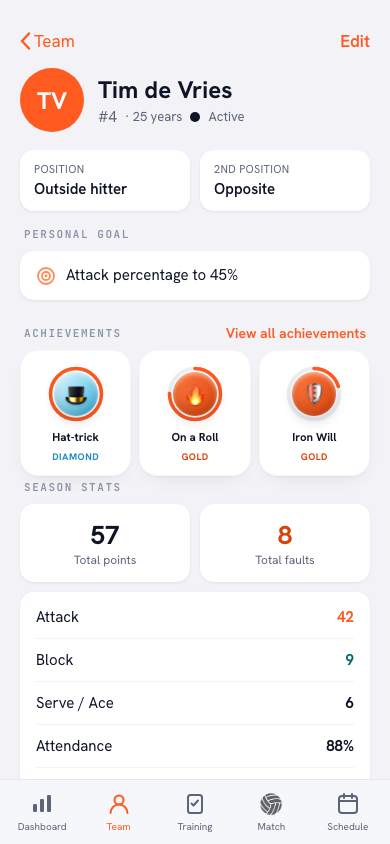
Put the numbers alongside that, but in that order. The form indicator in Koach compares a player with his own average and shows whether he is dropping below his own baseline. Use it as a mirror, not as a verdict: what you are looking for is the week it tipped, because that week usually tells you the cause straight away. Turn it round and start with the numbers, and you arrive at the player with a chart and a conclusion — at which point the conversation is over before it began.
Three tipping points, three opening moves
Almost every player who has caved in has an identifiable moment. The opening move differs per tipping point.
- A team down. This isn't a skill problem but a status problem: he is now facing balls he can handle, and that is exactly why nothing proves anything. Opening move: within two weeks, give him a role that only he has in this team — fixed server on the key rotation, the player others turn to in reception. Without a role of his own he stays the demoted player instead of a load-bearing one.
- Three bad matches. The risk is that he overwrites his own memory: three matches become "I can't do it any more". Opening move: set checkable facts from an earlier period against it ("in November you had four matches in a row at your highest attacking share"). Not as a pep talk, but as a correction of a story that is factually wrong.
- Back from injury. The body has been cleared, the head is guarding the spot. Recognisable: he no longer dives, he lands on two feet, he steps out of the block. Opening move: build the unpredictability back up rather than the intensity — first tossed balls, then half-free ones, and only then game formats — and agree a signal he can use to skip a drill without having to explain.
The conversation: what you say and what you never say
Two sentences coaches use with the best of intentions that usually make it worse. The first is "just don't think about it". That makes exactly that thing the subject of the sentence: the player has to summon the miss up before he can push it away. The second is "you're plenty good enough". It sounds warm, but it tells the player his own observation is wrong — and his observation is the only thing he is sailing on at that moment. Someone whose eyes are denied stops talking about it.
Choose the moment deliberately: not in the changing room, not straight after a match, but two days later, standing up, while the balls are being put away. Five minutes. This is the structure, and you can use the sentences exactly as they stand:
- Observation, factual and specific. "These last three matches, when you're in doubt you play the ball over instead of attacking it. In November you didn't do that."
- No judgement, no diagnosis. "I don't know what's behind that." Above all, don't tell him he has lost his confidence — that is a label he then has to carry.
- One open question, then silence. "What do you see yourself?" Let the silence sit, even if he needs ten seconds.
- A proposal with a time frame in it. "For the next two weeks I want to agree something smaller with you: one job per rally, and it's a job you can't lose. In two weeks we look together at what it did."
What you leave out of this conversation matters just as much: no second subject, no technical correction, no remark about his attitude. One subject per conversation. The rest of your feedback language in those weeks follows the same line as in correcting without shouting: name the next job, not the last error.
Two weeks of one task that cannot fail
Here is the heart of it. A compliment is your opinion, and a player who doesn't trust himself certainly doesn't trust your opinion of him. Evidence is his. So for two weeks you give him one task in which he collects his own evidence. A task like that meets three requirements:
- He carries it out himself. No team result, no outcome a teammate or an opponent can influence.
- It works eight times out of ten. If it works five out of ten it isn't a task but a test — and a test is precisely what this player does not need right now.
- It gets counted, not felt. Three times a practice, ten attempts, a tally mark. After two weeks he has a sheet full of recorded attempts: that is something other than "I thought it was going better".
Notice that the task is about behaviour and not about quality. For a passer: every rally you pick your position first and call "mine" or "yours" — what gets counted is whether you called, not how the pass was. For a hitter: you approach every ball, including the one you don't get. For a setter: on the first ball of every rally you name your hitter out loud before you play. For a middle coming back from injury: you jump with every opponent attack, even when you are late. Tasks like this literally cannot fail, and that isn't a trick — it is the only way to manufacture a run of successes in weeks where the results are against you.
Steer the ball as well: in a drill you decide what comes at him, so give him deliberately high, slow balls for the first five minutes and then raise the difficulty one step per practice. Record the task as a personal goal with a counting date attached, so that in two weeks it is a conversation about numbers and not about feelings. And stick to one task: add a second point of attention in week one and you weaken the agreement itself.
Substitutions and playing time during a dip
In these weeks your substitution policy does more than all your words put together. Four rules that make the difference:
- Never substitute straight after the error. There has to be at least one rally he plays between the error and the change. Otherwise the substitution is the punishment for that one ball, and that is what he remembers — not your explanation afterwards.
- Substitute at a neutral moment. At the start of a set, on a service change, or at a score that means nothing. How many substitutions you are allowed differs by the rules you play under; check that with your own federation.
- Say in advance what is going to happen. "You start the second set and you play it out, whatever happens." Certainty is half the recovery: a player who knows he won't be pulled at the first miss dares to make a choice again.
- Do substitute if he stops joining in. If he stops getting back into defence or stops covering, playing on isn't trust but neglect. Take him off with a job on the bench rather than with a look.
Don't let his playing time drop to zero, either. Below roughly one set a match he cannot collect evidence, and then every Saturday confirms his conclusion. Agree something concrete for the recovery period — for example: at least one full set per match, preferably the set that doesn't decide the match — and explain that this is temporary and why. How to explain an exception like that without the rest of the group reading it as favouritism is in sharing playing time fairly.
The timeline: six weeks, with a checkpoint after two
A recovery process without an end date becomes a permanent state. So put a clock on it.
- Week 0: the five-minute conversation, the task agreed, the counting date in the diary.
- Weeks 1 and 2: that task only. No extra feedback on the rest of his game, however tempting. You count along, he counts along.
- The checkpoint after two weeks. Not the question "is it going better?", because he will say yes to that. Three checkable questions instead: does he do the task without you reminding him? Does he pick the hard ball again at least once a match? Is he talking on court again? Two out of three yes means carry on and enlarge the task. Nought or one yes means not another six weeks of the same, but trying something else — a different position, a different drill format, or the last section of this article.
- Weeks 3 and 4: the task gets bigger and takes on risk. For instance: once per set you deliberately take the hard ball, whatever the outcome. The attempt still counts, the result still doesn't.
- Weeks 5 and 6: his old role back, in a match, at a moment you choose. Don't announce it to the group — he doesn't need a ceremony, he needs balls.
Say one thing up front, because it will save you the whole process: there is another bad match coming, and it is scheduled. A player who has a dreadful Saturday in week four and thinks he is back at zero falls back to week zero in two days. If he knows in advance that a setback is part of it, it becomes a dip in a line instead of proof that he was right all along. If the whole team is sinking rather than this one player, you have a different problem: that is the approach in breaking a losing run, and you are better off not confusing it with an individual process.
When it isn't a confidence problem
Before you invest six weeks, rule out four things that look exactly like this and call for an entirely different approach.
- Pain nobody knows about. A player who no longer dives or no longer swings fully through is sometimes simply protecting a shoulder or an ankle. Ask about pain, not about confidence — you'll get an honest answer to the first question, rarely to the second.
- Growth. In the youth game a dip can be purely physical: arms and legs are longer than the feel for timing. That resolves itself, but only after months, and the support is different — see the growth spurt in a youth player.
- Something outside the hall. A dip that starts at the same time in matches, at practice and in attendance is rarely tactical. Just ask, and accept that you won't get the answer immediately.
- The dip is correct. Sometimes the information is right: this player is in a position or a team that doesn't fit. Then a recovery process is only a delay. Better to explore a different role — that isn't a demotion but a correction.
And there is a limit. If it stops being about volleyball — stomach ache before every match, refusing to serve, freezing despite months of patience — that belongs with specialist support. The tools for the moment itself and the question of when to bring in a sport psychologist are in mental training. This article is about the weeks around it; that one is about the seconds inside it.
Key point: confidence is built with evidence the player produced himself and counted himself. Anything you say is at best the confirmation afterwards. If at the end of two weeks you cannot name a number, you have encouraged him — not helped him.
Frequently asked questions
How long do I give a player before I try something else?
Two weeks to the first checkpoint, six weeks for the whole process. If after two weeks he does his task without being reminded and picks the hard ball again now and then, it is working. If after two weeks you see movement on no point at all, don't repeat the same thing — look for a different cause first.
So compliments don't work at all?
They work as confirmation of something the player has already seen himself, not as a replacement for it. So say 'you called it nine times out of ten today' rather than 'well done'. The first is a fact he can check, the second is your opinion of him — and right now that is exactly what he distrusts.
Should I drop a player who has lost confidence from the starting six?
Not as a reaction to errors, but yes if he visibly stops joining in on defence. Substitute at a neutral moment and never straight after the miss, and keep his playing time at a minimum of one full set per match. Below that level he cannot build a single good experience.
What do I do if the player says nothing is wrong?
Accept that answer and carry on with the task anyway; you don't need an admission in order to help. Say you will come back to it, and meanwhile keep an eye on his attendance, because unexplained absences say more about this player than his words do.
Should the team know a player is in a dip?
Never name it to the group — that makes him the patient of the squad. What you do instead is keep his role in the team visible and give teammates a concrete job that helps him, for instance the setter giving him two free balls in the first set of every match.



Try it yourself in Koach
Less admin, more coaching.
Get started with KoachOr read first what the volleyball coaching app does.