
Why do volleyball players wipe their hands on their shoes?
The short answer
Volleyball players wipe their hands on the soles of their shoes to remove dust and sweat, so they get grip on the gym floor again. On a dusty or wet floor a rubber sole slips more easily. For many players it has also become a habit, which they repeat between points even on a clean floor.
Why do volleyball players wipe their hands on their shoes after almost every rally? Anyone watching volleyball for the first time sees more: players who huddle and slap hands after every point, and a server who bounces the ball three times. Sometimes there is a good reason behind it, sometimes it is habit, and sometimes a bit of superstition.
Why do volleyball players wipe the soles of their shoes?
The short answer: for grip. You play volleyball on a smooth indoor floor of wood or synthetic material, and your shoes have a rubber sole that has to hold on it at every take-off, every landing and every side step. Two things make that grip worse:
- Dust. Every gym floor has fine dust on it, and it sticks to your soles. A layer of dust between rubber and floor acts as a slip layer: your foot slides away sooner.
- Sweat. Players dive, roll and land on the floor, and sweat drips down. A wet spot is slippery, and your sole carries along what it picks up there.
Wiping your palm over the sole takes the dust off: your hand is slightly damp and picks it up. The effect only lasts a short time, until you have walked a few meters over the same floor again. That is why you see it after almost every rally.
A wet spot on the floor itself is a different matter. The rules forbid playing on a slippery floor (rule 1.2.1 of the FIVB's Official Volleyball Rules 2025-2028), and the game captain may ask the referee to check the floor (rule 5.1.2.2). At international matches so-called quick moppers come onto the court after a rally when needed and wipe the floor dry with small towels. In an ordinary gym a player does that themselves with a towel.
To be honest, for many players the wiping has become a tic. They also do it on a clean floor and when they did not take a single step in the rally. Then it is part of their ritual between points, and it does no harm. If you keep slipping even after wiping, look at your shoes themselves: a worn-smooth tread is an obvious cause.
Why do volleyball players huddle after every point?
After every rally the six players come together, tap each other's hands or shoulders and spread out again. From the stands it looks like a ritual, and it is, but it has three functions:
- Plans for the next rally. In volleyball something changes after every rally: who serves, where you stand, who is in the opponent's front row. In the huddle the setter says which attack they want to run, or the blockers agree who takes the opponent's strong hitter.
- Closing a rally. After a point you share it, after an error you leave it behind. The huddle is a fixed moment to let go of the last rally.
- Contact. Six players who look at each other after every rally know how everyone is doing.
Does it help? That is hard to measure in volleyball. In a study of basketball teams in the American NBA, researchers counted how often players touched each other, with hand slaps, pats on the shoulder and hugs (Kraus, Huang and Keltner, 2010). Players and teams who touched each other more early in the season performed better later in the season, even when the researchers took into account how good they already were. That is a correlation and not proof that the touching is the cause, and it was about basketball: for volleyball it has not been shown.
Why do they slap hands after an error too?
That surprises many spectators: someone hits the ball into the net and still gets a slap from everyone. That hand does not mean "well done" but "next ball". Volleyball is a sport in which you depend on each other in every rally. The player who just made the error may have to pass the next ball, and a team that turns away from them leaves them on their own. The opponent sees that too. What a team shows after an error, and how you make team agreements about it, is in body language in volleyball.
Why do volleyball players bounce the ball before serving?
Many servers do the same thing before every serve: bounce the ball a few times, spin it in their hands, breathe out and only then toss. That is allowed. The rules explicitly permit bouncing and moving the ball in your hands, as long as you toss or release the ball only once (rule 12.4.2). The server does have to hit the ball within eight seconds of the whistle (rule 12.4.4).
The reason is a fixed routine. The same rhythm before every serve gives your mind something familiar to do, instead of thinking about the score or the last serve. How to build such a serving routine is in mental training for volleyball players. Spinning the ball is how you find a familiar grip and the spot where your hand will contact it.
The number of bounces is personal, though, and that is where superstition starts. One player always bounces three times, another twice with the left hand. That number does nothing by itself: what helps is that it is the same every time. The same goes for the fixed spot of the water bottle or the shirt someone insists on wearing. Rituals like that can be reassuring, as long as you don't get thrown when it goes differently once.
Why do some players wear their knee pads low?
You see it in every gym: knee pads hanging halfway down the shin. Often the reason is simple. During warm-up and the hitting lines you rarely go to the floor, and lower down they are more comfortable, especially in a warm gym. Players whose role rarely has them diving sometimes leave them down for the whole match, and for some players it is simply fashion. On your shin they protect nothing, though: the pad belongs on your kneecap at the moment your knee hits the floor. How they should sit and which thickness suits which position is in volleyball knee pads.
Why do volleyball players wear arm sleeves?
An arm sleeve is a tight sleeve from the wrist to above the elbow, often on one arm only. Players wear one for three reasons:
- Against floor burns. In a dive or a roll your forearm slides across the floor. A sleeve prevents a burn.
- For the forearms. Players who pass a lot take the ball on the same spot every time. Some find that a thin sleeve makes that a little less sensitive; you still feel the ball through it.
- Warmth and habit. In a cold gym a sleeve keeps your arm warm, and for many players it is simply part of their kit.
A sleeve is neither required nor banned: the rules do not mention arm sleeves by name.
Other habits, explained elsewhere
- A beach volleyball player with their hands behind their back before the serve: those are signals to their partner about the block, see beach volleyball hand signals.
- One player in a different shirt: that is the libero, see why one volleyball player wears a different shirt.
- What they all shout during a rally, from "free" to "touch": volleyball terms from A to Z.
At your next match, watch only the players without the ball for one rotation. You will see when they wipe their soles, who does the talking in the huddle and what the server does before tossing the ball.
Watching as a parent?
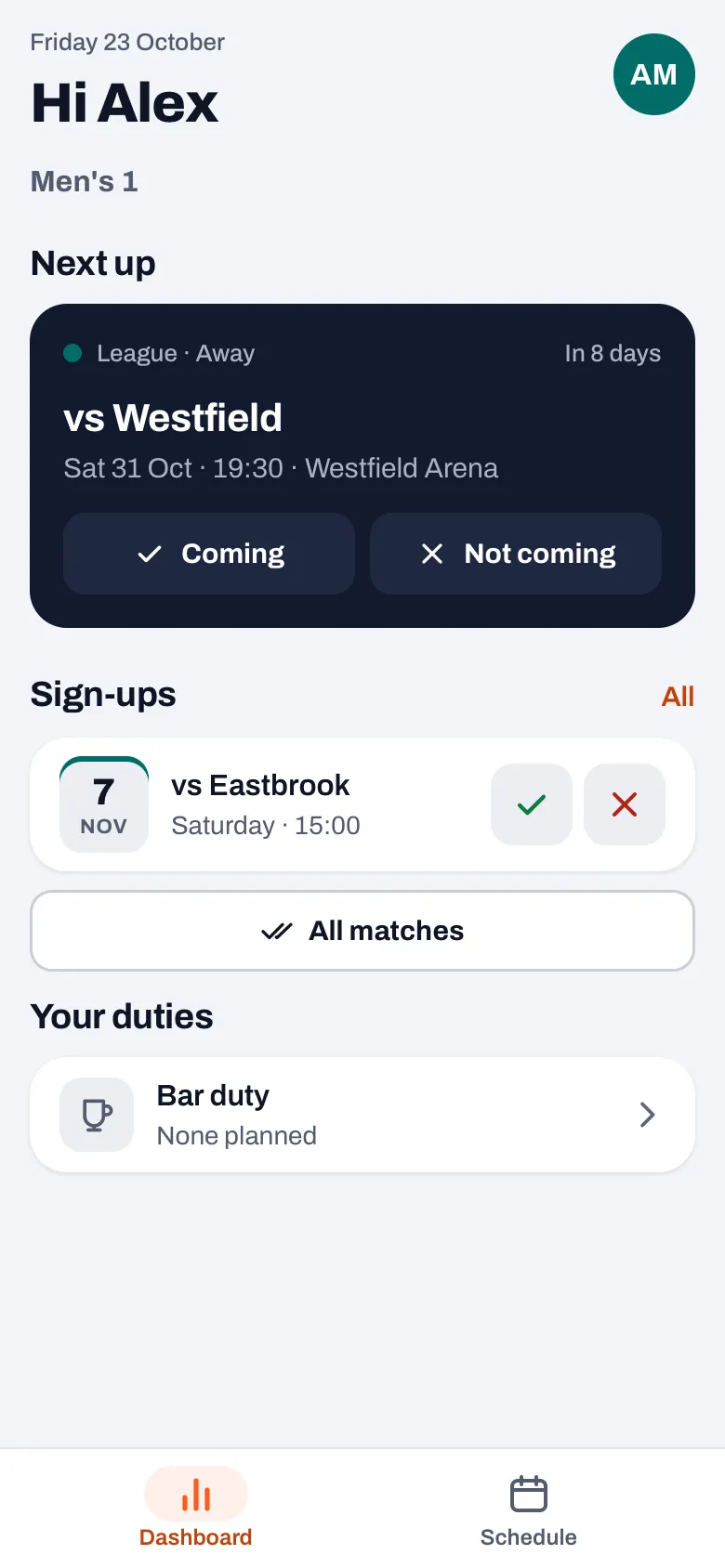
We make Koach, an app for volleyball coaches, their players and the parents. The app has nothing to say about shoes and huddles. But if your child's team uses Koach, as a parent your dashboard shows what is next on the schedule, with the day, the time and the place, you sign your child up with Coming or Not coming, and under Your duties you see whether you have been assigned, for example to drive. That way you know on Saturday where you need to be, and in the gym you can simply watch.
As a parent or player you pay nothing: your account falls under the team's subscription. If you are standing on the sideline as a coach for the first time yourself, read starting as a volleyball coach. What Koach costs a coach after the 14 free days is on the pricing page.
14 days free, no credit card. Coaching a team yourself? Put your matches in, and players and parents know on Saturday where and when.
Try Koach with your teamFrequently asked questions
Why do basketball and volleyball players wipe their shoes?
For the same reason: grip. Both sports are played on a smooth indoor floor in rubber soles, and dust and sweat make those soles slippery. Wiping a palm over the sole takes the dust off for a moment, so you don't slip on the next take-off or landing. For many players it has also become a habit they repeat even on a clean floor.
Why do volleyball players high five after every point?
After every rally play stops, and the team uses that pause to come together briefly: share a point, put an error behind you and agree on what happens in the next rally. The player who made an error gets a hand too; that does not mean well done, but next ball. Whether it measurably earns points is hard to say, but you see it in youth teams just as much as at international level.
How many times can you bounce the ball before a serve?
As often as you like, as long as you hit within eight seconds of the referee's whistle. The rules allow bouncing and moving the ball in your hands, but you may toss or release the ball only once before you hit it. The number of bounces is a personal habit; what helps is that it is the same for every serve.
Why do volleyball players wear their knee pads so low?
Usually because it is more comfortable when they are not defending, such as during warm-up, or because they like the look. Players whose role rarely has them diving sometimes leave them down for the whole match. On the shin they protect nothing, though: the pad belongs on the kneecap at the moment your knee hits the floor. So pull them up before the first defensive drill.


Know on Saturday where and when
14 days free, no credit card. Players and parents see the match in their schedule.
Get started with KoachOr read first what the volleyball coaching app does.