
Why does the libero wear a different color in volleyball?
The short answer
The player in the different jersey is the libero, a defensive specialist who only plays in the back row. Why does the libero wear a different color? The rules require it, so the referees can spot the libero instantly: they come in and out without limit and may not serve, block or attack a ball that is entirely above the net.
Why does the libero wear a different color from the rest of the team? Almost everyone watching volleyball for the first time wonders about the player in the odd jersey. The short answer: that player is the libero. Here you read why the libero is dressed differently, what the libero does and what they are not allowed to do, under the FIVB rules.
The player in the different jersey is the libero
Libero is Italian for free. The libero is a defensive specialist: they may replace any back-row player, as often as the team wants, and those replacements do not count as regular substitutions (rules 19.3.1.1 and 19.3.2.1). The libero is there to receive serve and dig hard attacks, and so often touches more balls than anyone else on the court. A team may list up to two liberos on the scoresheet, of whom only one is on the court at any time (rule 19.1). The FIVB introduced the libero in the late 1990s. In the introduction to the rules, the FIVB names it as one of the steps that adapted the game to a modern audience.
A team does not have to use a libero: the rules give a right, not an obligation. What changes when you play without one is in is a libero mandatory.
Why the libero wears a different color
The rules are clear. All players of a team wear the same uniform, except the libero (rule 4.3). The libero wears a uniform with a different dominant color from any color of the rest of the team, and it must clearly contrast with them (rule 19.2). The reason is not spelled out in the rule, but it follows from what the libero may and may not do. Their rules differ so much that the referees must be able to pick out the libero at a glance:
- The libero comes and goes all match long. Every time the libero enters or leaves, that is a libero replacement. There must be a completed rally between two libero replacements (rule 19.3.2.1). The libero enters and leaves the court through a separate zone along the sideline on the bench side (rule 19.3.2.7), and those replacements are recorded separately (rule 19.3.2.8).
- The libero only plays in the back row. A libero in the front row or in the serving position is always a fault.
- The libero may not serve, block or attempt to block (rule 19.3.1.3).
- The libero may not attack a ball that is entirely above the top of the net, wherever they are (rule 19.3.1.2). If the libero sets the ball with an overhand finger pass from the front zone, a teammate may not attack that ball while it is entirely above the top of the net (rule 19.3.1.4).
With a contrasting jersey, the second referee and the scorer's table see right away whether one of those rules is broken. For spectators it is a handy side effect: you know immediately who the defender is. All substitution and playing rules for the libero are in the libero: rules and role.
Which color and number does the libero get?
- The team chooses the color. The rules do not prescribe a color, only that the dominant color differs from every color in the uniform of the rest of the team. If a team plays in white with blue numbers, a white or blue libero jersey is therefore not allowed.
- The libero has a number, just like the other players (rule 19.2).
- Two liberos may each have their own color, different from each other and from the rest of the team (rule 19.2). That is why you sometimes see two contrasting jerseys on one team's bench.
- A replacement libero can wear a bib. If the libero cannot continue, for example because of an injury, and there is no second libero, the coach may designate as the new libero any player who is not on the court at that moment, except the player the libero replaced (rule 19.4.2.1). That player wears a libero jersey, or a jacket or bib that contrasts with the rest of the team, with their own number (rule 19.2). That explains the player who suddenly stands on court in a bib halfway through a match.
These are the FIVB rules. Federations and leagues can have their own arrangements for lower divisions and youth play, for example a bib instead of a full jersey. What else applies to uniforms, numbers and clothing is in volleyball uniforms and clothing rules.
Two players in a different jersey?
If you see two players in a contrasting jersey, the team has two liberos. Only one is ever on the court; the second can replace the first, and that does not count as a regular substitution either (rules 19.3.2.1 and 19.3.2.2). In FIVB World and Official Competitions for seniors, two liberos are mandatory if a team lists more than twelve players on the scoresheet (rule 19.1). Many teams have two so they can split the work, for example one for serve receive and the other for defense.
At your first match, watch the libero and the middle blockers. When a middle blocker rotates to the back row, they usually walk to the sideline and the libero comes in. When that spot rotates to the front again, they switch back. Follow that for a few rotations and you understand the system within one set.
Misunderstandings in the stands
- Is that the setter? No. The setter, who usually plays the second ball, wears the same jersey as the rest. The libero does sometimes play the second ball, but then often with a forearm pass or from behind the three-meter line, because of rule 19.3.1.4.
- Is that the captain? No, you recognize the captain by a stripe of 8 by 2 centimeters under the number on the chest (rule 4.3). Under the current rules a libero may be captain (rule 5); in that case the stripe is on the libero jersey.
- Is that some kind of goalkeeper? A little: the libero is the defensive specialist. But the libero has no area of their own on the court, may not catch the ball and may not block.
- Why does that tall player keep leaving the court? The libero usually replaces the middle blockers when they are in the back row. That is why you see the middle blocker walk to the sideline after rotating back every time. Why teams do this is in why the middle leaves the court in the back row.
- Why does the libero never serve? Under the FIVB rules it is not allowed. In some national competitions, such as in the United States, a libero may serve in one rotation; see can the libero serve.
Beach volleyball has no libero: two players play there without substitutes. Young children and many recreational teams also play without a libero. The full text is in the FIVB Official Volleyball Rules 2025-2028, and an overview of all the rules is in volleyball rules at a glance.
The libero on your own team
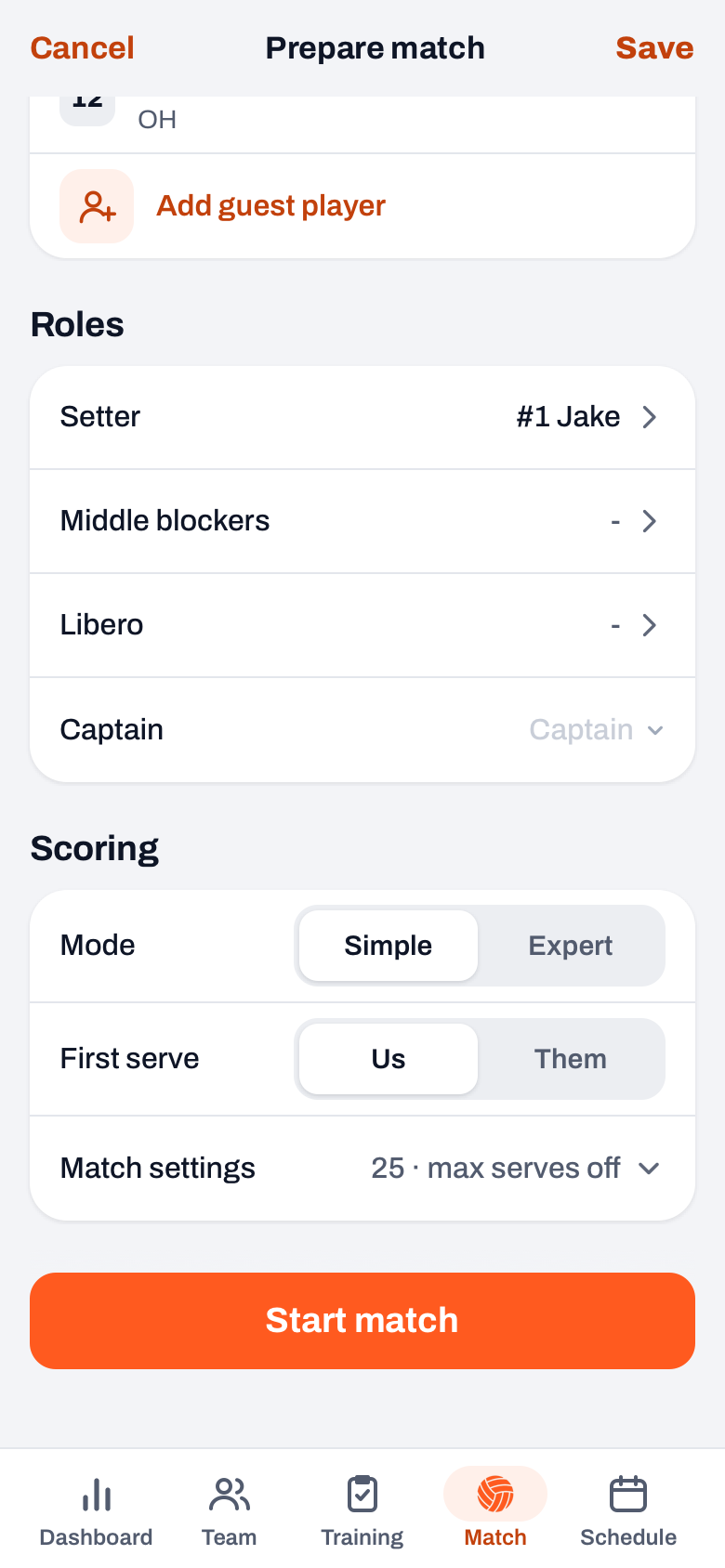
If you coach a team yourself, in Koach you designate your libero under Roles when you prepare a match, up to two per match, along with your captain. On the live screen the app then handles the libero for you: with Libero auto swap, which is on by default, the libero comes in for a middle blocker in the back row and goes out as soon as that spot rotates to the front row or your team has to serve from it. Libero replacements do not count toward the substitution counter, just as in the rules.
What Koach costs after the 14 free days is on the pricing page.
14 days free, no credit card. Designate your libero for your next match and let the app keep track of the libero replacements.
Try Koach at your matchFrequently asked questions
Why does the libero wear a different jersey?
Because the rules require it: the libero wears a uniform with a different dominant color from the rest of the team. That way the referees see straight away who the libero is. That is necessary, because the libero comes in and out without limit, only plays in the back row and may not serve, block or attack a ball that is entirely above the top of the net.
Why do two volleyball players sometimes wear a different jersey?
Then the team has two liberos. A team may list two on the scoresheet, but only one is ever on the court. In FIVB official competitions for seniors, two liberos are mandatory if a team lists more than twelve players. The two liberos may each wear their own color.
Can the libero be the captain?
Yes, under the current FIVB rules the libero may be both team captain and game captain. You recognize the captain by a stripe under the number on the chest; if the libero is captain, that stripe is on the libero jersey. Because the libero often has to leave the court, many teams do name a fixed stand-in for the moments the libero is on the sideline.
Does every volleyball team have a libero?
No. A libero is a right, not an obligation: a team may designate one or two, but may also play without. Only in FIVB official competitions for seniors are two liberos mandatory if a team lists more than twelve players. Beach volleyball has no libero, and children and recreational players often play without one.



Designate your libero in Koach
14 days free, no credit card. The app keeps track of the libero replacements for you.
Get started with KoachOr read first what the volleyball coaching app does.