
Two libero system or no libero: what the volleyball rules say
The short answer
A two libero system is allowed, and so is playing without a libero. Under the FIVB rules a team has the right to name up to two liberos, not a duty; only in FIVB senior competitions with more than 12 players on the scoresheet are two required. Without a libero, your middles simply play the back row.
Whether you run a two libero system or play with no libero at all, the rules allow both, and in many youth teams and small rosters playing without one is simply normal. Below you find what the rulebook says, what changes in a 5-1 when nobody wears the libero jersey, and which rules apply when you name two liberos.
Is a libero mandatory?
No. Under rule 19.1.1 of the FIVB Official Volleyball Rules 2025-2028, each team has the right to designate up to two liberos from the players on the scoresheet. It is a right, not a duty. A team without a libero plays within the rules, and the referee will not ask about it.
The rulebook has one exception. In the official FIVB senior competitions a team may list 14 players on the scoresheet instead of 12 (rule 4.1.1). If there are more than 12, two liberos are mandatory. On top of that, a federation or league can have its own rules, especially for youth. One example from one country: Volleyball Canada's development model uses no libero for boys and girls in the under-14 and under-15 age groups; only in the stage after that do players focus mainly on one position. This differs by country and by league, so check the rules of your own federation. What the libero may and may not do when you have one is covered in the libero rules; the full rulebook is summarized in volleyball rules at a glance.
Why teams play without a libero
- A small roster. A libero is one of the players on your scoresheet, but can only come in for back-row players. With eight players and a libero you have one regular substitute left; without a libero you have two.
- Development in youth volleyball. A middle who stays in the back row learns to pass, dig and keep playing after their serve. What the standard libero replacement costs your middles in playing time and skills is covered in why middle blockers get subbed out in the back row.
- Your libero is not there. Then you play without one, or you list another player as libero on the scoresheet for this match. That is allowed, as long as that player wears a jersey in a color that clearly differs from the rest of the team (rule 19.2).
- Middles who pass well. If you do not see your middles in the back row as a weak spot, a libero gains you little and costs you a substitute.
Playing without a libero in a 5-1: what changes?
Without a libero, your two middle blockers play all six rotations. For three rotations they are in the front row to block and hit the quick set, for three rotations in the back row. You notice that in three places.
- After the serve, the middle stays on. Even with a libero the middle serves in position 1, because the libero may not serve (rule 19.3.1.3). The difference comes after that: without a libero the middle stays in the back row until they rotate to the front again, also when you are receiving, instead of walking to the bench.
- Serve receive. The libero was one of your three passers. Without a libero the third passer becomes the middle in the back row, or, in the rotations where the setter is in the front row, the opposite. If you want to keep the middle out of serve receive, you receive with two players, and that takes two outside hitters who can cover the whole court together.
- Defense. Give the back-row middle a fixed spot in your defensive system, so they do not have to work out where to stand every rally. And train them there as well: a middle who never plays defense in practice will not do it in a match either.
A defensive specialist with regular substitutions
If you still want to replace the back-row middle without a libero, you can do it with a regular substitution, for example for a player who digs well. But regular substitutions are limited. You have six per set (rule 15.1). A starting player may leave the game once per set and come back once, only to their own position in the lineup, and a substitute may enter once per set, only for that one starting player (rule 15.6).
Do the math. Taking the middle out in the back row and putting them back in for the front row costs two substitutions, and you can do that only once per set for each middle. For two middles that is four of your six substitutions. If your team goes through the rotation more than once in a set, your middle simply plays the back row the second time. A libero replacement has none of those limits: it is unlimited and does not count as a substitution (rule 19.3.2.1).
| What you want | With a libero | Without a libero |
|---|---|---|
| Replace the middle in the back row | Unlimited, does not count as a substitution | With regular substitutions: two per middle, once per set |
| Who serves in position 1 | The middle | The middle |
| Regular substitutions for everyone else | All six | Six, minus what you use for the middles |
| The middle learns to pass and dig | Hardly | Yes, three rotations per cycle |
| Who can make a regular substitution | All players except the liberos | All players |
The two libero system: the rules at a glance
- Up to two, and one on court. Both liberos are recorded on the scoresheet in the lines reserved for the libero (rule 19.1.2). The libero on court is called the Acting Libero in the rulebook, the other one the second libero, and there is never more than one on court at the same time (rule 19.1.3).
- Libero for libero is allowed directly. The libero on court may only be replaced by the player they came in for, or by the second libero (rule 19.3.2.2).
- One rally in between. Libero replacements are unlimited, but there must be a completed rally between two libero replacements (rule 19.3.2.1). That also applies to a swap between your two liberos.
- Jerseys. Both liberos wear a jersey that clearly differs from the rest of the team, and they may also differ from each other (rule 19.2). Why that color exists is explained in why the libero wears a different color.
- When one drops out. With two liberos you carry on with the other one; you may only re-designate a new libero when that one cannot play either (rule 19.4.3.1). With one libero, the coach may re-designate as libero any other player who is not on court at that moment, except the player the libero replaced (rule 19.4.2.1). The former libero may then not play for the rest of the match (rule 19.4.2.2). You may also continue without a libero: then the player the libero replaced comes back.
Exactly when you may swap and which replacements get whistled is covered in the libero replacement rules.
When do you choose two liberos?
- Split serve receive and defense. One libero plays when you receive, the other when you serve and have to defend. That works because a libero-for-libero swap is allowed directly; just keep the completed rally in between in mind.
- Per set or per opponent. Against a team with hard jump serves you use the libero who passes those calmly, against a team that tips a lot the libero who is quick on defense.
- Playing time in youth teams. Two players learn the position, instead of one who plays everything and one who watches.
- A backup. If your libero gets injured, a second one is ready straight away, in the right jersey.
Play one scrimmage a week without a libero, even if you have one. Then your middles know how to pass on the night your libero is sick, and you see in advance who will be your third passer.
Without a libero or with two liberos in Koach
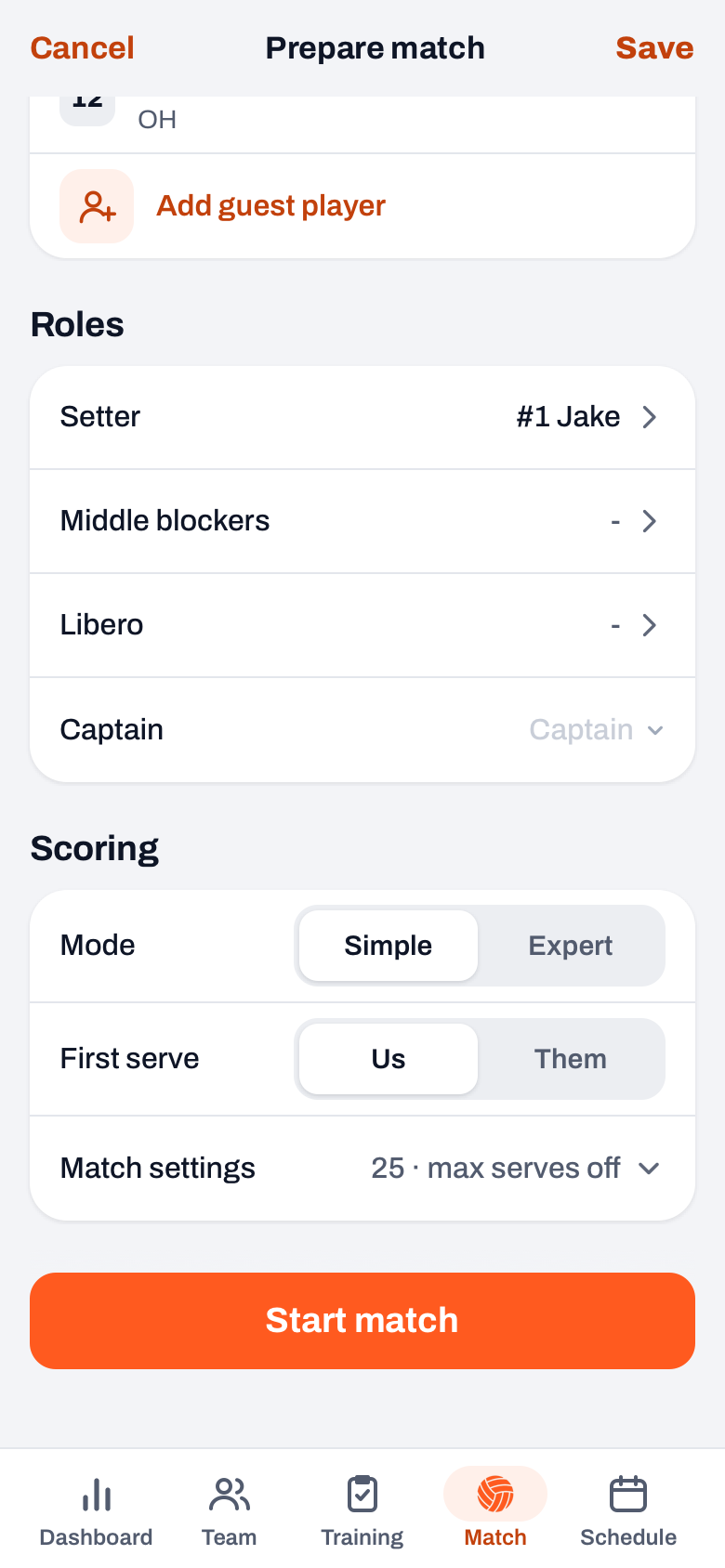
In Koach you choose per match how you play. In Prepare match, under Roles, there is a Libero row. You tick up to two liberos, or you leave the row empty and play without one. Untick your regular libero and you can put that player in the lineup as a regular court player. At the set break you adjust the roles for the next set. How the app follows two liberos during a set is covered in two liberos in the app.
If you play with a libero, the match stats show the row With the libero on court afterwards: the share of rallies you won with the libero in and the share without. If you are not sure whether a libero adds anything for your team, that row gives you a fairer answer after a few matches than your gut feeling.
If you only want to see on paper how your 5-1 rotates without a libero, untick Use a libero in the free rotation generator. Both middles then stay on the court in all six rotations. What Koach costs after the 14 free days is on the pricing page.
14 days free, no credit card. Play your next match without a libero or with two, and see afterwards what it cost or gained you in rallies.
Try Koach at your next matchFrequently asked questions
Can you play volleyball without a libero?
Yes. Under the FIVB rules a team has the right to designate up to two liberos, but it does not have to. Only in the official FIVB senior competitions are two liberos mandatory when more than 12 players are on the scoresheet. Some federations have their own rules for youth; check the rules of your own league for those.
How many liberos can a volleyball team have?
Up to two on the scoresheet, and only one of them is ever on court at a time. The second libero may replace the libero on court directly, as long as there is a completed rally between two libero replacements. Libero replacements do not count toward your six regular substitutions per set.
What happens if your only libero gets injured?
The coach may re-designate as libero any other player who is not on court at that moment, except the player the libero replaced. The injured libero may not play for the rest of the match. You may also continue without a libero: the player the libero replaced then comes back onto the court.
Can a regular player take over as libero if the libero is absent?
Yes, before the match. You list another player in the libero line on the scoresheet, and that player plays in a jersey that clearly differs from the rest of the team. During the match it is only possible if your libero drops out, through a re-designation by the coach.


Play your next match with or without a libero
14 days free, no credit card. After a few matches you see what the libero adds to your rallies.
Get started with KoachOr read first what the volleyball coaching app does.