
Two liberos in the app: the role follows who is on court
You have listed two liberos, exactly as the rules allow, and halfway through the second set you bring the other one on. Two points later the line-up on your screen no longer matches what you see on court. That is not a counting error on your part: it sits in the question of who the app considers to be the libero at that moment. Since September 2026 Koach answers that question differently, and there is one reason for it.
Two names on the sheet, one player on court
A team may put two liberos on the match sheet. Only one of the two is ever on court. That is the whole rule, and on paper it is tidy. In the hall it is less so, because everything attached to the libero hangs on the question of which of the two is playing right now: which position they may stand in, who they came on for, and the moment they have to go off again.
As long as you work with one libero you notice none of this. The role and the person are the same thing then, and you can point at it without thinking. The moment a second one is added, those two come apart. The role travels with the player on court; the name on the sheet stays where it is. A scoreboard that does not make that distinction will sooner or later follow the wrong player.
Why teams list two is no mystery. One is the better passer, the other defends better or is taller. If one gets injured you are not left empty-handed. And in youth volleyball coaches simply use the second libero to give two players court time in a position where otherwise only one gets a turn. When you may change and what applies after an injury is in the rules for exchanging the libero. This article is about the screen you look at during the match.
How you register two liberos
It starts with the line-up, not with the scoreboard. Before you start the first set, you point out in Koach who the libero is. You can designate two players there, just as on the sheet. Who they are does not change during the match: they are the two who stay libero for the whole game, and nobody else can be given the role.
What does change is which of the two is playing. That is a separate question, and the app treats it separately too. On the scoreboard you see which player stands where across the six positions on court; if a libero is on, they stand there under their own name. The other libero sits with the substitutes, visible as a libero, ready to come on. There is never more than one on court at a time, and the app does not allow it either.
The background to the role itself — where the libero may stand, why they wear a different shirt, what they may not do — belongs with the libero rules. For scoring you need only one thing: the app knows there are two, and it knows which of the two is on now.
The screen follows who is playing, not who was designated
This is the heart of it, and it is worth reading once properly, because everything after it follows from it. Koach answers the question of who the libero is with: whoever is on court at this moment. Not the first one you designated, not the top one in the list. Change liberos and the role moves across at that moment to the player coming on.
That sounds like a detail, but it is the difference between a line-up that is right and one that slowly drifts out of step. Because the app does more with the libero than show them. It watches the position the libero stands in, it takes them off when they would rotate to the front row, and it puts back the player who was replaced. All of those actions have to be about the player who is really there.
Until September 2026 the app did not do that. If you brought the second libero on, it went on treating the first one as the libero. As long as the rallies went on you noticed little. It went wrong at the rotation: the second libero stayed in a position they should have left, and after a few rotations there were two liberos on court at once while a middle blocker had disappeared. You were then looking at a line-up on your screen that did not exist in the hall, and you usually only found out at the moment it mattered.
The fix was not an extra button but a different question: not who is designated as libero, but who is on now. From that moment on the rotation is right even if you change liberos halfway through a set.
A change between two liberos does not count
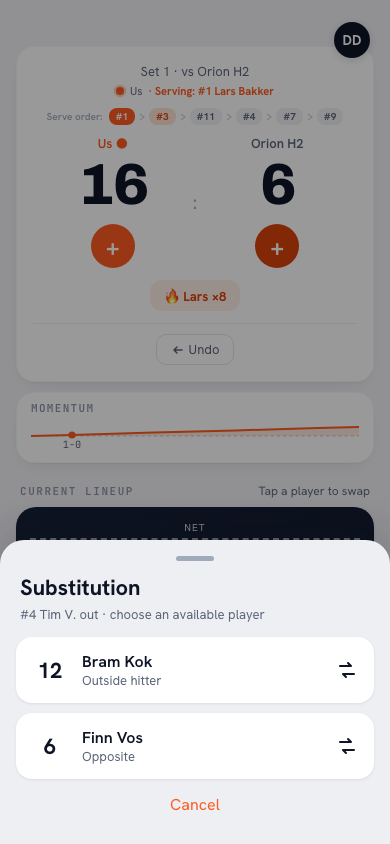
A team has six substitutions per set. For most coaches that is the counter the screen keeps an eye on: at five you start thinking, at six you are done. A change between the two liberos falls outside it. Under the rules it is not an ordinary substitution — FIVB 19.3.2.1 does not count it — and all that has to sit in between is a completed rally.
In the app that means two things. To start with, your counter does not go up when you change liberos: you keep your six ordinary substitutions in hand. And beyond that, the change remains possible once the six are gone. If you are in the fifth set with an exhausted substitution counter and still want your other libero on, you can; the app does not block it and neither does the referee.
That is exactly the scenario in which coaches used to hesitate. You doubt the rule, you do not dare, and so you leave a player on that you wanted off. The screen takes that doubt away because it simply carries on. What the app does not do for you is count the rally: the rule that a completed rally has to sit between two libero replacements is between you and the second referee. Which libero replacements get waved off for that reason and how to avoid them is in the article on the illegal libero replacement.
Ordinary substitutions behave no differently here than usual. If a regular substitution goes wrong — wrong player, counter full, somebody who has already been on twice — you are in the territory of the illegal substitution, and there the app does count along.
The replaced player stays attached to the libero
When a libero comes on court, a player goes off. The app remembers which one. It has to, because when the libero goes off again, it is that same player who comes back — not a random middle blocker and not whoever happens to be sitting next to you.
With two liberos that raises one question, and the answer is reassuringly simple. If you change one libero for the other, the new libero replaces the same player. The registration stays as it was; only the person in the libero shirt changes. So the middle blocker who went off comes back at the moment the libero leaves the court, even if by then that is the other libero.
In practice that is the difference between playing on calmly and puzzling for half a set. Without that link you would have to remember yourself after every libero replacement who it was that went off, and that is exactly the sort of admin that disappears the moment things get tense. Now it is on the screen: you see the libero on court, and you see the player waiting for them at the bench.
The switch for changing automatically
Koach has a switch called Swap libero automatically. If it is on and the libero is off court while a middle blocker arrives in position 5 or 6, the app puts the libero in for them by itself. That saves you an action at every rotation, and it is the way most teams play: the libero comes on for the middle blocker in the back row, always, with nothing to decide.
With two liberos that switch keeps doing what it did, with one difference you need to know: the app brings on the libero whose turn it is at that moment, so the one you last had on court. If you want to change liberos, do it deliberately with a substitution; the automatic switch does not choose between the two for you.
There are teams who would rather have the switch off. That is a defensible choice if you coach youth and the libero does not need to come on every rotation, or if you want to make the change yourself because otherwise you do not register it. Then turn it off and bring the libero on and off by hand. In both cases the role follows the player who is on court.
Unsure about the change itself rather than about the screen? When you may change liberos, what applies after an injury and who may still come on then is described separately from the app in the rules for exchanging the libero.
What you do in the hall
Most of this you do not need to know during the match. Three things you do.
Designate both liberos before the first set starts, not halfway through. The app only lets you give the role to those two players, and that is the same agreement as on the sheet: whoever is not on it does not become a libero later.
Make the libero replacement through the substitution screen, even though it does not count. That is the only way the app knows the role has moved. Make the change on court but not on the screen and you will spend the rest of the set looking at a line-up that is wrong — and that is precisely the problem this solved.
And after the change, look at your line-up once. Not out of mistrust, but because it is the cheapest check there is: if the new libero is in the position you expect, the rest is right too. If not, you know it within one rally instead of at 22-21. How to keep track of the rest of the match, from serving order to set score, is in tracking a volleyball match live.
Frequently asked questions
Does a change between my two liberos count towards the six substitutions per set?
No. Under the rules a change between two liberos is not an ordinary substitution, and Koach does not count it either. Your counter stays where it was, and you can still make the change once your six ordinary substitutions are gone. The only condition is that a completed rally sits between two libero replacements; that remains something you and the second referee watch for.
Does the replaced player come back if I change liberos?
Yes. The player the libero came on for stays registered, even if another libero takes their place. The new libero replaces the same player, so that player simply comes back at the moment the libero leaves the court. You do not have to keep track yourself of who it was that went off; it is on the screen, at the bench.
Why were there sometimes two liberos in my line-up at once?
That was the behaviour from before September 2026. If you brought the second libero on, the app went on treating the first one as the libero, and when rotating to the front row the wrong player went off. After a few rotations there were two liberos on court and a middle blocker had disappeared. Since then the role follows the player who is really there, and the rotation is right after a libero replacement too.
Can I make a third player libero halfway through the match?
No, and the rules do not allow it either. The match sheet holds at most two liberos, and those are the two who stay libero for the whole game. Koach therefore only allows the role for those two. So designate them before the first set starts. If a libero drops out, the rules for redesignation apply; those are described separately from the app with the libero replacement.


Try it yourself in Koach
Less admin, more coaching.
Get started with KoachOr read first what the volleyball coaching app does.