
Illegal Libero Replacement: the Four Mistakes That Get Whistled
The referee blows the whistle, the ball goes to the opponent, and nobody on the bench knows exactly what went wrong. Was the libero in the front row? Did the libero come in for the wrong player, or go off again too quickly? An illegal libero replacement feels like bad luck, but there is a pattern behind it. The libero replacement is the only exchange you can make without limit, and what you can do without limit you soon do without paying attention. This piece shows which four mistakes get whistled, why they happen precisely after a break in play and which routine prevents them.
Whom the libero may replace and how the fixed rhythm with the middle blockers works is covered in the libero replacement rules. Here it is only about what goes wrong, why it goes wrong and how to prevent it.
Illegal libero replacement: the four forms that get whistled
Almost every whistle around the libero comes down to one of these four. If you can tell them apart, you know straight after the whistle where to look.
1. The libero rotates into the front row. The libero may only replace a back-row player. If the libero's spot rotates forward after a side-out and the libero does not go off in time, the libero is on court as a front-row player at the moment of service. This is the fault that most often happens without anyone making a decision: simply nothing happens. What other restrictions the libero has is in the libero: rules, role and registration.
2. The wrong player. The libero comes in for a player who is in the front row at that moment, or the libero goes off and a different player comes back from the one the libero replaced. That second one is the sneaky variant: the libero may only be replaced by the player the libero replaced.
3. Two libero replacements without a rally in between. The libero goes off, someone sees it was too early, and the libero comes back in the same break in play. A rally has to be completed between two libero replacements, so that is not allowed.
4. The replacement after the whistle for service. The referee has already authorised the serve and only then does the libero walk on or off court. Libero replacements have to take place while the ball is out of play and before that whistle.
What it costs differs per fault and per moment it is noticed. As a rule the replacement is corrected and your team receives a sanction. How heavy that is depends on the regulations of your own federation; those are decisive, even if you saw something different happen at another match.
Why it goes wrong precisely after a time-out, a substitution or the change of set
During ordinary rallies, libero replacements often go perfectly well. A team learns the rhythm quickly, because it is the same every few rotations. It goes wrong as soon as that rhythm is interrupted, and that happens at three moments.
- After a time-out or an ordinary substitution. The team walks to the bench and back again. Who is on court afterwards is decided by feel instead of by order. The libero walks to their usual spot, while the rotation has moved on one place in the meantime.
- At the change of set. The libero does not belong in the starting lineup; the libero only comes on court after the lineup for the new set has been checked. Anyone quickly filling in a new sheet during the set break sometimes puts the libero on it anyway, or forgets that the middle blockers start the new set in different spots.
- When the middle blocker is substituted. The libero was on for a middle blocker, and that middle blocker is replaced by a substitute. Now nobody is sure any more whom the libero is on for, and so also not who has to come back when that spot rotates forward. How an ordinary substitution works is in the substitution rules; why the libero replaces the middle blockers in particular is in subbing out the middle blocker for the libero.
In all three situations the cause is the same. There is a moment when nobody is specifically responsible for the question of whom the libero is on for. That is exactly the gap the routine further down closes.
The timing: one rally in between, and never after the whistle
Two of the four faults are not about where someone is standing, but about when the replacement happens. Those are made by the bench itself: they do not arise on court, but because someone on the sideline decides too late or changes their mind.
One rally in between. The rule is simple; the fault comes from doubt. The libero goes off because the bench thinks their spot is rotating forward, and a second later it turns out it wasn't yet. The reflex is to send the libero straight back on. That is not allowed: a rally has to be completed first. Once the libero has been replaced too early, play that one rally without them and put them back afterwards. If the libero gets injured, other arrangements apply; they are in an injured player during the match.
Never after the whistle. The whistle for service is the boundary. Anything replaced after that is too late. This fault is made by teams that only start thinking about the libero once the rally is over. The solution is to make the decision earlier: during the rally the bench already knows which spot rotates forward at a side-out, and therefore whether the libero has to come off.
If in doubt, wait a rally. A libero who stays off court for one rally longer costs you nothing. A libero who is replaced in a panic and comes straight back costs you a sanction. Decide before the end of the rally, or leave it until after the next one.
The libero replacement zone, and the misunderstanding about reporting to the scorer
Libero replacements go through a zone of their own: the strip along the sideline on your bench side, between the extension of the attack line and the end line. A libero who walks on court at the net, or through the substitution zone in front of the table like an ordinary substitute, is using the wrong place.
The second misunderstanding is about reporting. For an ordinary substitution you request it and the substitute goes to the substitution zone. For a libero replacement you do not have to request or report anything: the libero and the player being replaced simply walk through the libero replacement zone. The libero replacements are, however, recorded at the table.
That misunderstanding works both ways. Teams who think they have to report walk to the table or wait for a sign from the referee, and are therefore too late for the whistle. Teams who know reporting is not necessary sometimes think nobody is keeping an eye on it either. That is not true: what is recorded at the table can still bring a wrong replacement to light.
The libero watch on the bench: one task, one player
Most coaches know the advice to have someone on the bench keep an eye on the libero. It only works if that task is so small and so concrete that it still gets done at 22-23. Give one fixed substitute these five things, and nothing else:
- Before the set: know which two players the libero replaces and in which spots they start the set.
- At every side-out: check where the player the libero is on for is standing. If that spot rotates to the front row, call "libero off" and the name of the player coming back.
- After every libero replacement: say "one rally" out loud and allow no new libero replacement until that rally has been completed.
- After every time-out and every ordinary substitution: say whom the libero is on for now, or that the libero is off court.
- At the set break: check that the libero is not on the new lineup sheet and say whom the libero replaces first after the check.
Two agreements make the routine watertight. Nobody else calls libero replacements, not even the coach: the coach is watching the rally. And the libero only moves on the libero watch's signal, not on their own initiative. If there is no substitute, the setter takes over the task, because the setter has the rotation in their head at every side-out anyway.
Practise it in training, or it will not exist in the match. Apply the same rules in every game form with a libero, including the libero watch. A wrong replacement in practice costs a point for the other team.
What Koach does automatically — and what it doesn't see
During live scoring the app can track the libero replacement for you. The live screen has the Swap libero automatically switch for that. If it is on and there is a middle blocker in position 5 or 6 while the libero is off court, the libero comes in for them. If that spot rotates to the front row, the libero goes off and the middle blocker comes back. The libero replacement also does not count towards the substitution counter of six per set.
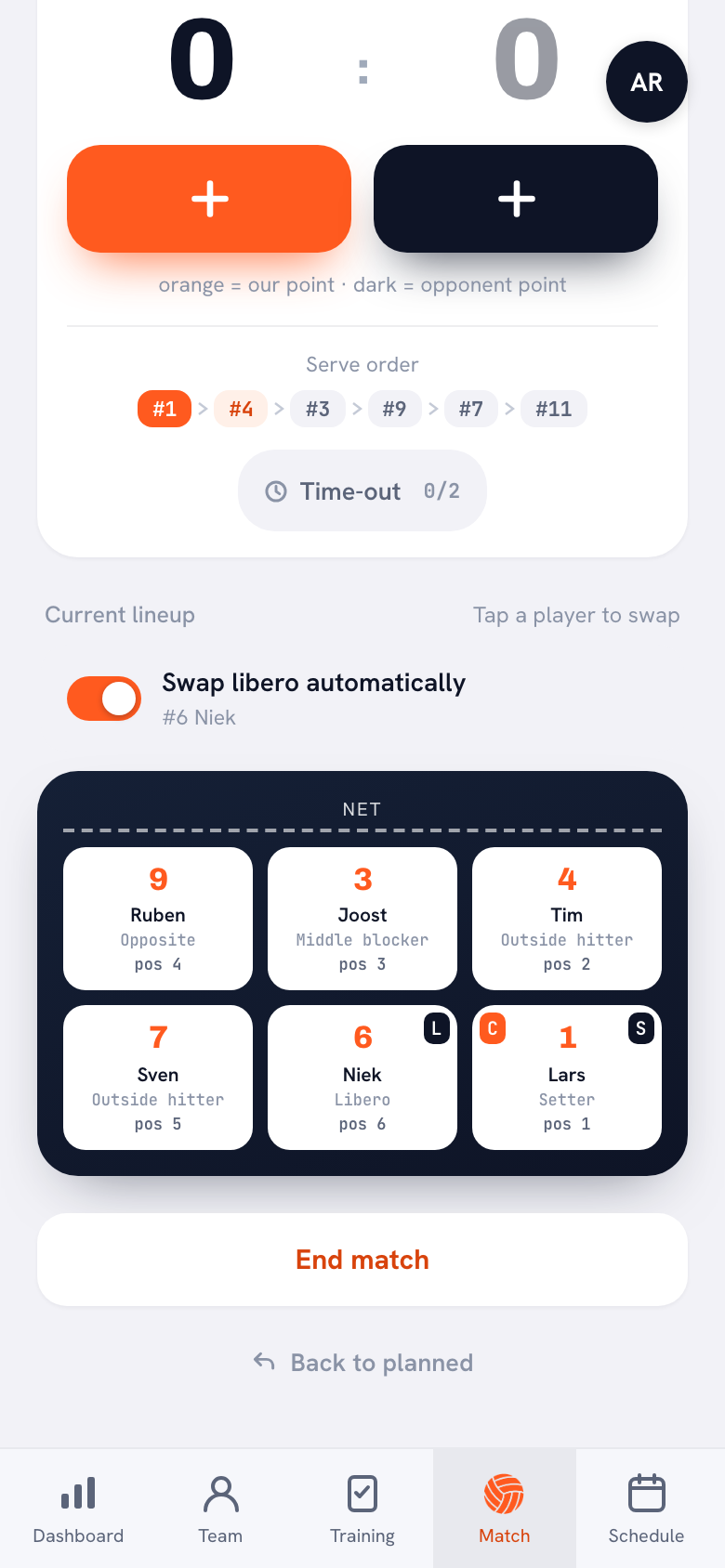
If you turn the automation off and replace the libero yourself, a warning with name and position appears as soon as the libero ends up in the front row anyway. The same warning is on the lineup screen. And if there is no middle blocker in position 5 or 6 at the set break, the app tells you the libero stays off court that set.
What the app does not do:
- The automation only works for a designated libero replacing a player with the position Middle blocker. If you have the libero come in for a different player, you make the replacement yourself.
- The rule of one rally in between is not monitored, and the app does not see the whistle. So it does not know whether a replacement is too late.
- In competitions where the libero is allowed to serve, the automation does not fit: turn it off there. Which rules differ on that point is in can the libero serve?
- The app swaps on the screen, not in the gym. The libero still has to walk on time. What the app prevents is you losing track of who should be on court; the libero watch on the bench is still needed.
If you no longer want to answer the question of whom the libero is on for from memory, turn on the automatic libero replacement in Koach for your next match and give your libero watch the screen: at every side-out they see who should be on court. Try Koach free for fourteen days.
Frequently asked questions
What is an illegal libero replacement in volleyball?
An umbrella term for faults in libero replacements. There are four you see most often: the libero rotates into the front row, the libero is exchanged with the wrong player, there is no rally between two libero replacements, or the replacement happens after the whistle for service. As a rule the replacement is corrected and the team receives a sanction; the regulations of your own federation determine how heavy.
What happens if the libero comes in for the wrong player?
The replacement is corrected and your team receives a sanction, the weight of which is set out in your federation's regulations. Pay particular attention on the way back: the libero may only be replaced by the player the libero replaced. If a different player comes back, for example because the middle blocker has been substituted in the meantime, that is the same fault.
Why is our libero suddenly in the front row?
Because the libero's spot rotated to the front row after a side-out and nobody called back the player the libero was on for. It happens most often after a time-out or an ordinary substitution, when the rhythm has been interrupted. It is a different fault from two neighbours standing in the wrong order; that neighbour rule is in the positional fault.
Can an app keep track of libero replacements for me?
Partly. During live scoring Koach can track the libero replacement for a middle blocker in position 5 or 6 by itself, and warns you when the libero is in the front row while you are making the replacements yourself. The app does not monitor the rule of one rally in between, does not see the whistle and does not fit competitions in which the libero serves. In the gym the libero still has to walk on and off themselves.
Does a libero replacement count towards the six substitutions per set?
No. Libero replacements are separate from ordinary substitutions and you may make as many as you like, as long as there is always a rally in between. How ordinary substitutions work is in the substitution rules.


Try it yourself in Koach
Less admin, more coaching.
Get started with KoachOr read first what the volleyball coaching app does.