
Volleyball uniform rules: jerseys, numbers, shorts and sleeves
The short answer
The FIVB volleyball uniform rules: jerseys, shorts and socks are the same color and design for the whole team, with numbers on the chest and back (officially 1 to 20). Only the libero wears a different color. Shoes are light and without heels, and objects that could cause injury come off.
Volleyball uniform rules only seem to matter once the referee points at a jersey before the match. This is what the official FIVB rules ask of the uniform, the numbers, the libero, shorts, socks, sleeves, shoes and jewelry, and what to pack so a uniform problem never costs you a player.
What do the rules say about volleyball uniforms?
The FIVB Official Volleyball Rules 2025-2028 say little about clothing. A player's equipment consists of a jersey, shorts and socks (together the uniform) and sport shoes (rule 4.3). Jerseys, shorts and socks are the same color and design for the whole team, with the libero as the only exception, and the uniform must be clean (rule 4.3.1). A uniform in a different color or without an official number is forbidden (rule 4.3.5).
National federations adopt these rules but may deviate from them in their own competitions, and in youth and lower leagues they do. There the requirements for socks or the size of the numbers, for example, are sometimes more relaxed. What applies to you is in the competition rules of your own federation. This article follows the international rules; the other rules of the game are in volleyball rules at a glance.
Jersey numbers: which, where and how big
The number is what the referee, the scorer and the opponent see of a player. That is why the rules are precise here:
| Item | What the rules require |
|---|---|
| Numbers | 1 to 20; in FIVB senior competitions with larger rosters, higher numbers are allowed (rule 4.3.3) |
| Position | Centered on the chest and centered on the back (rule 4.3.3.1) |
| Color | Clearly different in color and brightness from the jersey (rule 4.3.3.1) |
| Height | At least 15 cm on the chest and 20 cm on the back, with the strip forming each digit at least 2 cm wide (rule 4.3.3.2) |
| Captain | A stripe of 8 by 2 cm under the number on the chest (rule 4.3.4) |
| Libero | Numbered like the rest of the team (rule 19.2) |
The limit of 20 is the international rule; a federation can allow higher numbers in its own competitions. Check that before you have a new set printed. Within a team every player has their own number, and that number is on the scoresheet. The guidelines for referees ask them to check before the match that the numbers on the jerseys match the team list. How to hand out and keep track of numbers in your squad is covered in assigning and managing jersey numbers.
The libero in a different color
The libero wears a uniform with a different dominant color from the rest of the team, and it has to contrast clearly (rule 19.2). If a team has two liberos, they may also differ from each other. If a new libero is designated during the match, that player wears a jacket or bib in a contrasting color. Why the rule exists and how to spot the libero from the stands is explained in why one volleyball player wears a different jersey.
Shorts, long pants, socks and sleeves
- Shorts. The rules list shorts as a fixed part of the uniform, for men and women. They don't prescribe cut or length, as long as the whole team wears the same.
- Long pants or leggings. The rules only know them as training suits in cold weather: with permission of the first referee, for the whole team in the same color and design, and numbered like the jerseys (rule 4.4.3). So one player in leggings under the shorts is not a right; whether it is allowed is up to your competition rules or the referee.
- Socks. Part of the uniform, so the same color for everyone (rule 4.3.1).
- Jersey tucked in. The Refereeing Guidelines and Instructions 2025 ask referees to have jerseys tucked into the shorts where possible; a tight jersey that doesn't tuck in is always fine.
- Knee pads and compression. Padded protection (in the rules: compression pads) may be worn for protection or support (rule 4.5.3). In official FIVB senior competitions it has the same color as the part of the uniform it belongs to, or black, white or neutral if everyone who wears it has the same color. Which knee pads to choose is covered in knee pads for volleyball.
- Arm sleeves. The rules don't mention arm sleeves by name. If you wear them, the safest choice is the same color agreement as for compression pads; when in doubt, the first referee decides.
Shoes, jewelry and glasses
- Shoes. Light and pliable, with a rubber or composite sole and no heel (rule 4.3.2). What to look for when you buy them is in buying volleyball shoes. Playing barefoot is only allowed with permission of the first referee (rule 4.4.1).
- Jewelry. The rules don't mention jewelry by name. They forbid objects that may cause injury or give a player an artificial advantage (rule 4.5.1), and rings, necklaces, bracelets and dangling earrings can cause injury in a dive or a block. So the safe agreement is: off before the warm-up. If something can't come off, talk to the referee before the match.
- Glasses or contact lenses. Allowed, at the player's own risk (rule 4.5.2). Sports glasses with a strap stay in place better and break less easily than regular glasses.
What if the uniform isn't right?
With permission of the first referee, a player may change a wet or damaged jersey between two sets or after a substitution, as long as the new jersey has the same color, the same design and the same number (rule 4.4.2). A player who pulls on a jersey with a different number because theirs is torn is not on the scoresheet with that number; solve it with a jersey that carries the player's own number.
If both teams turn up in the same color, the referee guidelines say the team listed first in the official program changes. In national competitions, the competition rules decide who changes. If you play away against a team with the same club colors, ask beforehand what the home team will wear.
Pack the kit bag before the season starts. A captain's stripe to stick on, a libero jersey or bib in a contrasting color in case your libero drops out, and a list of who has which number. In the first practice, check that every number on a jersey also belongs to the right player in your squad.
Jersey numbers and uniforms in Koach
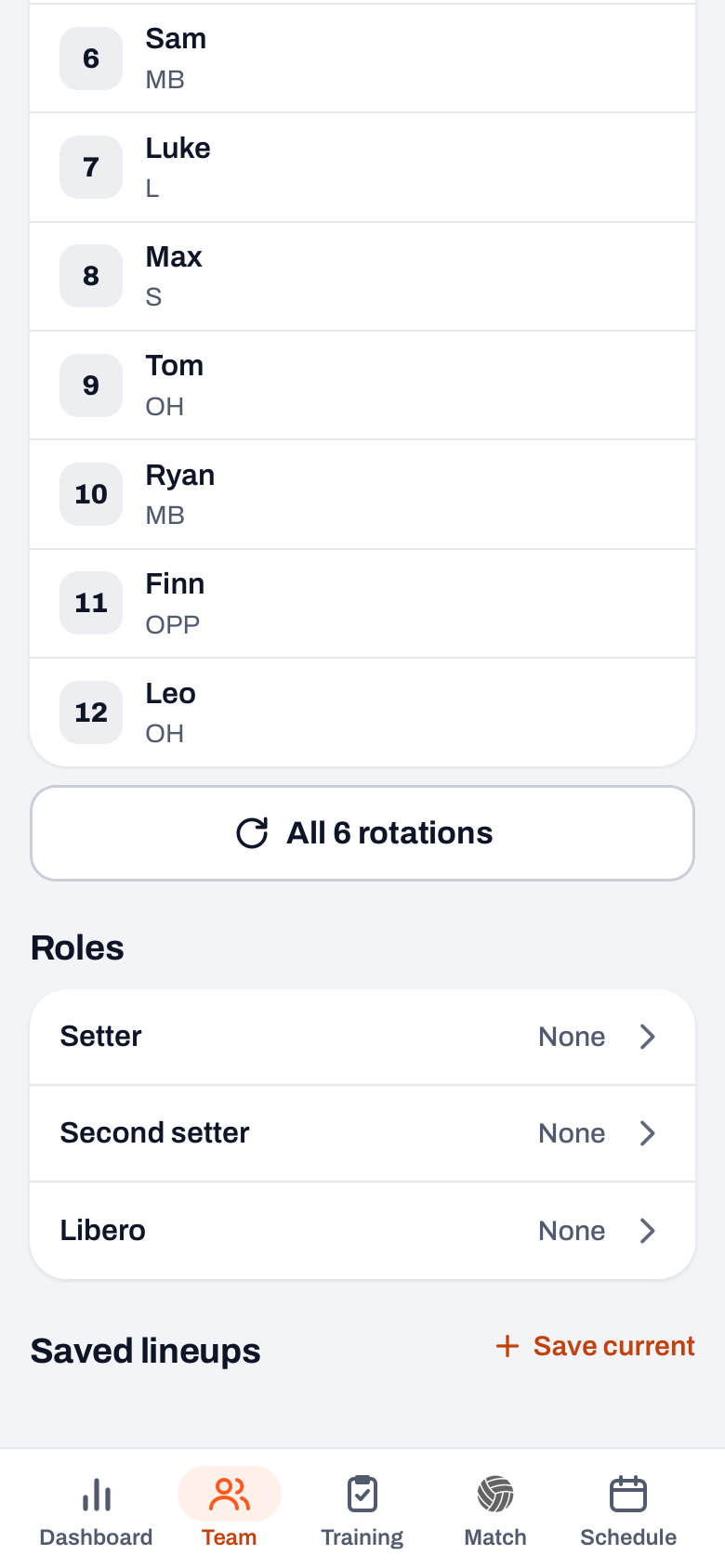
The numbers your players wear on their backs are listed with each player in your squad in Koach. When you add a player, the app suggests the lowest free number, and if you pick a number that already belongs to someone else, Koach asks whether you are sure. Below the lineup, under Roles, you designate your libero. The number is also what you tap during live scoring, so if you check the numbers in the app against the real jerseys in the first week, you score on the right player for the rest of the season.
If your club orders uniforms and asks players to chip in, the treasurer can set up a kit fund as a fee with the Club plan and see for each member who has already paid. Koach does not process payments itself. What that plan does for a club is on the page for clubs; the prices are on the pricing page.

14 days free, no credit card. Put your squad with jersey numbers in the app tonight and check them against the jerseys on Saturday.
Put your team in KoachFrequently asked questions
Can you play volleyball in long pants?
Under the FIVB rules, only as training suits in cold weather, with permission of the first referee, and then for the whole team in the same color and design, with numbers like on the jerseys. In national competitions the competition rules may be more relaxed. Check with your federation or the referee beforehand.
Which jersey numbers are allowed in volleyball?
The international rules list numbers 1 to 20, with higher numbers in FIVB senior competitions with larger rosters. A federation can allow higher numbers in its own competitions. The number sits in the center of the chest and the back, at least 15 cm high on the chest and 20 cm on the back, in a color that clearly contrasts.
Can you wear jewelry during a volleyball match?
The rules don't mention jewelry by name, but they forbid objects that may cause injury or give an artificial advantage. Rings, necklaces, bracelets and dangling earrings can cause injury, so take them off before the warm-up. If something can't come off, talk to the first referee before the match: the referee decides.
Do all players have to wear the same shoes?
No. The color rule applies to jersey, shorts and socks. Shoes must be light and pliable, with a rubber or composite sole and no heel, but brand and color are free. Playing barefoot is only allowed if the first referee permits it.

Set up your squad with jersey numbers
14 days free, no credit card. On Saturday you score live on the right numbers.
Get started with KoachOr read first what the volleyball coaching app does.