
How to split teams fairly in practice: four ways that work
The short answer
To split teams fairly in practice, spread the key positions and your strongest players over both sides first, then adjust after the first round. A random split is quick but often lopsided; splitting by level or by position takes a minute and gives you even teams.
How you split teams for the game at the end of practice looks like a detail, until a 25-9 eats the last twenty minutes of your evening. Here are four ways to split teams, when to pick which one, how to fix a side that is too strong in time, and how it works in Koach.
Why should you split teams fairly in practice?
Even teams produce long rallies, and long rallies are where the things you want to train happen: pressure, decisions, a ball that keeps coming back. If one side is much stronger, that side does not have to do anything to win, and the other side mostly learns how to lose. After ten minutes nobody plays all out anymore, and your game has turned into fifteen minutes of keeping warm. The final block is exactly where your focus should become match-like, as running a volleyball practice explains.
There is a social side too. The classic method, two captains picking in turns, leaves the same player standing last in the gym every week. At a practice where you want everyone to come back, that is a bad trade for a few minutes less work.
Four ways to split teams
1. Random
Count off in twos, pull bibs out of a bag, draw cards or use a random picker on your phone. It is quick and nobody feels picked or passed over. The downside: with twelve players you easily end up with one team that has both setters or your three best hitters. Random works well in small-sided games and in groups where the difference in level is small. If you still want chance, draw within groups: first split the setters, then the middles, then the rest.
2. By level
Rank your players in your head, from strongest to weakest, and split them in a snake order: the strongest to A, places two and three to B, four and five to A, and so on. Alternating (1 to A, 2 to B, 3 to A) looks fair, but then team A gets the better player of every pair. With the snake order it comes out exactly even with twelve players: add up the ranking numbers per team and both sides total 39. Do this before practice, not out loud in the gym.
3. By position
Give each team a setter, one or two middles, passers and an opposite, so both sides have a real lineup. Then the rallies look like a match, and each setter gets all the second balls of their team. Only one setter? Let them switch teams every round, or have a player on the other side set who sometimes has to do that in matches as well.
4. Rotating
After every round two players move to the other team, or the winning team gives a player to the team that lost. That way nobody spends the whole evening on the team that keeps losing, and everyone plays with and against everyone at some point. The downside: a fixed lineup or system cannot settle in. Use it with recreational players and in free formats, not when you are training a new system.
| Method | Quick | Even teams | Fits |
|---|---|---|---|
| Random | Yes | Varies | Small-sided games, a group of similar level |
| By level | A minute beforehand | Yes | Groups with big differences in level |
| By position | A minute beforehand | Usually | Training a lineup or system |
| Rotating | Yes | Over the whole evening | Recreational players and free formats |
How do you stop one side from being much too strong?
Even with a good split you will sometimes get it wrong. So check the score after five minutes, or after the first round. If it is 10-3, step in with the smallest change that works:
- Swap one player. Do not reshuffle everything; moving one player from the strong side to the weak side is usually enough.
- Give the weaker team a head start. Start the next round at 5-0, or let the strong team start at 12-18. The catch-up game in game formats for volleyball practice works exactly like that.
- Limit the strong side. Their best hitter may only attack from behind the attack line, or their points only count after three contacts.
- Split fixed pairs. A setter and a hitter who find each other blindly make a team stronger than the names suggest. Put them on different teams.
- Play yourself. With an odd number or a big gap, the coach can join the weaker side, as long as you can still see what is going on.
You will not solve big differences in level with the split alone. How to differentiate within one drill, so your strongest players are challenged without the rest dropping out, is covered in coaching a volleyball team with different skill levels.
Odd numbers, too few or too many players
- One player left over. Play seven against six and have a different player of the bigger team step off at every side-out. That way everyone rotates and nobody stands still for long.
- Eight to ten players. Play four against four or five against five. Everyone gets more contacts and has to cover more space. How to divide the court with four players is in the 4 vs 4 formation.
- Sixteen or more. Make three or four teams and let the winner stay on, or play on two courts. Formats for big groups are in volleyball drills for large groups.
Splitting teams in Koach
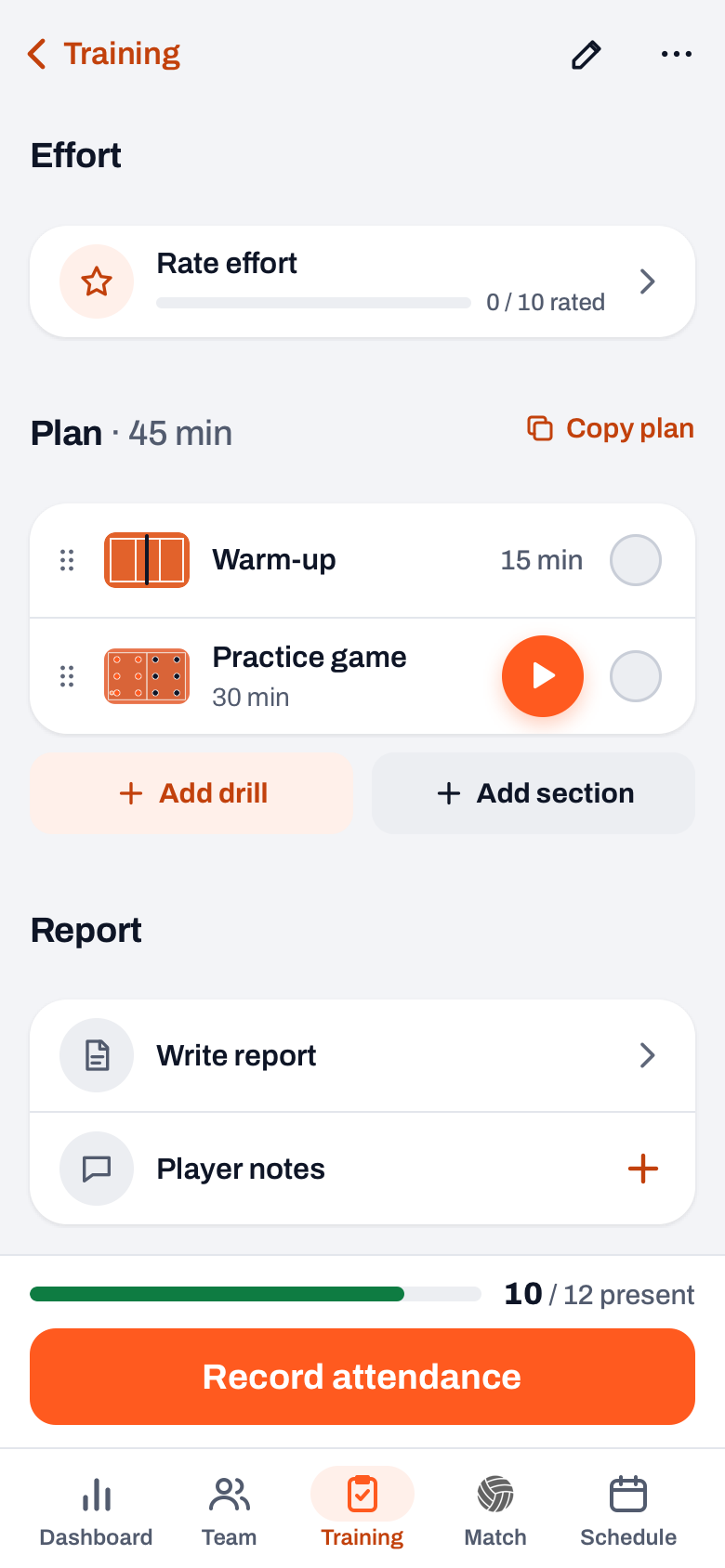
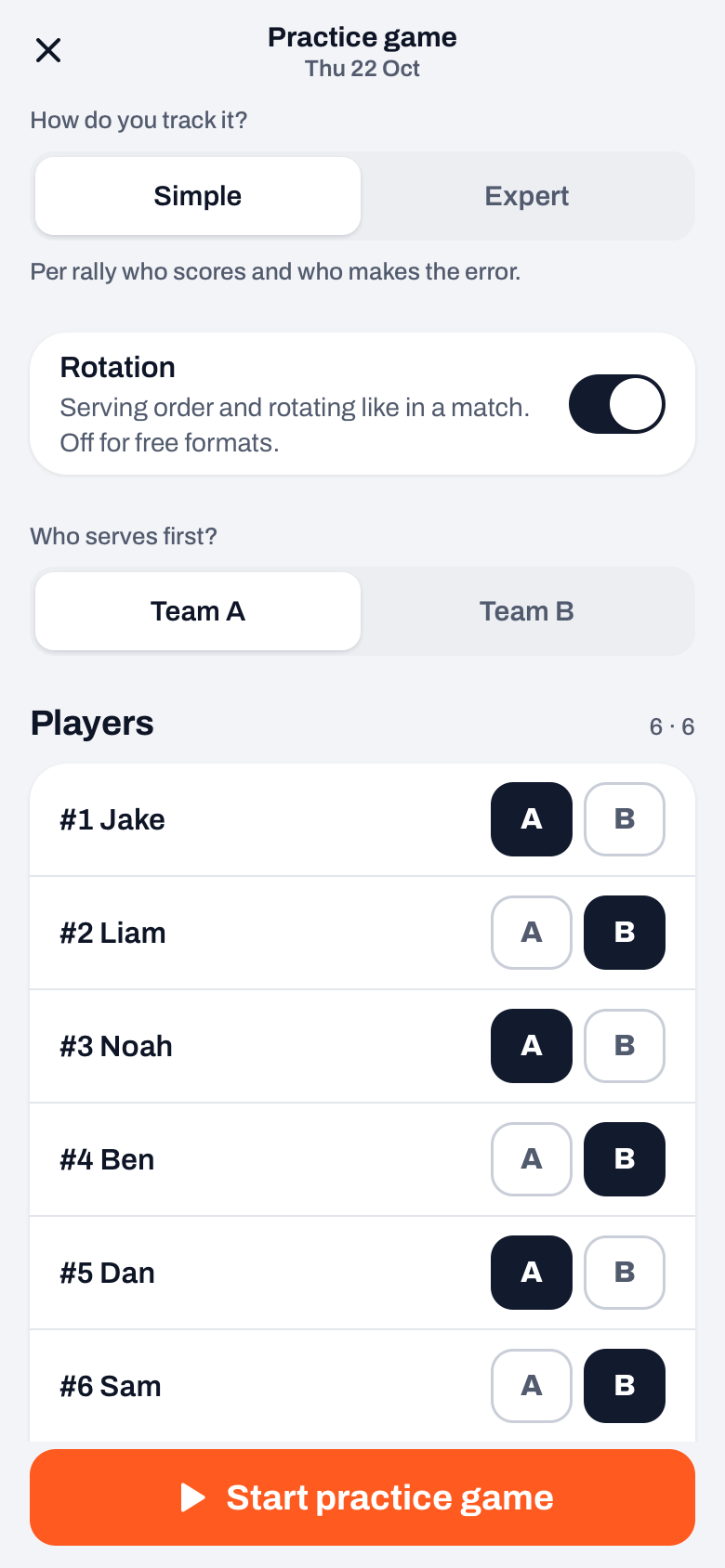
If you play the game as a practice game in Koach, first add the Practice game section to the plan of your practice. The orange start button on that section opens the setup screen, and that is where you split the teams. For each player you tap A or B. At the top are the players who signed up for the practice, then that evening's guest players and at the bottom, lighter, the players who did not sign up. Next to Players you see how many players each team has, for example 6 · 6.
Koach does not split the teams for you: there is no random draw and no automatic split by level. You make the split yourself, with one of the four methods above. The app does help you run it:
- With Rotation on, the order in which you tap is the serving order. The first six are on court, the rest on the bench, and you move someone up with the arrow.
- Fewer than six per team is fine, so four against four or five against five works too.
- While playing in Simple mode, tap a player and choose Move to team B (or A) to switch them to the other team. With Substitute with or Comes in for you substitute within a team.
- After Finish and save you see the score of every round. If the rounds ended 25-12 and 25-14, you know how to split differently next week.
14 days free, no credit card. Split your teams in the app on Tuesday and see per round afterwards whether the game was even.
Try Koach at your practiceThe practice game is included in Coach and Club, for every coach of the team. What the plans cost after the 14 free days is on the pricing page.
Split before practice, not in the gym. Make the teams at home or in the changing room, on paper or in your head, and announce them all at once at the start of the block. Then there is no picking moment and the game starts right away.
Frequently asked questions
How do you split teams randomly?
Have players count off in twos, hand out bibs from a bag or let them draw a card. If you want chance without lopsided teams, draw within groups: split the setters first, then the middles, then the rest. That keeps it random, but your two setters do not end up on the same team.
Should players pick the teams themselves?
Preferably not the classic way, with two captains picking in turns: then the same player is picked last every week. If you want to involve players, have them form pairs of similar level and split the pairs over the teams yourself. That keeps it fair and nobody gets picked last.
What do you do with an odd number of players?
Play seven against six and have a different player of the bigger team step off at every side-out, so nobody stands still for long. Or play smaller, four against four or five against five, with the extra player as a sub who rotates in every round. A coach who joins the weaker side works too, as long as you can still see what is going on.
Can Koach split the teams automatically?
No. In the practice game you tap A or B for each player yourself. The app does put the players who signed up for the practice at the top, lets you switch players between teams while playing and saves the score of every round. You can try Koach free for 14 days, with no credit card and every feature.

Split the teams for your next game with Koach
14 days free, no credit card. After one practice you see per round whether the teams were even.
Get started with KoachOr read first what the volleyball coaching app does.