
End of set in volleyball: who scores the clutch points from 20?
The short answer
The end of a set starts as soon as either team reaches 20 points. From then on every error weighs more, you save a timeout and you choose deliberately which serve and which attacker. Measure it by counting the rallies from 20 separately; in Koach that is under Momentum as Closing phase (from 20).
The end of a set in volleyball is the part where a team that started well can still lose. What changes from 20, how do you train for it, and how do you measure who scores the points then? With a worked example of four sets and the trap of small numbers.
When does the end of a set start?
A set goes to 25 points with a lead of at least two points, with no cap; the deciding fifth set goes to 15. That is in the official FIVB rules; some national and youth competitions play shorter sets, and that differs by country and competition. The end of a set is not a term from the rules. Coaches usually draw the line at 20: from then on a team needs five points or fewer. In a set to 15 that line moves to 10.
What changes is not the rule but the arithmetic. At 10-10 a serve error is one point out of 25; at 23-23 the same error can hand the opponent a set point. Players feel that, and that is why many teams play differently from 20 than before: more cautiously, or in a rush.
What changes from 20?
- The serve: pressure or safety. A serve that safely lands in gives the opponent an easy side-out. A hard serve can turn into an error. Choose per server, not for the whole team: look at how many errors their serve costs and how many points it brings.
- The timeout. Under the same FIVB rules you get two per set, of 30 seconds each. Many coaches save one for the end of the set: to break an opponent's run, or just before a rally you have to win. When to take it and what to say is in using timeouts.
- The substitution. A serving specialist or an extra blocker for the last points is only possible if you still have substitutions left; the maximum is six per set. Plan it before the set, not at 22-22.
- Who gets the ball? At the end of a set everyone wants the ball to go to the best attacker, and the opponent knows that too. An agreed second option makes you less predictable.
- The rotation. Know in which rotation your team is weak. If that rotation comes up at 21-21, that is the moment for your timeout or your substitution. You find your weak rotations with side-out and break point by rotation.
How do you train the end of a set?
- Start games at 20-20. Play short sets from 20-20 or 21-21, three or four times in a row. That way your team is at the end of a set more often in one practice than in a whole match.
- Give one side a deficit. Let one team start at 20-23. Coming back from behind is a skill of its own, and players who practise it often panic less.
- Make the serve count. From 20, a serve error in the practice game counts double. Then every server chooses deliberately between pressure and safety, just like in a match.
- Rehearse the end game plan. Agree who gets the ball after a good pass and after a bad one, and play it out until it happens by itself.
The mental side, such as a fixed serving routine and what to say to a player who freezes at 23-23, is in mental training: handling pressure.
How do you measure who scores from 20?
Count the rallies played from the moment either team has 20 points, and note who wins them. On paper you draw a line in your score sheet in each set at the moment someone reaches 20; everything after that line is the end of the set.
Worked example: a four-set match
You win 3-1: 25-22, 23-25, 25-18 and 26-24. From the moment either team had 20 points, the sets went like this:
| Set | Score at the first 20 | Rallies after that, for-against |
|---|---|---|
| 1 (25-22) | 20-18 | 5-4 |
| 2 (23-25) | 17-20 | 6-5 |
| 3 (25-18) | 20-14 | 5-4 |
| 4 (26-24) | 19-20 | 7-4 |
| Total | 23-17 |
Over the whole match you won the end of the set 23-17 (5 + 6 + 5 + 7 against 4 + 5 + 4 + 4). Three things stand out:
- Set 3 counts even though nothing about it was tense. At 20-14 the set was as good as won, and still that 5-4 is in the total.
- In set 2 you won the end 6-5 and still lost the set. That set was lost before 20: you went into the end of the set three points behind.
- Without set 3 you are left with 18-13, from the three sets that were really close. That is the number that tells you something about your team under pressure.
What is a good end of set?
There is no standard for it, and a percentage without a comparison says little. So put the end of the set next to the whole match. In the example you won 99 of the 188 rallies over the whole match (25 + 23 + 25 + 26 against 22 + 25 + 18 + 24): just over half. At the end of the sets you won 23 of the 40: almost six in ten. So your team played slightly better from 20 than in the rest of the match. Had it been the other way round, you would know where your practice needs to go.
Forty rallies in a four-set match is not much. Two rallies going the other way, and 23-17 becomes 21-19. So look at a series of matches: a team that loses the end of the set five times in a row has a pattern; a team that loses it once had a bad night.
14 days free, no credit card. Score Saturday's match live and afterwards see in one row how your team played from 20.
Try Koach with your teamMeasuring the end of a set in Koach
If you score the match live, in Simple or in Expert mode, Koach counts the end of the set for you. Open the played match, choose Stats and scroll to Momentum. At the top is the longest run for and against, below that the score flow of each set as a wave, and in the table with the columns For and Against the row Closing phase (from 20). That row counts the rallies in which either team already had 20 points; in a set to 15 the app counts from 10.
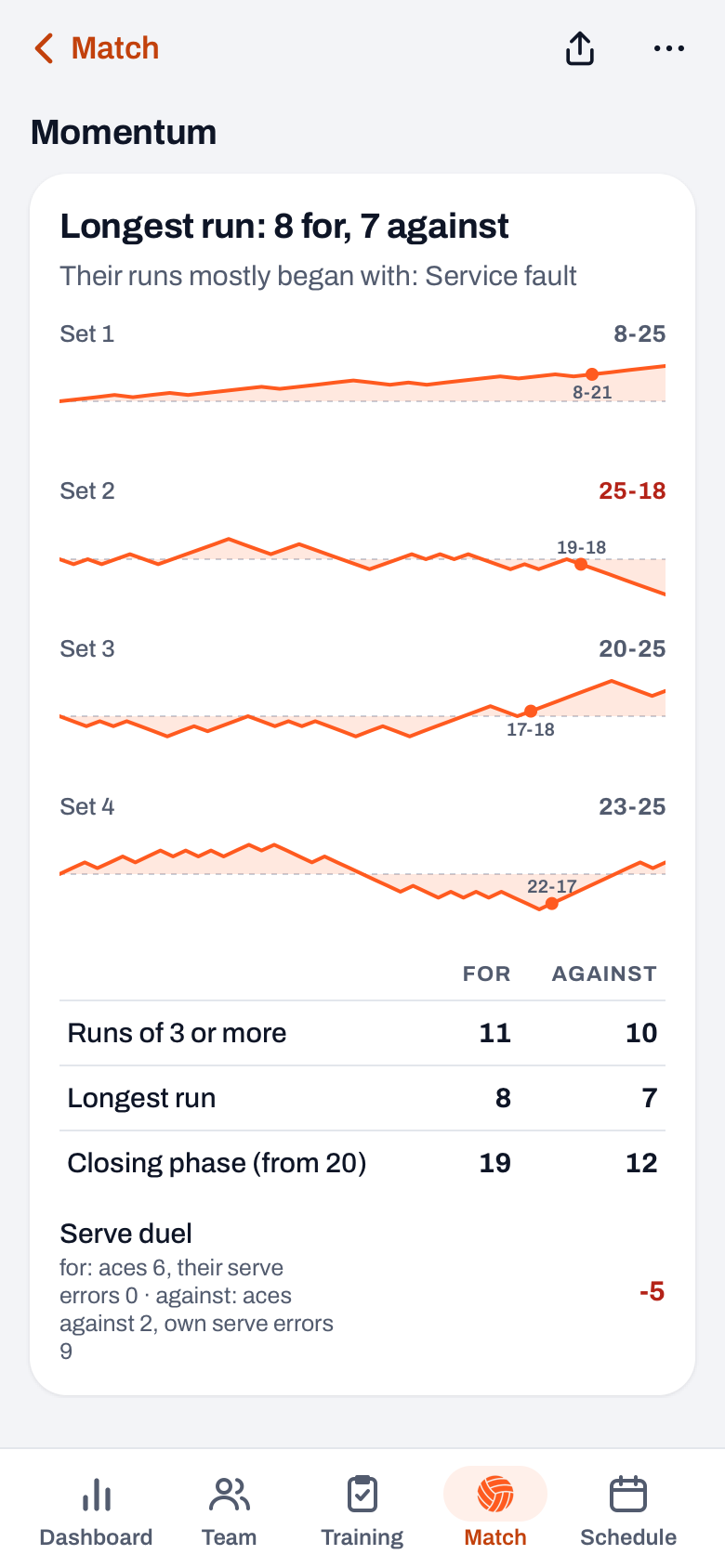
The table is the total for the match. If you pick a set chip, you only see that set's wave and the table disappears. So per set you read the end of the set from the wave, or you count it as in the worked example. How to read that wave and find a turning point is in the momentum line; going back rally by rally is done with the score progression.
During the match the timeout screen helps. It shows the Most errors and the Weakest rotation of the set, and when you take your second timeout it also shows Since timeout 1 with the score for that stretch and an arrow for whether it got better or worse. In Simple mode the live screen shows at Timeout and Sub how many you have already used this set; in Expert both are under More.
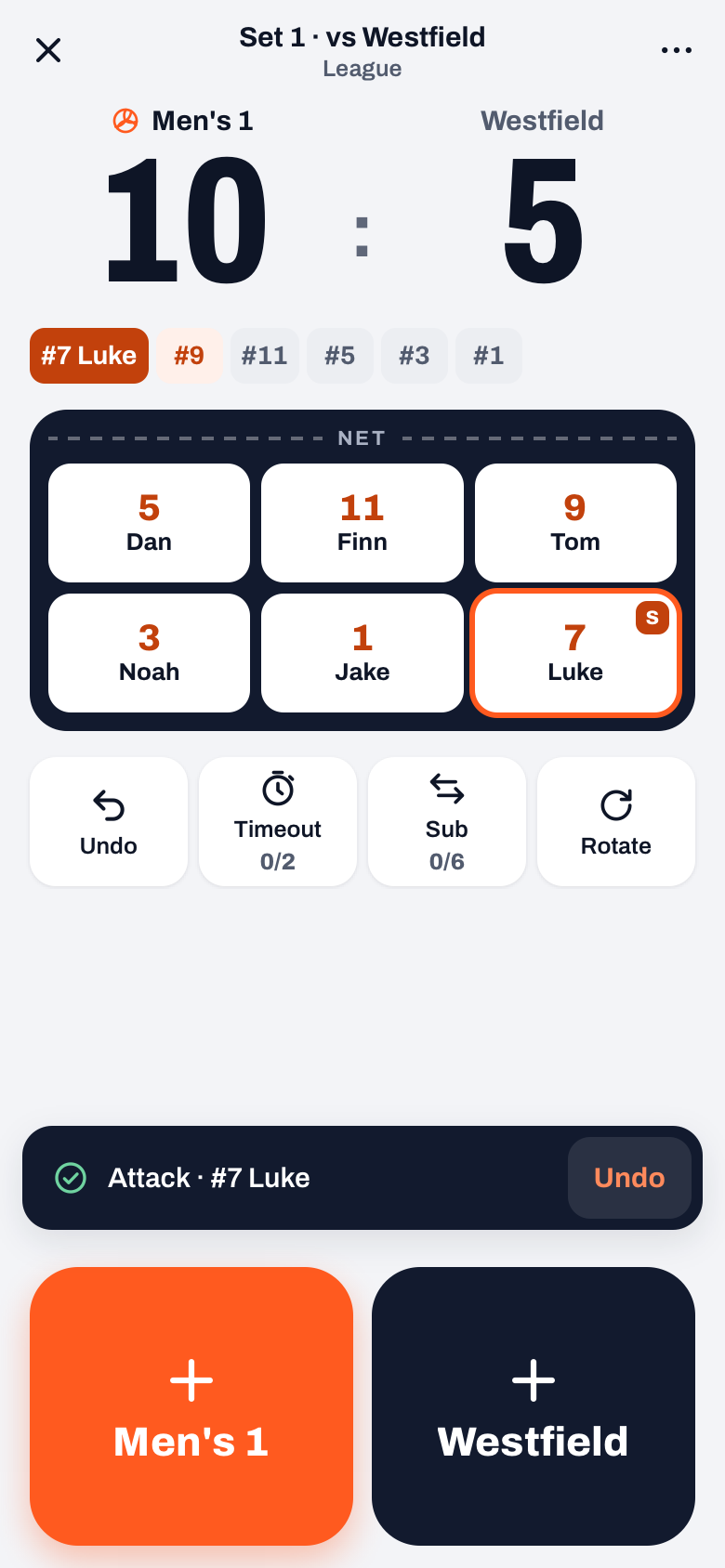
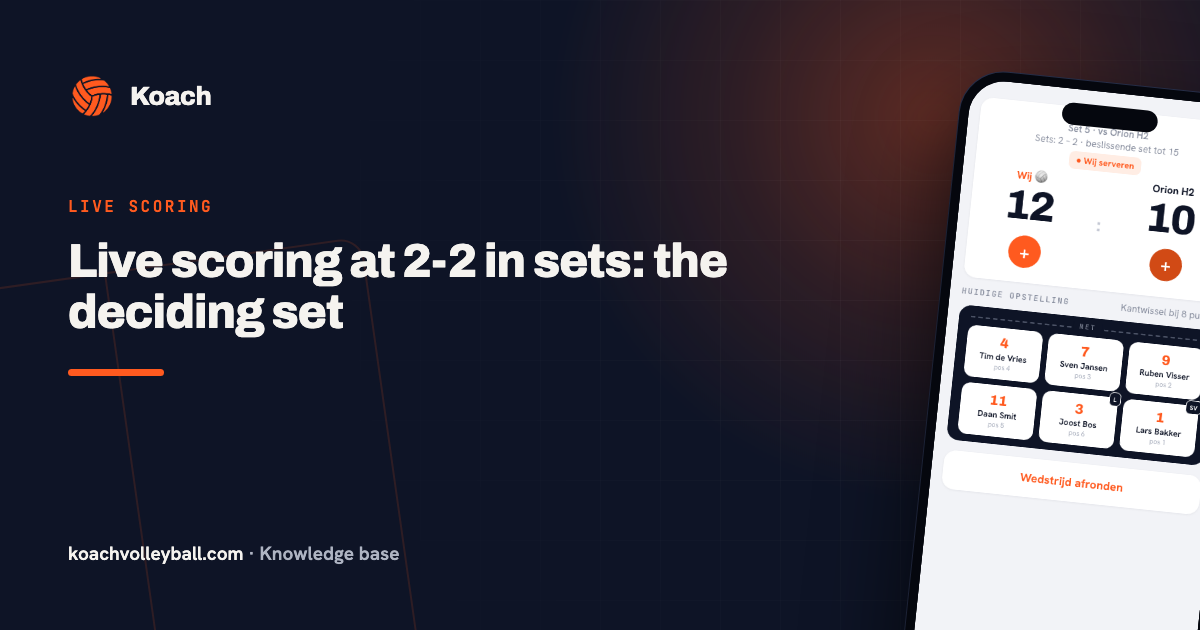
The end of the set only counts for matches you have scored live in the app since Koach 3.0, not for a result you enter afterwards and not for a match that an authorised score keeper finishes. In a deciding set to 15 the end of the set starts at 10; what else is different in that set is in the deciding set. How to read these numbers alongside the rest of your match stats is in understanding volleyball statistics.
You can try Koach free for 14 days; what it costs after that is on the pricing page.
Write your end game plan on one card. Who serves with risk and who plays it safe, who gets the ball after a bad pass, and at what score you take your last timeout. If you still have to think about that at 22-22, you are too late.
Frequently asked questions
When does the end of a volleyball set start?
Coaches usually draw the line at 20 points: as soon as either team has 20, it needs five points or fewer to win the set. In a set to 15, such as the deciding set, the line moves to 10. It is not an official term from the rules. Koach uses the same lines in the Closing phase (from 20) row.
How many timeouts do you get per set in volleyball?
Under the official FIVB rules each team gets two timeouts of 30 seconds per set, and six substitutions. Some national and youth competitions differ from that, so check the rules of your own competition. Many coaches keep one timeout for the end of the set, to break an opponent's run or just before a deciding rally.
Should you serve safely at the end of a set?
Not necessarily. A safe serve gives the opponent an easy side-out, a hard serve can turn into an error. Choose per server: someone who wins more points than they give away when serving with pressure can keep pushing. Someone who misses a lot under pressure aims for a spot instead of power. Train that choice in practice with games that start at 20-20.
What does it cost to measure the end of a set in Koach?
You can try Koach free for 14 days, no credit card, and the Momentum table with the Closing phase (from 20) row is simply part of it. After that you choose the Coach or Club plan; the amounts are on the pricing page. There is no extra work: the app counts the end of the set from the points you already enter live.
Measure your end of set on Saturday
14 days free, no credit card. After the match you see who scored the points from 20.
Get started with KoachOr read first what the volleyball coaching app does.