
Reading back the score progression: what happened in set 3?
"Weren't we ahead in set three?" Everyone remembers that — nobody remembers how it slipped away. The score progression is the match's black box: it records exactly where things turned.
What the progression shows that the result hides
A set score of 21-25 could be a hundred different matches: never in it, or given away from 18-14 up. The point-by-point progression makes the difference visible in three patterns:
- Runs: streaks of three or more points — the moments when the match flowed or drained away. Almost always tied to a single serving turn.
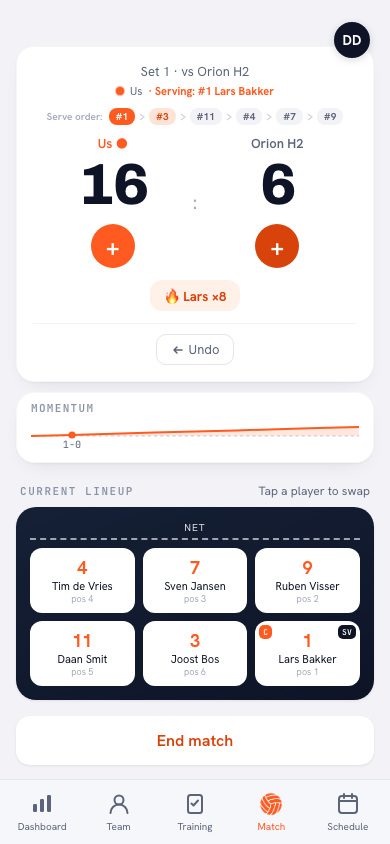
- Turning points: the moment the lead changed hands. What happened there — a substitution, an injury, a time-out not taken? On the momentum line you slide your finger across the wave to see the score at every rally; a dot automatically marks the start of the longest scoring run.
- Endgame points: the rallies from 20-20 on. Who got the ball, who finished, who gave it away?
How to read it as a coach
Look for patterns, not culprits. One lost run is bad luck; the same run in three matches — always around point 18, always on the opponent's serve after your substitution — is information. Combine the progression with the player statistics: if the endgame points structurally come from one player, you know who to (keep) feeding. And connect it to your time-out policy: did the interruption come before or after the opponent's run?
From progression to training focus
Ideally the progression ends in a training goal. Do you sag after your own scoring runs (concentration), lose the long rallies (conditioning or patience), or go quiet after point 20 (pressure training — the 24-23 serve from the serving drills)? Saturday's set writes Tuesday's programme.
Review the progression with the team, visually. Show the set instead of retelling it: 'here it was 18-14, these are the seven rallies after'. Players accept a chart faster than a reproach — the progression belongs to nobody and to everyone.
Frequently asked questions
Do I need a dedicated stats volunteer for this?
No — the progression emerges by itself from the regular point tracking of two taps per rally. Whoever tracks live automatically builds the black box.
What counts as a 'run' to watch for?
Three or more points without an answer. Statistically, sets turn on such streaks; two runs against you in one set is almost always the explanation for losing it.
How do I keep the debrief from becoming a tribunal?
Discuss patterns, not people: 'we lose the points after our own runs' instead of 'you switch off'. And start with the run you did produce — there is always one of those too.



Try it yourself in Koach
Less admin, more coaching — starting at your next practice.
Get started with KoachOr read first what the volleyball coaching app does.