
Volleyball match analysis: find what really cost you the sets
Volleyball match analysis usually starts the morning after a lost match: you know that it went wrong, but not why. That is exactly when the analysis tends to get stuck at the first impression — we played badly, we were not switched on — and with that conclusion there is nothing you can do at the next practice. Below are five leaks in a fixed order. Each leak is one question, with the number that answers it, and you do not need video for any of them.
Volleyball match analysis: the leaks first, the causes later
The trap in a volleyball match analysis is not that you see too little, but that you find something too early. You remember two blocks that came straight back at you and three balls that went out, and those five moments shape the story. The set you lost 23-25 because you never got an attack going in one rotation leaves no picture behind, so it falls outside your conclusion.
That is why you use a fixed order. Five leaks, in this order, because in this order they get harder to repair: the points you gave away yourself you can work on at the very next practice, while the end phase of a set is the slowest thing to change.
- Points you gave away. How many points did the opponent get without having to play for them?
- Serve receive and side-out. Did you still get a decent attack out of the opponent's serve?
- One rotation. Did you lose evenly, or did the losses pile up in the same lineup?
- Serving and points on your own serve. Did your own serve produce anything other than errors?
- The turning point. At what moment did the set slip away, and what happened there?
Allow twenty minutes, and do not do it on the evening itself. An analysis made while you are still angry or relieved mostly confirms what you already thought.
If you are not losing one match but every match, first read how the set scores and the standings show whether it is the level: a losing streak calls for a different analysis than a single defeat.
Leak 1: points you gave away
The question is not how many errors you made, but how many points the opponent got without having to do anything for them. A service error, an attack into the net, a net fault on the block: those are the cheapest points there are, and they are also the quickest to win back. One thing matters when you count: a good attack or an ace by the opponent is not your own error. Mix those up and you end up with a number that gives you nothing to repair.
What you are looking for is the spread, not the total. Twelve errors, neatly spread over six players and five types: that is a team having an off day. Twelve errors of which eight are of the same type, or by the same player: that is a practice assignment.
If you score the match live in Koach, that spread is ready in the match detail after the last ball: by error type and by player. Without an app, a sheet with five tally columns works too, as long as someone keeps it up for a whole set.
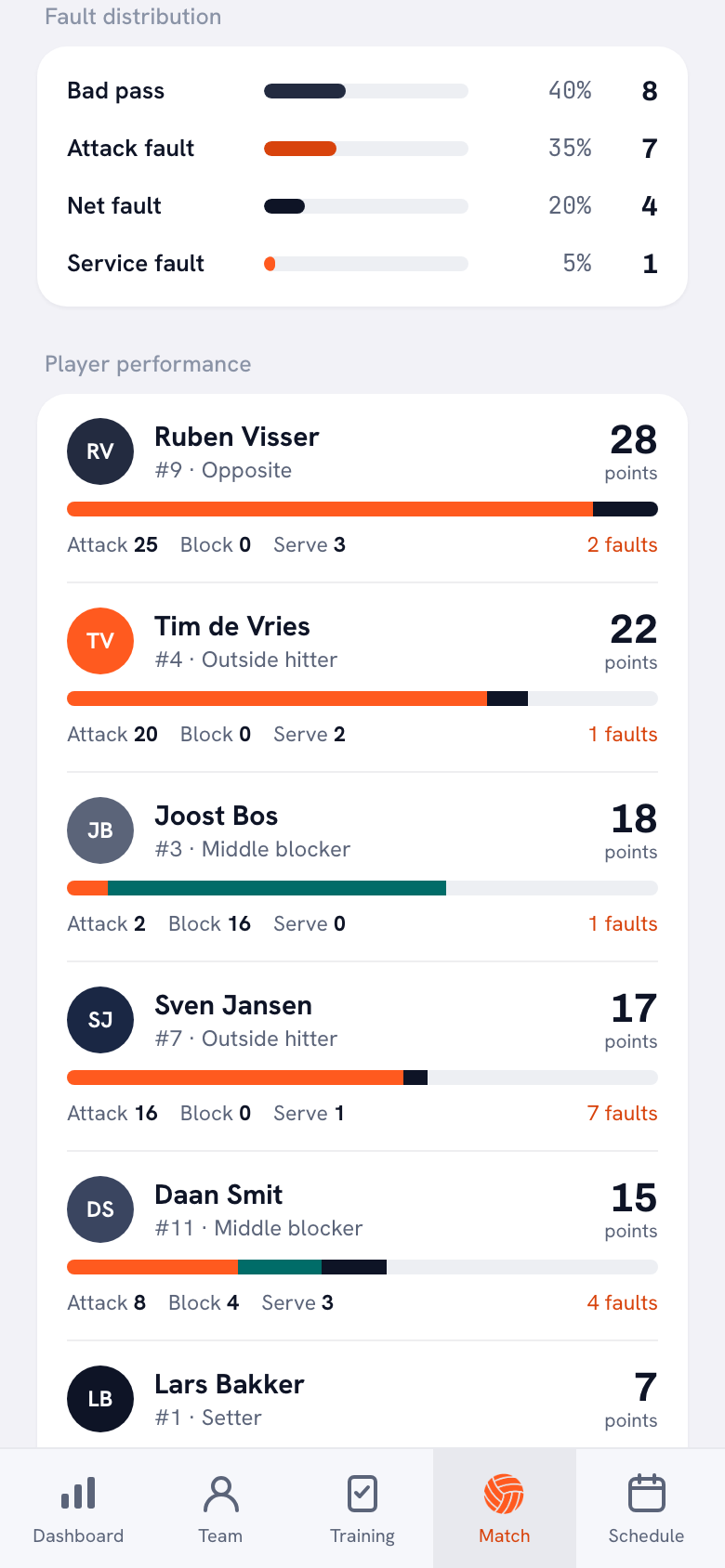
If it hangs on one player, do not substitute straight away. Which errors come with a role and how to have the conversation about them is in error load per player. If most errors are on the serve, do not just look at the count: how to set the errors against the pressure your serve creates is in serving stats and aces.
Leak 2: serve receive and side-out
The question here is narrow: after the opponent's serve, did your team still get an attack that could achieve something? If not, you are losing rallies you never even get to play, and during the match that feels like bad luck and afterwards like a difference in level.
Two numbers answer it. The first is reception per receiver — who got the balls and what came of them; how to record that during a match is in tracking reception. The second is the share of rallies you still win on the opponent's serve; what exactly that number measures and how to calculate it is in side-out percentage.
If this is where you find the leak, do not immediately schedule passing drills. Collapsing serve receive has four different causes that look exactly the same from the sideline; which of the four applies to you is what you work out with the four leaks in serve receive.
Leak 3: one rotation that cost the set
You do not always lose a set evenly. Often there is one lineup in your team in which you fail to score three or four times in a row, and that run costs you the set while the other rotations are fine. On the scoresheet that is invisible, because all it shows is the final score.
The number you need is the share of rallies won per rotation, and for that it has to be clear who the setter is — otherwise you do not know which lineup you were in. If one rotation stands out, the real work begins: the four causes behind a rotation like that, and five repairs, are in finding your weakest rotation.
One match is not a trend. Everything you find above is a clue from a single evening. A number that comes back in two or three matches is a leak; a number that stands out once is usually the opponent. Only decide about your lineup or your system once you have seen the pattern twice.
Leak 4: serving and points on your own serve
The question: did your own serve produce anything other than errors? A team that only serves safely gives the opponent a free attack every rally and struggles to score on its own serve. A team that takes too many risks gives the points away immediately. Your serving policy sits between those two.
Look at two things. First, where your points came from: attack, block, serve or opponent errors. Second, the longest runs of points you scored on your own serve, per player — that shows which server actually put the opponent in trouble. What such a run tells you and how to read it is in serving runs on your own serve.
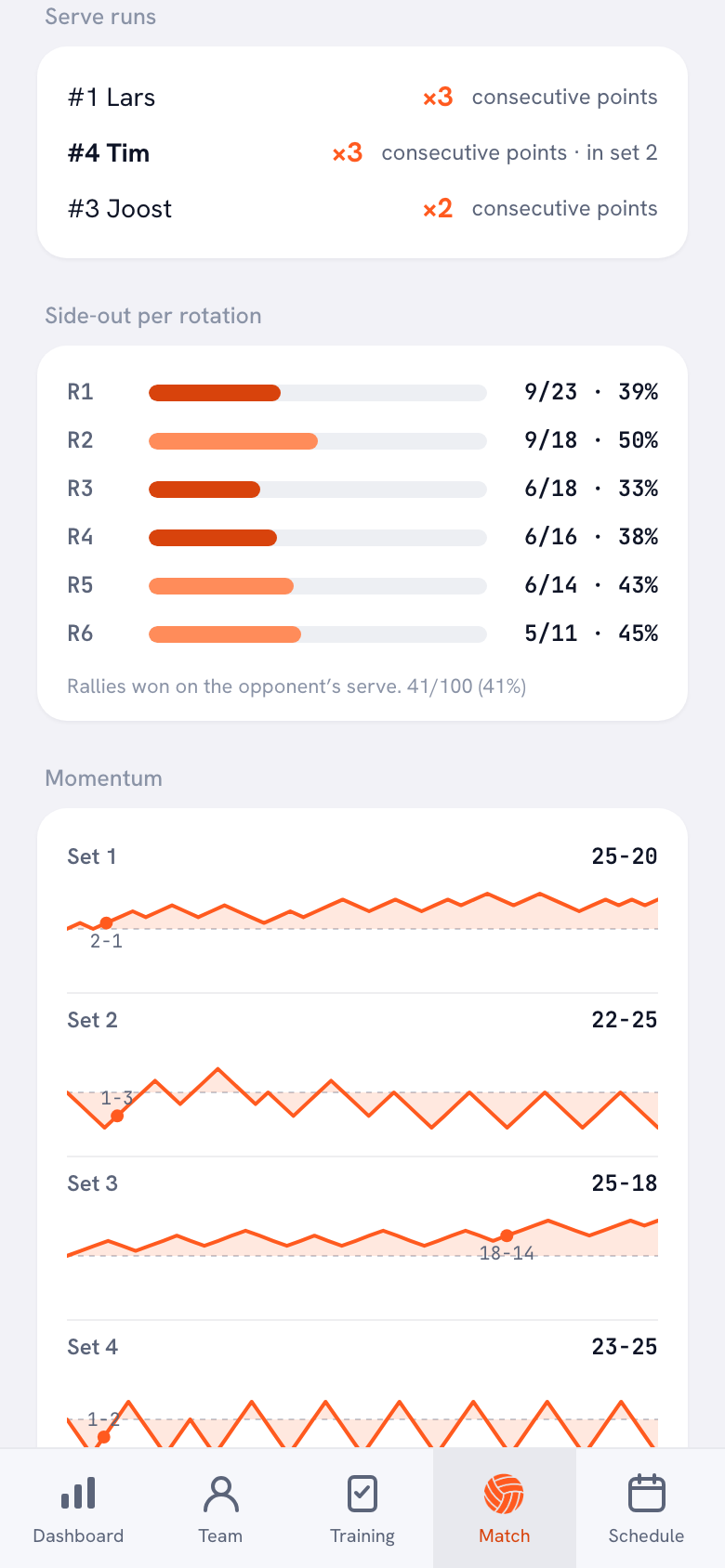
If you hardly score on your own serve even though you do get into the rally, the leak is not in the serve itself but in what happens next: in scoring on your own serve. Three places to look: where you serve to (targeted serving), how your block is set up when the ball comes back (organising the block) and whether you still build an attack after a dug ball (transition drills).
Leak 5: the turning point in the end phase
Sets you lose by two or three points look like bad luck, and often they are not. There is frequently one moment when the opponent takes four or five points in a row, while the rest of the set is level. So the question is not why you lost, but what exactly happened during that run: who was serving, which rotation you were in, and what went wrong on the court.
The score progression of the set answers that. How to read such a progression back as a coach is in reading back the score progression; how to find the turning point in the line of a set is in the momentum line of a match. If you want to act on it during the match, the set break is the moment: what you can see there on one screen is in the break between two sets.
This is where the analysis stops and something else begins. What you discuss with your players from these five leaks, in which order and how many numbers you bring, is a separate conversation with its own rules — that is in the match debrief with data. A twenty-minute analysis does not become a twenty-minute debrief.
Two things you deliberately leave aside. The report per player you read separately and with different questions; reading player stats is the place for that. And the pattern over a series of matches belongs in the season analysis, not in the analysis of one evening.
What these five steps cost you depends mainly on what you recorded during the match. If you tracked nothing, you do it from memory and often get no further than one or two of the five leaks. If you scored live in Koach, the error breakdown, the side-out per rotation (with a setter set), the points by type, the serve runs and the score progression of every set are in the match detail afterwards, plus reception if you tapped it in, and from the second match onwards you can put two matches side by side. The analysis is still your work — the looking up is not.
Frequently asked questions
How soon after the match should you do the analysis?
Not on the evening itself, and no later than a few days afterwards. Right after the match the last two rallies colour your whole judgement; after a week nobody remembers where a run came from. The next day is usually the best moment: the images are still fresh, the emotion has gone, and you still have time to adjust the next practice.
Which numbers do you need at a minimum if you don't track everything?
Two. The number of points you gave away yourself, split by type, and the set scores with the moments when three or more points in a row went one way. Those two get you to leak 1 and leak 5, and those are also the two leaks you can do something about straight away at the next practice. The rest you can add later.
What if every set was lost for a different reason?
Then that is the outcome, and you put the match aside. A team that collapses on serve in the first set and on serve receive in the third does not have a leak but a fluctuating level, and you fix that with how you build your practices, not with a tactical intervention. Keep the numbers and check after two or three matches whether something does come back.
Do you share the analysis with your players?
Not in this form. Five leaks with numbers attached is material for your practice plan, not for a team talk: players switch off at the third table. What you do share with the team is a small selection with its own structure, and you only put that together once the analysis is finished. Include only what players can influence themselves, and link it to what you are going to do in practice.
Can you analyse a match without video?
Yes, and for most amateur teams it is the only realistic option. Four of the five leaks above follow from counts you make during the match or take from the score progression afterwards. Video mainly helps with the fifth leak, because there you want to see what happened during a run, but even that you can replace by jotting down one word during the match for every run of three points.



Try it yourself in Koach
Less admin, more coaching.
Get started with KoachOr read first what the volleyball coaching app does.