
Use volleyball stats to plan practice: what to work on this week
The short answer
To use volleyball stats to plan practice, take four steps: pick the biggest leak, turn it into one focus, choose a drill and a game that bring out that leak, and measure the same number in the next matches. In Koach the biggest leak and the weakest rotation are ready for you after a match scored live.
Using volleyball stats to plan practice is the step most coaches skip. After Saturday you know exactly how many serve errors there were, and on Tuesday you still run whatever was already on the plan. Here is how to make that translation in four steps, with examples for the patterns that come up most often.
Why is one match not yet a practice plan?
A match is one evening against one opponent. A strong server on the other side, a player who was ill, a hall with a low ceiling: one match is full of chance. If you overturn your whole plan after every match, you train something different every week and never see whether anything works.
The opposite is just as wasteful: collecting numbers and doing nothing with them. The middle way is one leak at a time. You pick the biggest leak from the last match, train it for two or three weeks and see whether the number moves. If the same leak comes back in two matches, you know it was not chance. How to go through a match step by step looking for leaks is in volleyball match analysis; which numbers matter at all is in understanding volleyball statistics. This article starts where that analysis stops: what do you train on Tuesday?
From stats to practice in four steps
- Pick the biggest leak. Not the moment that stuck with you most, but the place where you lost the most points. Look first at your own errors by type, then at side-out and break point by rotation, then at serve receive. One type of error that clearly stands out is a leak. Errors spread evenly over everything are more likely just an off night.
- Turn it into one focus. Rewrite the leak as something your players can do. "Fewer attack errors" is a wish. "After a poor set, a controlled ball deep into the court" is an instruction.
- Choose a drill and a game that bring out the leak. In the technique block you train the skill itself; in the game at the end, the scoring rewards exactly that behaviour. A drill in which the leak never occurs cannot fix it either. Drills per skill are on the drills page, and eight game formats with their own scoring in scrimmage games for volleyball practice. How a whole session is built around one focus is in running a volleyball practice.
- Measure whether it works. Look at the same number in the next two or three matches. If it moves the right way, your practice carries over. If it stays the same while it did get better in practice, your drill is not yet realistic enough. In practice itself you measure with a practice game, a game between your own players in which you rate only that one skill.
Where do you find the biggest leak in Koach?
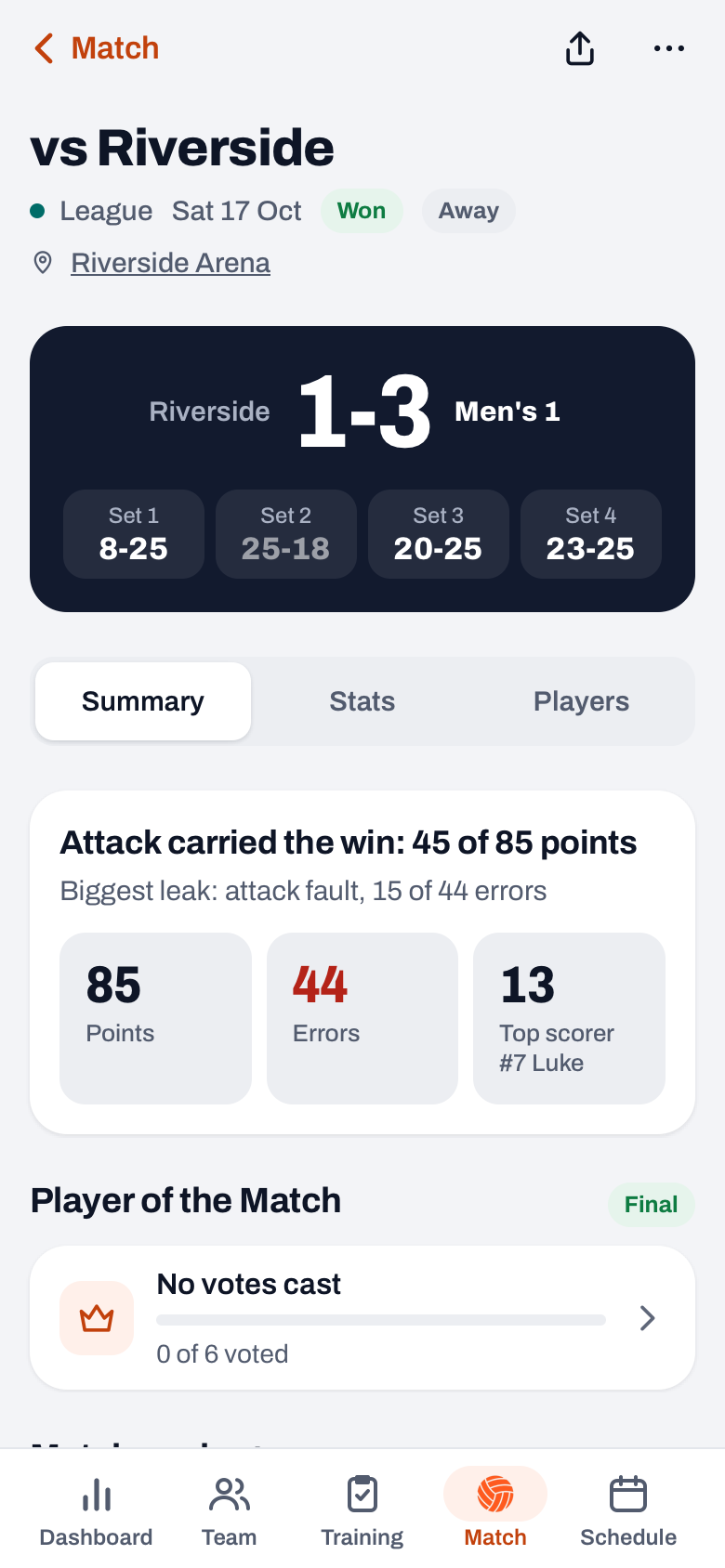
If you score the match live in Koach, the Summary of the played match has a line at the top that starts with Biggest leak:, followed by the error type and how many of all your errors that was. Under Stats you find the errors by type, with the type that cost the most points, and the Rotations table with your side-out per rotation and, if you scored the match yourself in the app and not through a score keeper, also the break points and errors. If you scored the match in Expert, you also find the Skill ratings per skill and the Expert figures there.
14 days free, no credit card. Score Saturday's match live in Koach and see straight away which leak you train on Tuesday.
Try Koach at your next matchFour patterns and what to train
Lots of serve errors
What you see: serve errors are the biggest leak, or under Momentum it says Their runs mostly began with: Service fault, meaning a serve error by your team. What you train: serving with a consequence. Not softer, but to a zone and with a score: in is a point, out is a point for the other side. Finish with an end game from 20-20, because that is where a serve error weighs most. How you measure: serve errors per set in the next matches, and whether you still win points on your own serve. Fewer errors but no more break points means your team has started serving too carefully.
One rotation leaks
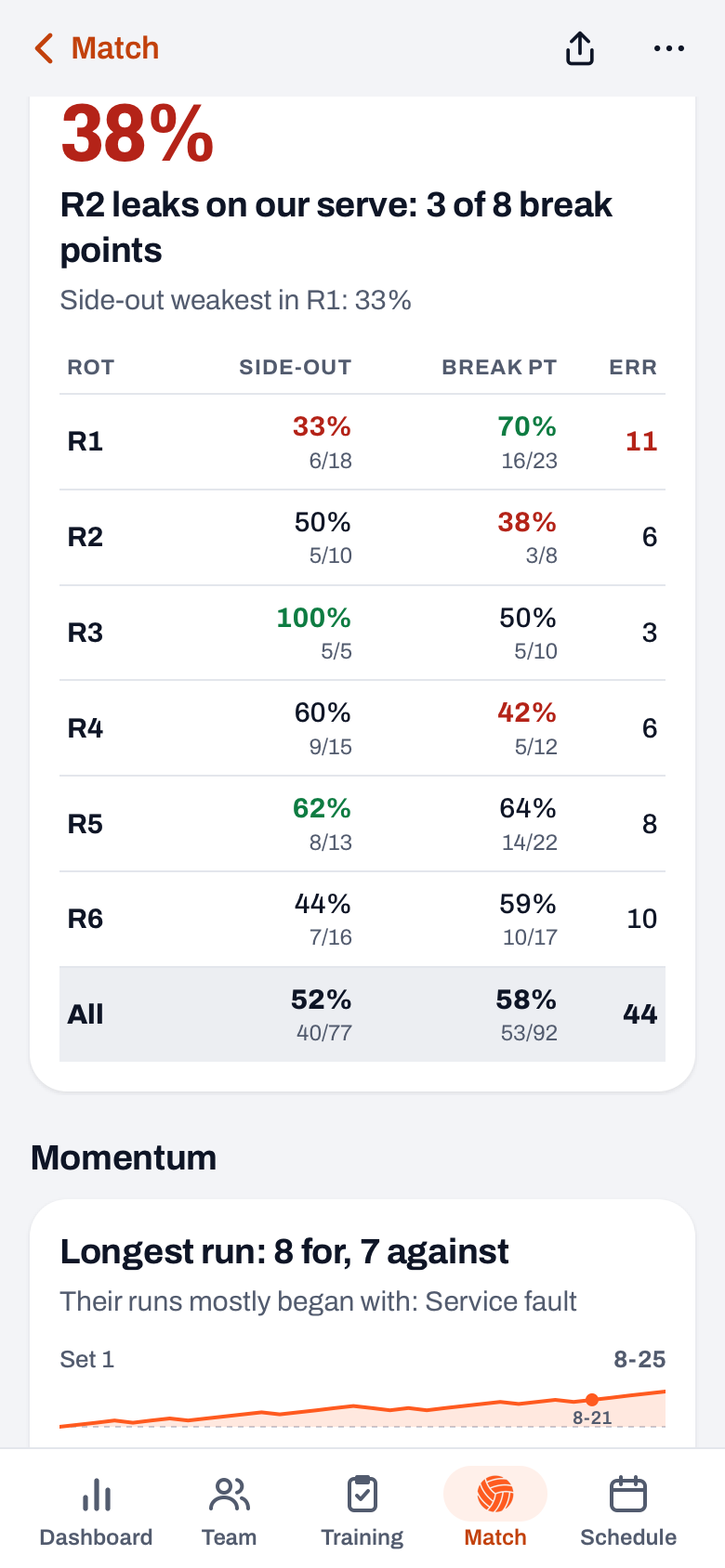
What you see: under Rotations a line such as R4 leaks on our serve, with how many break points you won there, or Side-out weakest in a particular rotation. What you train: put your team in a game in exactly that rotation, such as the rotation challenge from the scrimmage games above, and watch who passes, who attacks and where the gap is. The usual causes and their fixes are in finding your weakest rotation. How you measure: the same rotation in the next matches. Mind the small numbers: per rotation you only play a handful of serving turns in one match, so only judge after two or three matches.
Serve receive and side-out
What you see: a low side-out over the whole match, lots of bad passes among the errors, or in Expert at Skill ratings the line Reception was the weak spot. What you train: receiving a real serve from the other side, not a tossed ball, with three passers calling the ball to each other. Finish with the pass bonus or the side-out bonus game. How you measure: side-out in the next matches, and in Expert the average reception rating. In practice you score a practice game in Expert with Reception as the focus.
Attack errors
What you see: attack fault as the biggest leak in the summary, or under Errors the line Attack fault cost the most points. What you train: attacking against a block, with a choice: hard, a tip or a controlled ball deep into the court. An attacker who can only hit hard also hits hard after a poor set, and then into the net or out. How you measure: attack errors per match, and in Expert the attack efficiency: kills minus errors, divided by the number of attacks.
Put the focus where you will see it on Tuesday
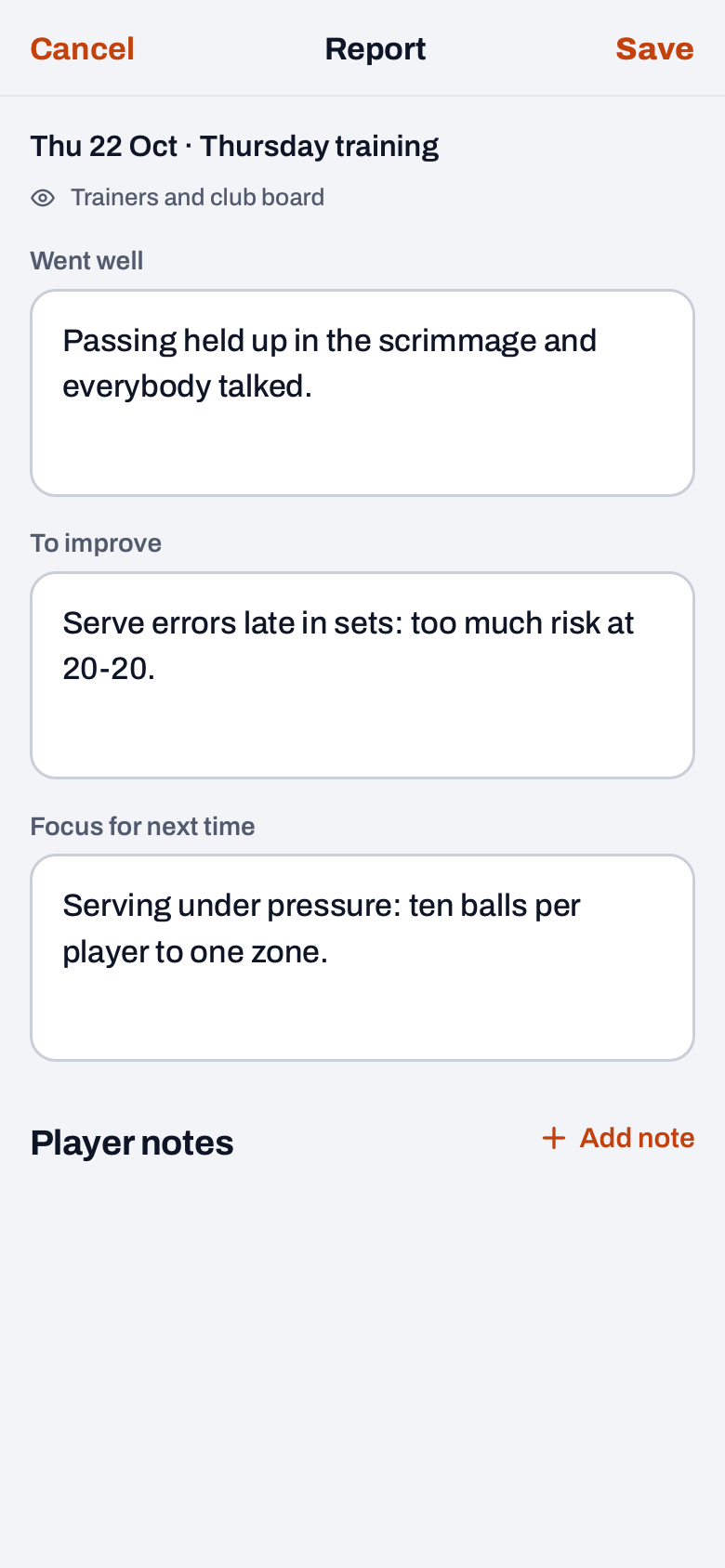
The leak is chosen; now it has to end up in your practice. In Koach, open the next practice, tap the pencil and write the focus in the Focus field. It then appears in the practice detail right below the time, so you and your fellow coach see it as soon as you open the practice. Then put the drill that brings out the leak in the plan as the first part after the warm-up.
After that practice you close the loop in the report. Under Went well and To improve you write whether the focus came back, and under Focus for next time what still needs to happen. That line then appears automatically above the plan of the following practice, under Focus. How to keep such an evaluation short and useful is in evaluating a practice. Live scoring, the analysis and the report are included in Coach and Club; what they cost after the 14 free days is on the pricing page.
One leak at a time. After a match, pick one number and train it for two or three weeks. If you tackle a new leak every week, you never know which approach worked.
Frequently asked questions
Which stats do you use to plan practice?
Start with the errors by type: that is where you gave points away yourself. Then look at side-out and break point by rotation, and at serve receive. The total number of points says little; the breakdown tells you what to train. Pick one, the biggest leak, and make it the focus of the next few weeks.
How many matches do you need before you change your practice?
To try something, one match is enough: pick the biggest leak and train it. To draw a conclusion you need two or three. If the same leak comes back, it is a pattern and not chance. With numbers per rotation you need more patience, because per rotation you only play a handful of rallies per match.
How do you know whether your practice is working?
Measure the same number in the next matches as the one you started with, for example serve errors per set or the side-out in one rotation. If it moves the right way, your practice carries over. If it gets better in practice but not in matches, make the drill more realistic: with a real serve, an opponent and a score.
Do you need to keep stats to train this way?
It helps, but a sheet of paper with tally marks for one type of error works too. In Koach you note in Simple mode for each point how it ended and who was involved; after the match that already gives you the errors by type and the rotations. You can try Koach free for 14 days, no credit card.


Let your next match decide your practice
14 days free, no credit card. After one match you know which leak to train on Tuesday.
Get started with KoachOr read first what the volleyball coaching app does.