
Coaching journal after practice: what went well, what to improve
The short answer
Write your coaching journal right after practice with three questions: what went well, what to improve and what the focus is for next time. Write one or two concrete sentences per question about what you saw. In Koach those three fields are in the practice report, and the focus shows up at your next practice.
A coaching journal after practice takes five minutes, and still most coaches skip it. Not out of unwillingness: after ninety minutes in the gym you want to go home. Here you get a fixed format of three questions, example lines that actually move you forward and a way to carry the evaluation into your next practice.
Why evaluate a practice right after it ends?
Because two days later you no longer remember. A practice evening is ninety minutes in which a hundred small things happen. Which drill worked, why the game stalled, who checked out after twenty minutes: it all fades just as fast. If you write it down right away, you have a starting point next week. If you put it off, you start from zero again.
Evaluating is also something other than rating. After practice you can give players a score for effort and technique; that is about the player. The evaluation is about the practice itself: did your plan work? In the four phases of running a volleyball practice this is the last step, and it is a short one. You evaluate the season as a whole once, with attendance and effort included; that is covered in evaluating the practice season. The five minutes after each practice are the building blocks for it.
Which three questions go in your coaching journal?
- What went well? What worked, in which part of practice, and why. The why matters most, because you can only repeat what you understand. "The serving drill went well" is an observation. "The serving drill went well because every miss was a point for the other side" is something you can do again next week.
- What can be improved? Not everything that went wrong, but the one thing that held the practice back most. Often it is something of your own: an explanation that took too long, a drill that was too hard, players standing around waiting.
- What is the focus for next time? One task for yourself, or for the coach running the next practice. Concrete enough to turn into a part of your plan.
You will find the same three questions under other names. Coach education courses often use what went well and even better if; in schools the same idea is known as glows and grows. The format matters little, as long as you keep three things apart: what you want to keep, what you want to change and what you start with next time.
Example: from a vague to a useful journal entry
The difference between an evaluation that moves you forward and one you might as well have skipped is how concrete it is. The same practice, written down twice:
| Question | Vague | Useful |
|---|---|---|
| Went well | Good atmosphere, everyone joined in. | Passing held up in the game; the passers called every ball. |
| To improve | Serving was bad. | Serve errors at the end of the game: too much risk at 20-20. |
| Focus for next time | More serving practice. | Serving under pressure: ten balls per player to one zone, with a count. |
The right column follows three rules. Write down what you saw, not what you felt. Name the part of practice or the moment. And keep it to one or two sentences per question. A journal with three short, concrete lines per practice is something you still read back in March; a journal full of half pages is not.
Where do the answers come from?
- The goal of the evening. Did the team reach what you chose as the focus beforehand? Without a goal, evaluating is guessing. How to pick that goal is covered in setting the focus of your practice.
- The plan. Which sections did you finish, which halfway and which not at all? A plan that never gets finished is too full. In Koach you mark each section Done, Partly done or Not done, so you can see it later.
- Who was there. Six players at a planned six-on-six explains a lot.
- The score of the game. Was it even, and did your focus come back in the rallies?
- Your players. Ask the group one question at the end, for example: what was hardest today? The answer often belongs under To improve.
How to keep your coaching journal in Koach
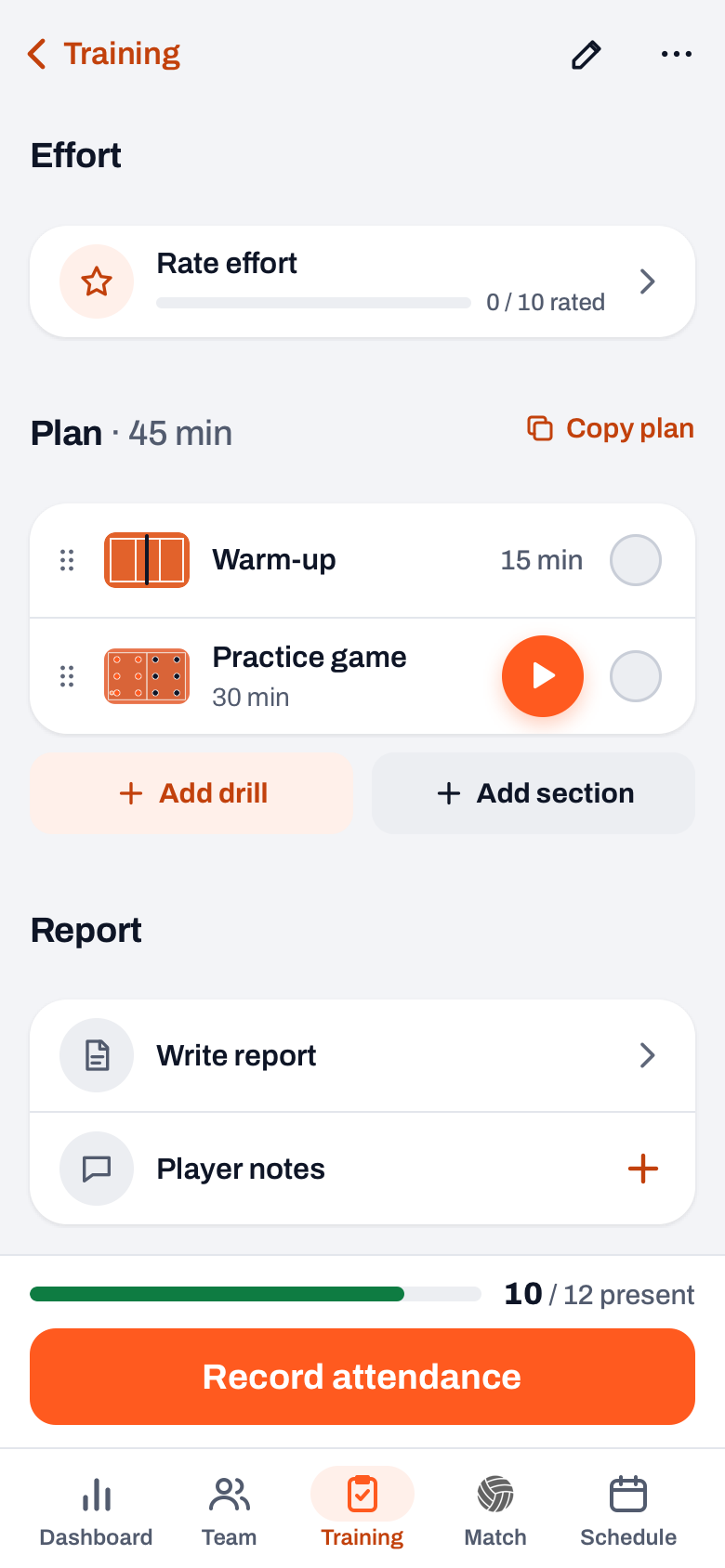
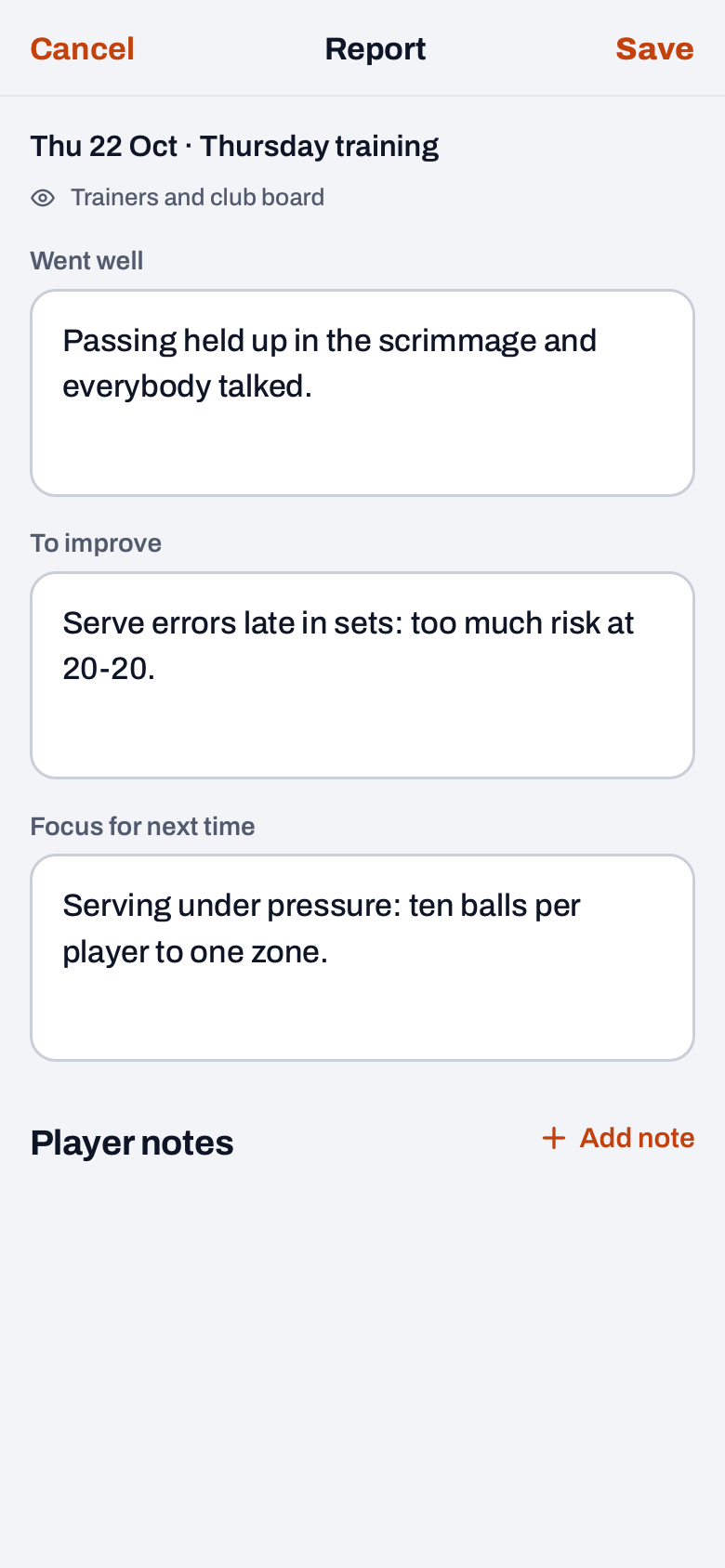
In Koach every practice has a Report section in the practice detail from the day of the practice on. Tap Write report and a screen opens with exactly the three questions: Went well, To improve and Focus for next time. You save with Save at the top right.
14 days free, no credit card. Write the three sentences in Koach after your next practice and see whether your focus shows up above your plan the week after.
Try Koach after your practiceAt the top of the screen you see who can read the report. In a standalone team that is Trainers of this team; if your team belongs to a club, it says Trainers and club board. Players and parents do not see the report, so you can also write down that your own explanation did not work. If you coach with two coaches, you both write in the same report, and below it you see who updated it last. What else belongs with the report is in the practice report after a session.
Below the report are the Player notes. If something is about one player, do not put it in the report but tap Add note: the note belongs to the player and to this practice. With the Follow up switch you mark that something needs to happen. Why notes per player pay off so much is explained in keeping notes per player.
If your team belongs to a club on the Club plan, the club manager, the board and the technical manager read along in the team log: per practice the attendance, how many sections were done, whether there is a report and which focus is set. What a technical manager does with that is covered in the role of the technical manager. There is no button to share or export a report. What Coach and Club cost is on the pricing page.
From journal entry to your next practice
An evaluation is only finished once it ends up in your next plan. In Koach half of that happens by itself: when you open the next practice, the Focus section sits above the plan with the focus from the last report, the date and who wrote it. If a colleague runs that practice, they also know where to start.
The other half you do yourself. Make that focus the first section after the warm-up, and check in that evening's report whether it worked. If the same point under To improve comes back three weeks in a row, change the approach instead of repeating the same drill. If you also want to steer your practices with what the match showed, read how to turn match stats into practice.
Write it down before you put the balls away. Three sentences on the bench in the gym while the players get changed. At home it will not happen, and by the next morning you have forgotten half of it.
Frequently asked questions
What does a coaching journal template look like?
A useful template is short: the date, the goal of the practice and three questions. What went well? What can be improved? What is the focus for next time? For each question you write one or two sentences about what you saw, with the part of practice it belongs to. More fields do not make the template better, they only make you fill it in less often.
What do you write in a practice log?
Three short lines per practice: what worked and why, what disappointed most and what you start with next time. Add who was there if that explains something, and how the game went. If something is about one player, put it in a note for that player and not in the log of the practice.
How do you evaluate a practice together with your players?
Ask the group one question at the end, in a circle and within two minutes. Ask about something they could see, such as: what was hardest today, or when did it go well? A question like 'was it fun' only gets you a yes. Take what you hear into your own evaluation, usually under To improve.
Who can read the practice report in Koach?
The coaches of the team. If the team belongs to a club on the Club plan, the club manager, the board and the technical manager read along through the team log. Players and parents never see the report or the player notes. You can try Koach free for 14 days, with no credit card and every feature.


Evaluate your next practice in Koach
14 days free, no credit card. After one week your focus sits above the plan of your next practice by itself.
Get started with KoachOr read first what the volleyball coaching app does.