
My Volleyball Team Keeps Losing: Is It the Level or the Team?
The results are listed one under the other and there is not a single win among them. My volleyball team keeps losing, you think, and then you usually start with yourself: a different lineup, harder practices, a team talk. Yet the first question is a completely different one — who are you actually losing to, and by how much? Losing 20-25 five times against the top half of your division is a question of placement, not a problem. Losing 12-25 five times against everyone is something else. This piece shows how to read that difference before you change anything.
My volleyball team keeps losing: the first question is not 'what am I doing wrong'
A run of defeats feels like one problem, but it is two that you need to separate. The first is: are we losing to teams that are simply better? The second is: is there something in our own game that we can repair this week? As long as you mix those two up, you will change things that were not broken.
That is not theory but a practical warning. A coach who, after four defeats, shakes up the lineup, moves the setter and makes practices harder ends the month with a team that both loses and no longer knows where it stands. The change has then become the problem.
So this article is only about the question that comes before the plan: what do the results you already have tell you? What to do once you know something really is broken — the order of intervention, what you deliberately leave alone and how to talk the team through it — is in the plan for breaking a losing streak. Only start on that once this piece sends you there.
You don't need an app for this: the results, the standings of your division and a sheet of paper are enough.
Set scores say more than results: 25-20 is not the same as 25-12
A 0-3 result says almost nothing. Three sets of 20-25 and three sets of 12-25 produce the same result and are two completely different matches. In the first case you fall five points short per set, in the second thirteen.
So list your last five matches one under the other, but set by set. After each set, write down how many points you fell short. That is all you need. What you are looking for is the spread:
- Almost all sets roughly within five points. Your team belongs in this division and you are losing moments, not matches. There is something to repair here, and usually one thing at a time.
- Almost all sets with a gap of roughly ten points or more. Then you are structurally playing above your level. That is no disgrace and not a coaching problem either; it is a question of placement.
- One set close and the rest far off, match after match. This is the most interesting pattern. You can do it, but you can't sustain it — that points to concentration, fitness or a bench that is too thin, not to level.
Those boundaries are a reading aid, not a standard. If most of it falls in between, the next step says more than this one.
Watch out for one trap: a set you lost 23-25 after leading 20-15 is different from a set that was level from start to finish. The final gap is the same, the cause is not. For that you need the progression and not just the final score — we come back to that with the first signal below.
Who did you play? The standings as half an explanation
The second step is quick and often explains a large part already. Take the standings of your division and look at where the teams you have played so far are.
It happens that the first half of a schedule is heavy by chance. Five defeats against five teams from the top half is a schedule, not an indication of performance. Only when teams from the bottom half are among them, and you lose to those too, do you know something.
Three things to write down:
- How many of your opponents so far are in the top half of the table? If they were only teams from the top half, you don't know anything yet.
- How did those opponents do against each other? If number two also loses 20-25 to number one, your 20-25 fits the normal picture of this division.
- Is there a team in the standings with set scores similar to yours? If so, you have a mirror: look at what happened in your match against them.
There is a third layer that often gets skipped: the weeks themselves. Illness, exams, holidays, a long trip to an away match, two practices that were cancelled — write down for each match how many players you turned up with and whether you were able to train fully in the week before. A run that coincides with a half-empty gym on practice night is not a level problem.
Three signals that there is something to repair
If the set scores and the standings say you belong where you are, look further into the match itself. There are three signals you can see without a statistics program, with a sheet of paper and one person on the bench keeping a tally.
Signal 1: the gap opens up in one stretch. Have someone on the bench write down the score every few points. If you see it was level at 12-12 and not at 12-18, the set was not lost in the end phase but halfway through. A run of six points in a row like that often has one identifiable cause: one server you couldn't handle, one rotation, or a moment when heads dropped.
Signal 2: one rotation structurally costs more. Have someone tally per rotation how many points you win and lose while the opponent is serving. If one rotation lags far behind the other five, you have something concrete. How to single out that rotation and what to do with it afterwards is in finding your weakest rotation.
Signal 3: the opponent hardly has to do anything for it. For one set, tally who won the point: did it come from their attack, block or serve, or from an error by you? If the majority comes from your own errors — serve into the net, attack out, four hits, net fault — the difference in level is smaller than the result suggests. This is the signal with the most room for improvement, because your own errors are the quickest to influence.
If one of the three points somewhere, take one match where it showed up and go through it completely with match analysis in five steps: from the points you gave away to the turning point late in the set. If you find nothing on any of the three, that is also an outcome: then you have evidence that nothing is broken.
Tally one thing per match, not three. A bench player who has to track the progression, the rotations and the error types at the same time gives you three unreliable lists. Pick one per match and stick with it until you see the pattern. Three matches with one number say more than one match with three numbers.
If it is the level: what you steer on instead
If the set scores and the standings show that you are playing against better teams, the result is not a useful goal for the time being. A team that hears every week that it has lost eventually stops listening. So you need something else to measure whether things are getting better.
What works for that are goals you can reach within one match and that do not depend on the opponent:
- Fewer service errors of your own than in the previous match. One number, immediately visible, entirely your own.
- At least once, three points in a row. Against a stronger team that is a real achievement and it is clearly visible.
- Winning the first rally after a time-out. Small, concrete, and it trains exactly what is missing during a losing run.
- One agreement from practice that shows up in the match — the free ball that goes to the setter, or the cover behind the hitter.
Name those goals before the match, and discuss them afterwards in the same order. How to have that conversation with numbers instead of impressions is in the debrief with data. And don't confuse this with what you say in the first minutes after a heavy defeat: that is a different conversation, and it is in what to say after a heavy defeat.
Also record the outcome of this analysis for your club. If at the end of the season you can show that you fell ten points or more short in almost every set, that is a much stronger argument for a different placement than saying it was too hard.
What you can look back on in Koach — and what the app doesn't tell you
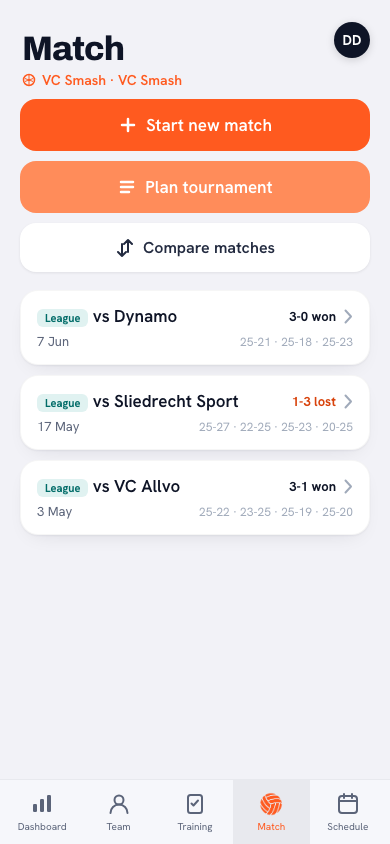
If you scored your matches live in Koach, most of these numbers are already there. The match overview keeps the set scores and the match detail the progression per set, so you can tell 20-25 and 12-25 apart without relying on memory. The momentum line shows per set where it tipped, and that is usually not at 24-22 but much earlier. Side-out per rotation is on the dashboard, with the number of rallies measured next to it, so you can see whether the figure means anything — how to read that percentage is in the side-out percentage. During the match the time-out sheet already names the weakest rotation and the error type that occurred most often in that stretch. And from two played matches onwards you can put matches side by side.
Four limits come with it, and you need to know them before you read the numbers. The app does not tell you what to change; it supplies the figures, the choice remains yours. Side-out is only calculated over rallies in which the opponent serves, and the breakdown per rotation only works if you have set a setter — without a setter everything ends up in one pile. There is no point scoring percentage. And a match you have finished keeps the figure calculated at the time: recalculating retroactively is not possible. That last point means something uncomfortable: if you only start scoring now that the run is already under way, you have no comparison material from before.
If you want something to look at during the next run: score your next two matches live and then put them side by side. Then you change something based on a number instead of a feeling. You can try Koach free for 14 days.
Frequently asked questions
My volleyball team keeps losing — where do I start?
Not with your lineup, but with the results you already have. List your last matches set by set and write after each set how many points you fell short. Put the standings next to that: if so far you have only played against the top half, you don't know anything yet. Only if the sets are close and you also lose to comparable teams is there something to look for in your own game.
How many matches do you need before a number says something?
That does not depend on the number of matches but on the number of rallies measured. A side-out percentage calculated over a handful of rallies in one rotation fluctuates too much to draw conclusions from. So always look at the number of rallies behind the figure; in Koach it is shown next to it. A pattern you see recurring in three matches is more reliable than an outlier in one.
How do I know whether we have been placed in a division that is too strong?
Look at the point difference per set, not at the results. If you fall ten points or more short in virtually every set, and that also applies against the teams at the bottom of the table, you are structurally playing above your level. If most sets are within five points, you belong there and are losing moments rather than matches. Also present that overview to your club when you discuss next season's placement.
Which numbers can I still look back on if I didn't score live?
Only what is on the scoresheet or in the results: the set scores and the final score. That is less than you would like, but enough for the first two steps in this article — the point difference per set and the comparison with the standings. The progression within a set, the rotations and the error types cannot be reconstructed afterwards, so for those you have to start tallying or scoring from the next match.



Try it yourself in Koach
Less admin, more coaching.
Get started with KoachOr read first what the volleyball coaching app does.