
Blocked vs random volleyball practice and differential learning
The short answer
Blocked vs random practice in volleyball is about the order of repetitions: one skill over and over, or skills mixed in an order players cannot predict. Differential learning goes furthest: no repetition is the same and you do not correct toward one ideal model. The evidence for it is promising, but thin.
Blocked vs random practice in volleyball is the debate where differential learning always comes up. This article puts the four ways to order repetitions side by side, explains why a drill that looks good does not always stick, shows what the research does and does not say, and gives variations per skill for your next practice.
Four ways to fill the same ten minutes
Say you have ten minutes for passing. You can fill those minutes in four ways, and the number of ball contacts is the same in all four. The difference lies in the order and in how much changes from one repetition to the next.
| Form | What it looks like for passing | What the player does |
|---|---|---|
| Blocked practice | Thirty passes in a row off the same toss, from the same spot | Repeat one movement until it is grooved |
| Variable practice | The same pass, but the toss changes in height, distance and direction | Adapt the movement to a different ball each time |
| Random practice | Pass, set and serve mixed, in an order the player does not know | Choose again on every ball and rebuild the movement |
| Differential learning | Every pass deliberately different: narrow stance, bent arms, after a turn, with one hand on the other wrist | Work out what works, within a space that keeps changing |
Between blocked and random there is also serial practice: pass, set, serve in a fixed order, over and over. None of these forms is wrong. They just do something different to your players, and you only see that when you look beyond the drill itself.
Why a drill that looks good does not always stick
In 1979 Shea and Morgan had participants learn three movement tasks, one group in blocks and the other in random order. During practice the blocked group was clearly better. In the test that came later it was the other way round: the group that had practiced in random order retained the tasks better and transferred them better to a new variant (Shea and Morgan, 1979). This is called the contextual interference effect.
A common explanation: in blocked practice you copy the previous repetition, while in random practice you have to retrieve the movement afresh for every ball. That takes effort and makes the drill messier, but it is exactly the effort you have to make in a match too. A review by Soderstrom and Bjork puts it more broadly: what you see during practice is an unreliable measure of what sticks later, and conditions that make practice harder often pay off more in the long run (Soderstrom and Bjork, 2015).
For a coach that is uncomfortable. The blocked drill in which almost every pass reaches the setter after ten minutes feels like a successful practice. The random form that stays messy feels like a failure. A coach who only judges what they see that evening will systematically choose the form that sticks least.
What differential learning does differently
Differential learning goes one step further than random practice. The German movement scientist Wolfgang Schöllhorn proposed it in the late 1990s. The starting point: there is no ideal technique everyone must copy, and a player learns from the differences between repetitions. So you repeat nothing exactly and do not correct toward one model movement. Instead you add large variations in the movement itself, such as the stance, the arm angle, the tempo or the rhythm, so the player finds a stable solution on their own.
The difference from variable practice: there it is mainly the ball that changes and the technique remains the goal. In differential learning you change the technique itself, including in ways you would never use in a match.
What the research does and does not say
- Contextual interference is strong in the lab, weaker in the gym. In research on sports skills the effect is smaller and less consistent. In a study of high school students who practiced three volleyball skills from a skills test, in blocks, randomly or in a mixed form, all groups improved, but the researchers found no advantage for random practice (Petranek and French, 2007).
- Skill level determines how much variation helps. According to the challenge point framework of Guadagnoli and Lee, every player has their own optimal difficulty: a beginner already learns enough from a simple task, while an advanced player needs more variation to keep learning (Guadagnoli and Lee, 2004).
- Differential learning: promising, not proven. A meta-analysis of 27 studies found a small advantage during learning and a medium advantage at the later test, compared with other methods. The authors themselves warn: few and small studies, large differences between studies and a high risk of bias. Compared with other forms of variation, the evidence is scarce and mixed (Tassignon et al., 2021).
The sober conclusion: variation deserves a fixed place in your practice, but there is no reason to throw everything out. Anyone who says differential learning always works better is claiming more than the research does.
When blocked practice is the right choice
- A new technique. A player who cannot yet set overhead needs repetition first. Variation costs attention they do not have to spare yet. How to teach a technique in isolation and put it back into the game is in the analytic, synthetic and whole methods.
- An error that has crept in. Briefly go back to a predictable ball to fix one detail, then quickly vary again.
- Just before the match. In the warm-up you want confidence and rhythm, not a learning stimulus. Repetition belongs there.
If you work with a beginner group, move along the scale skill by skill: blocked first, variable after a few practices, then random. Whether a drill also resembles the match, with a real opponent and a score, is a second question; that is covered in game-like drills.
How to use it at your next practice
Pick one technique per practice and give it eight to twelve minutes of differential work. Four rules keep it useful: make the variations big enough that players notice them, give feedback on the outcome (did the ball reach the target?) and not on the form, avoid variations that invite injury, and finish with a form in which players choose and keep score.
- Pass: narrow or wide stance, arms slightly bent, weight on the heels, after a half turn, with one hand on the wrist of the other, looking at the coach first and only at the ball on "now".
- Set: from standing still and after a short sprint, with your back to the target, from a kneeling position, in a jump, with one foot forward and then the other.
- Serve: low and high toss, the other foot forward, from different spots behind the line, with a short and a long arm swing.
- Attack: an approach of two, three and four steps, short and long arm swing, hitting with a still wrist or with lots of wrist. Always land on two feet; that is the one thing you do not vary.
A full practice structure, from warm-up to scrimmage, is in running a volleyball practice, and how to fit such a block into a program of several weeks is in building your practice blocks.
Test learning a week later, not on the evening itself. Start the next practice with the same short measurement, for example ten serves per player to one zone or ten passes on the target. Only that number tells you whether last week's variation has stuck.
Tracking learning over several practices
Because learning only shows later, you need to remember what you did last week and what you saw. In Koach you add the differential block as its own section in the plan of the practice: with + Add section you give it a name, a duration and a description where you can list the variations. With Copy plan you bring it back next week.
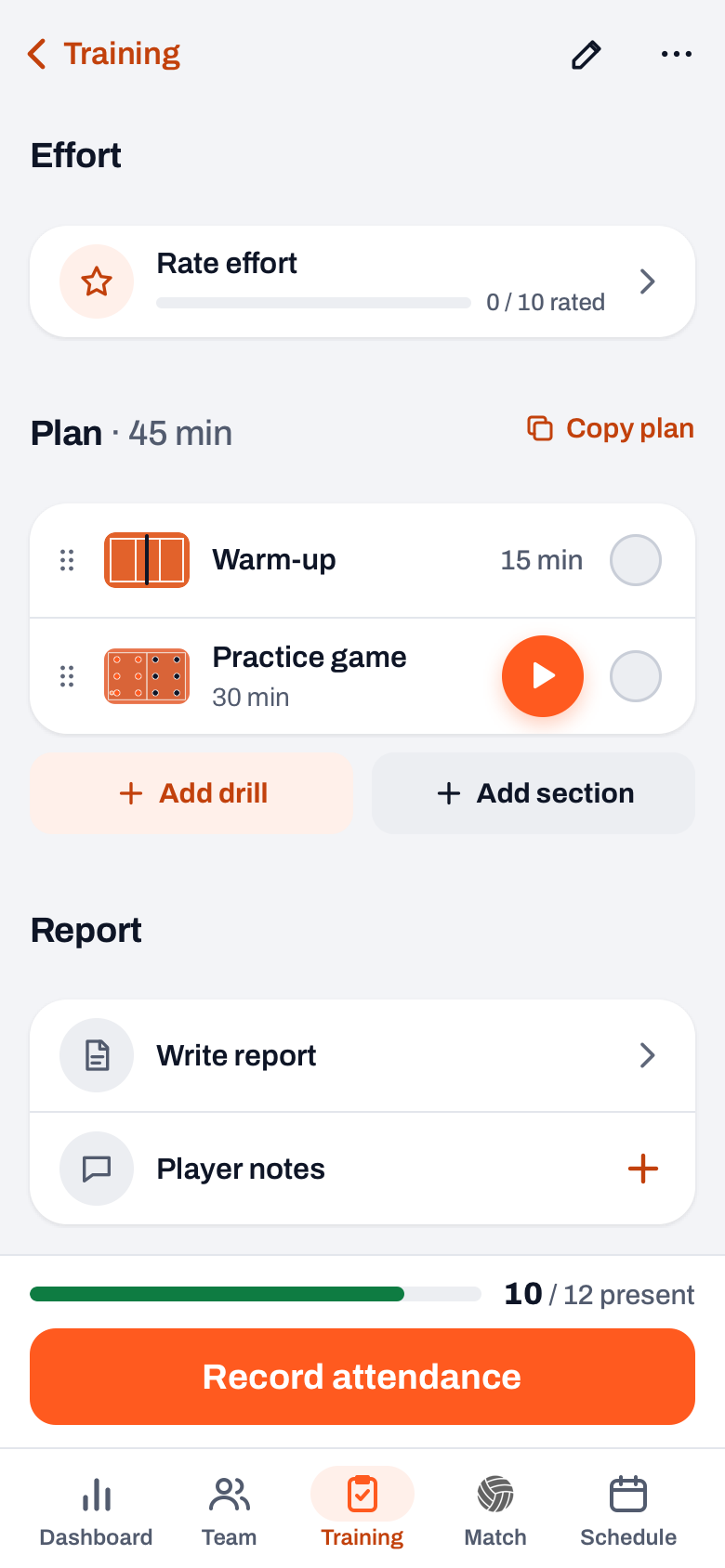
After practice you write in the report under Went well and To improve what you saw, and under Focus for next time the measurement you will open the next practice with. That way the comparison is ready without you having to remember it. What Koach costs after the 14 free days is on the pricing page.
14 days free, no credit card. Put a block of differential passing in your plan on Tuesday and open Thursday with the same measurement.
Plan your practice in KoachFrequently asked questions
What is the difference between blocked and random practice?
In blocked practice you repeat one skill many times in a row, for example thirty passes off the same toss. In random practice skills or variations alternate in an order the player does not know. Blocked practice gives better results during the session, while in many studies random practice sticks better, especially for players who already have the basics.
Is differential learning suitable for kids and beginners?
In moderation. A beginner first needs enough repetition to find the basic movement, and too much variation costs attention they do not have to spare yet. Playful variations are fine, as long as the drill succeeds: catching a ball after a turn or passing from a kneeling position. Build up the variation as the technique becomes more stable.
Do you never correct in differential learning?
Within the differential block you do not correct toward one model movement; the feedback is about the outcome, such as whether the ball reached the target. Outside that block, normal coaching still applies. If you see an error that can lead to injury, such as landing on one leg, you always step in.
How long before you see an effect?
During the differential block itself you often see worse results. Whether it works only shows at a later measurement, a few days later at the earliest. So plan a fixed measurement at the start of the next practice and compare it over a few weeks, instead of judging on the evening itself.
Put your next practice block in Koach
14 days free, no credit card. In two weeks you see what has stuck.
Get started with KoachOr read first what the volleyball coaching app does.