
Volleyball lead-up games: from throw-and-catch to real volleyball
The short answer
Volleyball lead-up games are simplified versions of volleyball in which you temporarily replace the hardest technique, usually with catching and throwing. You start with a throw-and-catch game in small teams and remove one rule per step, until players use three contacts without catching.
Volleyball lead-up games let beginners play the real game right away, even when the ball still flies everywhere after a forearm pass. This article is for coaches and PE teachers working with players aged 11 to 16: a series of six steps from throwing and catching to real volleyball, with the rules for each step and the moment to move on.
What makes a game a lead-up game?
A beginner who has to master the pass before being allowed to play spends weeks standing in line and never sees a rally. A lead-up game turns that around. The structure of the game stays: a net, your own side of the court, three contacts, a point when the ball hits the floor. Only the technique that does not work yet is temporarily replaced by something that does, usually catching and throwing. That way players learn from the first lesson what volleyball asks of them: getting under the ball, choosing who to play to, reading the other side of the court.
The idea comes from Teaching Games for Understanding by Bunker and Thorpe (1982): you adapt the game to the player, not the player to the game. In the United States the throwing version is known as Newcomb, and many schools in Germany and Switzerland know it as Ball über die Schnur. Single games for children aged 8 to 11 are in volleyball games for kids, and the progression for the youngest is in mini volleyball drills by level. This article is for the age after that: 11 to 16, stronger and faster, but with the same sticking points in the pass, and with little patience for anything that feels like a kids' game.
The series in six steps
Play each step three against three on a narrow court, for example a badminton court with a net or a rope, unless stated otherwise. For the throwing games, hang the net or rope at least at reaching height, so the ball has to go over in an arc; as soon as players start playing the ball, move to the height that fits their age. Have teams switch courts every five minutes, so everyone plays everyone.
Step 1. Throw-and-catch volleyball
Rules: every ball is caught. You may not walk with the ball in your hands, and you throw within three seconds. Each team catches and throws three times, by three different players; the third throw goes over the net. The serve is a throw from behind the end line. A point is a ball that hits the floor on the other side. Learning goal: choosing a position under the ball, calling for it, the three-contact build-up.
Step 2. Catch above your head, throw like a set
Rules: you may only catch with two hands above your forehead, and you release the ball with the same extension of arms and legs as in an overhead pass. The third ball is thrown over the net with one hand, using the arm swing of a spike. Learning goal: the shape of the set and of the hitting arm, without a failed contact ending the rally.
Step 3. One catch per team
Rules: each time the ball is on your side, the team may catch it once. The other contacts are played, overhead or with the forearms. The team decides which contact becomes the catch. Learning goal: play where you can, catch where you must. Watch where they catch: it is almost always the first ball, and that tells you what your technique block should be about.
Step 4. The first ball may bounce
Rules: nobody catches anymore. Each team's first ball may bounce once before it is played; the set and the third ball are played directly. The serve is underhand, from a line a few meters inside the court. Learning goal: gaining time to get under the ball and keeping the platform still. Remove the bounce first on a free ball and then on the serve.
Step 5. Three against three, everything played
Rules: no catching, no bounce. Each team plays three contacts; a ball that goes over after one or two contacts gives the other team a point. The serve stays underhand, and the distance grows to the end line. Learning goal: the three contacts under pressure, and the first attack: playing the ball down over the net instead of a safe arc.
Step 6. Four against four with rotation, then six against six
Rules: four against four on a bigger court, with a fixed serving order; a team rotates as soon as it wins the serve back. Then move to six against six on the full court. Learning goal: positions, rotation and defending a court together. What changes in that move to the full court is covered in volleyball drills for ages 12 to 14.
| Step | What is still allowed | Move on when |
|---|---|---|
| 1. Throw-and-catch | Catching and throwing everything | Almost every team gets three throws |
| 2. Catch above the head | Catching, but in set shape | The throw looks like a set |
| 3. One catch | One catch per side | The ball crosses the net twice in most rallies |
| 4. Bounce | First ball may bounce | The pass usually reaches a teammate |
| 5. Everything played | Underhand serve from closer in | Most balls go over in three contacts |
| 6. Rotation | Smaller court, fewer players | Ready for six against six |
How to move on without the game stalling
- One rule at a time. If you take away two aids at once, the rally drops back to one contact and you do not know which rule caused it.
- Not everyone has to be on the same step. On one court, let a strong team play without a catch against a team that still has one. The game stays the same; only the demands differ.
- Going back is fine. If a step stalls after ten minutes, go back and phase the old rule out halfway: catching only on a ball behind the end line, for example.
- Keep the teams small. With three a side, everyone touches the ball often; with six a side, the least confident players wait at the back.
- A step takes weeks, not minutes. With beginners, count on two to four practices per step, each with a technique block on the contact that is still being caught in the game.
Where the game fits into your whole practice, between warm-up, technique block and scrimmage, is in running a volleyball practice. If you teach PE, you work through the same series over several lessons; how to organize one lesson for a whole class on one court is in volleyball in PE class.
Give each step a fixed name. Throwball, one catch, bounce ball, free play. After two weeks you only say the name at the start and everyone is playing within a minute. Players also know which step comes next, and they will ask for it.
Mistakes that make the series stall
- Catching for too long. Catching is a set of training wheels. If it stays in for weeks without you training the technique, players mainly learn to catch well.
- Six against six too early. On a big court with beginners, the ball comes over once and then lies on the floor. Smaller games produce more rallies.
- A hard ball and a low net. Then the third ball becomes a shot instead of a build-up, and the cautious players drop out.
- Elimination games. A player who is out learns nothing. Have teams switch courts instead of dropping out.
Putting the series in your practice plan
A series of six steps over a few months is something you want to find again. In Koach you add the game as a section in the plan of a practice: with + Add section you give it a name, such as the name of the step, a duration and a description with the rules. For the next practice you bring the plan back with Copy plan and only change the rule that comes off. Drills for the technique block alongside it are in the volleyball drills.
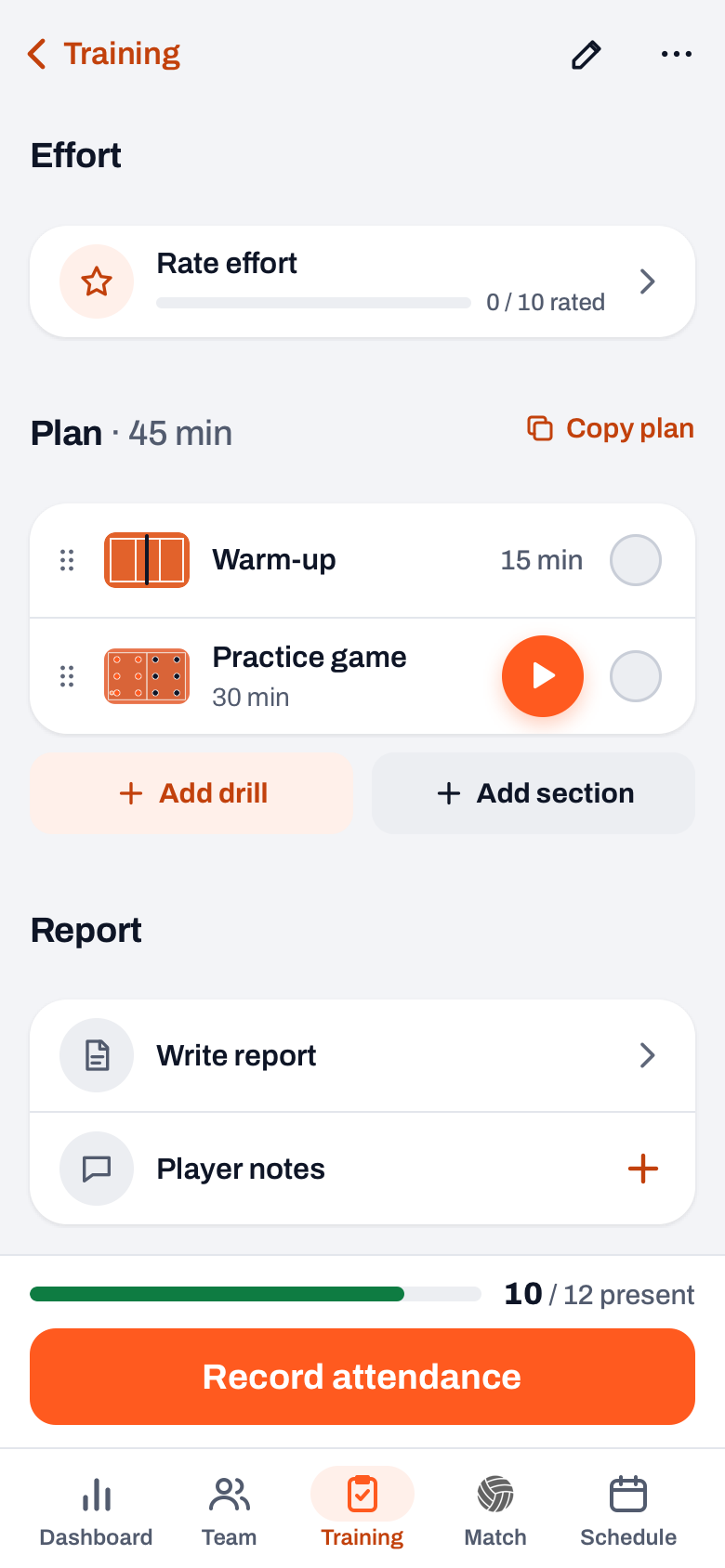
From step 5 you can also track the game as a practice game. You add the Practice game drill to the plan with + Add drill, put players in team A or B, even with fewer than six per team, and switch Rotation off for free formats. For each rally you tap which team wins the point and, if you like, who scored or who made the error. Afterwards each player's points and errors are under Practice games. That way you see over a few weeks whether the errors on the first ball are going down. What Koach costs after the 14 free days is on the pricing page.
14 days free, no credit card. Put step 1 of the series in your next practice and copy it next week with one rule less.
Plan your practice in KoachFrequently asked questions
Isn't catching bad for volleyball technique?
Not if it is temporary and you phase out the catch step by step. Catching keeps the rally alive, so players learn where to stand and who to play to. You train the technique itself alongside it in a short block. If catching stays in the game for weeks without you training the contact, players mainly learn to catch.
How many players per court in lead-up games?
Two or three a side works best for beginners: everyone touches the ball often and nobody can hide. Only when the ball goes over in three contacts in most rallies do you move on to four against four with rotation, and then to six against six.
Which ball should you use for lead-up games?
A light, soft ball, especially once players start using their forearms. A hard match ball hurts beginners' forearms and makes them cautious. For the throwing games any ball that is easy to catch will do; switch to a regular volleyball when the pass usually reaches a teammate.
Do lead-up games work for adult beginners too?
Yes, the series is the same, only moving on often goes faster because adults understand the rules straight away. Do not call it a little game but a game with a purpose, and drop the bounce step sooner. Drills for that group are in volleyball drills for adult beginners.

Put your lead-up games in your plan tonight
14 days free, no credit card. After a month you see per step who is playing the ball.
Get started with KoachOr read first what the volleyball coaching app does.