
Volleyball pressure in psi: how much air goes in a volleyball?
The short answer
Under the FIVB rules an indoor volleyball should be at 0.30 to 0.325 kg/cm²: a pressure of 4.26 to 4.61 psi, or 294 to 319 mbar (0.29 to 0.32 bar). A beach volleyball is softer, at 0.175 to 0.225 kg/cm². Measure with a ball pressure gauge once the ball is at gym temperature.
Volleyball pressure in psi is set in the rules down to the third decimal, and yet almost every club inflates its balls by feel. You notice it in red forearms and in balls that bounce off the platform like a rock. Here are the right values in every unit, and how to measure them.
What air pressure belongs in a volleyball?
The official answer is in rule 3.1 of the FIVB Official Volleyball Rules 2025-2028: the inner pressure of an indoor ball is 0.30 to 0.325 kg/cm². The rules themselves convert that to 4.26 to 4.61 psi and to 294.3 to 318.82 mbar (the same as hPa). The same rule gives the circumference of 65 to 67 centimetres and the weight of 260 to 280 grams. Those sizes, and the lighter balls for children, are covered in which volleyball size for which age.
Beach volleyball has its own rules, the Official Beach Volleyball Rules 2025-2028. There the ball is a lot softer: 0.175 to 0.225 kg/cm², or 171 to 221 mbar. A beach ball is also slightly bigger, with a circumference of 66 to 68 centimetres.
Two related rules matter just as much on match day. All balls used in one match must have the same circumference, weight, pressure, type and colour (rule 3.2). And the first referee checks the balls before the match (rule 23.3.1.1). So a ball that is clearly off can be rejected.
The pressure converted: psi, bar, mbar and kPa
Many balls show the recommended pressure next to the valve, in kg/cm² (sometimes written as kgf/cm²), in psi or in both. A ball pressure gauge usually reads in psi or bar. That is why the same values are below in all the common units. Bar and kPa are derived from the mbar values in the rules. The psi for beach is converted, because the beach rules do not give it.
| Unit | Indoor volleyball | Beach volleyball |
|---|---|---|
| kg/cm² | 0.30 to 0.325 | 0.175 to 0.225 |
| psi | 4.26 to 4.61 | about 2.5 to 3.2 |
| mbar or hPa | 294.3 to 318.82 | 171 to 221 |
| bar | about 0.29 to 0.32 | about 0.17 to 0.22 |
| kPa | about 29 to 32 | about 17 to 22 |
For an indoor ball, aim for the middle of the range, around 0.31 kg/cm² or 4.4 psi. Every ball loses some air over time, and if you inflate right at the lower limit, you will be below it a few weeks later.
How to measure and inflate a volleyball
You cannot do it by feel. The whole permitted range is only 0.35 psi wide, and you cannot feel a difference like that with your thumbs. A needle gauge therefore belongs with the ball pump. Here is how:
- Let the ball reach room temperature. Measure in the gym, not straight after the ball bag comes out of a cold car or storage room. Why is explained below.
- Wet the needle. A drop of water, or whatever the manufacturer recommends. A dry needle can damage the valve, and then the ball goes flat faster.
- Insert the needle straight into the valve. Not at an angle and without levering. Read the gauge.
- Adjust in small steps. Too soft: one or two strokes of the pump and measure again. Too hard: briefly press the release button on the gauge and measure again.
- Pull the needle straight out and put the measured ball aside, so you know which balls are done.
Do not use a compressor, like the one at a gas station. It pumps far past the limit in a few seconds, and its gauge is too coarse for a margin of a few hundredths of a bar.
Too hard or too soft: what do you notice?
A ball that is too hard comes off your forearms and fingers faster, bounces higher and hurts more. With young players that is exactly what you do not want: a player who is in pain when passing starts avoiding the ball. Setters often notice it first, because a hard ball is difficult to play softly and precisely.
A ball that is too soft feels dead. It comes off your platform slowly, you have to work harder for the same distance and when you set it stays in your hands longer. Players who train all week with soft balls spend Saturday getting used to a match ball that reacts differently. That is the real argument for a gauge: you want to train with the same ball you play with.
Why your ball is softer in winter
Air that cools down gives less pressure. Say you set a ball to 0.31 kg/cm² in a gym at 20 degrees Celsius and then leave it overnight in a car at 5 degrees. By the gas law the pressure then drops to roughly 0.24 kg/cm², well below the minimum. When the ball warms up again, the pressure comes back, as long as no air has escaped. It works the other way round too: a ball you set exactly right in a cold storage room is too hard in a warm gym.
On top of that, every ball slowly loses air through the valve and the bladder, some faster than others. A regular check catches both: at the start of the season, then every month, and before every home match or tournament day.
Tie the gauge to the ball pump. A gauge lying in a drawer in the clubhouse is one nobody uses. Tie it to the pump in the ball cart with a piece of string, with a card attached: indoor ball 4.3 to 4.6 psi. Then even the substitute coach measures.
Youth balls, light balls and the beach ball
The FIVB rules are about the match ball. Light balls and youth balls have no rule of their own in there; for those the manufacturer is the source. If such a ball shows a pressure other than 0.30 to 0.325, follow what is printed on the ball. Do not inflate a light ball harder to make it feel more real: that takes away the reason you bought it.
Never inflate a beach ball to indoor pressure. It is deliberately softer, for wind, sand and bare forearms, and at indoor pressure it becomes a hard, unpleasant ball. Which ball to choose for the sand is in choosing a beach volleyball, and which ball to buy for the gym in which volleyball to buy.
Making the ball check routine, so it does not depend on one coach
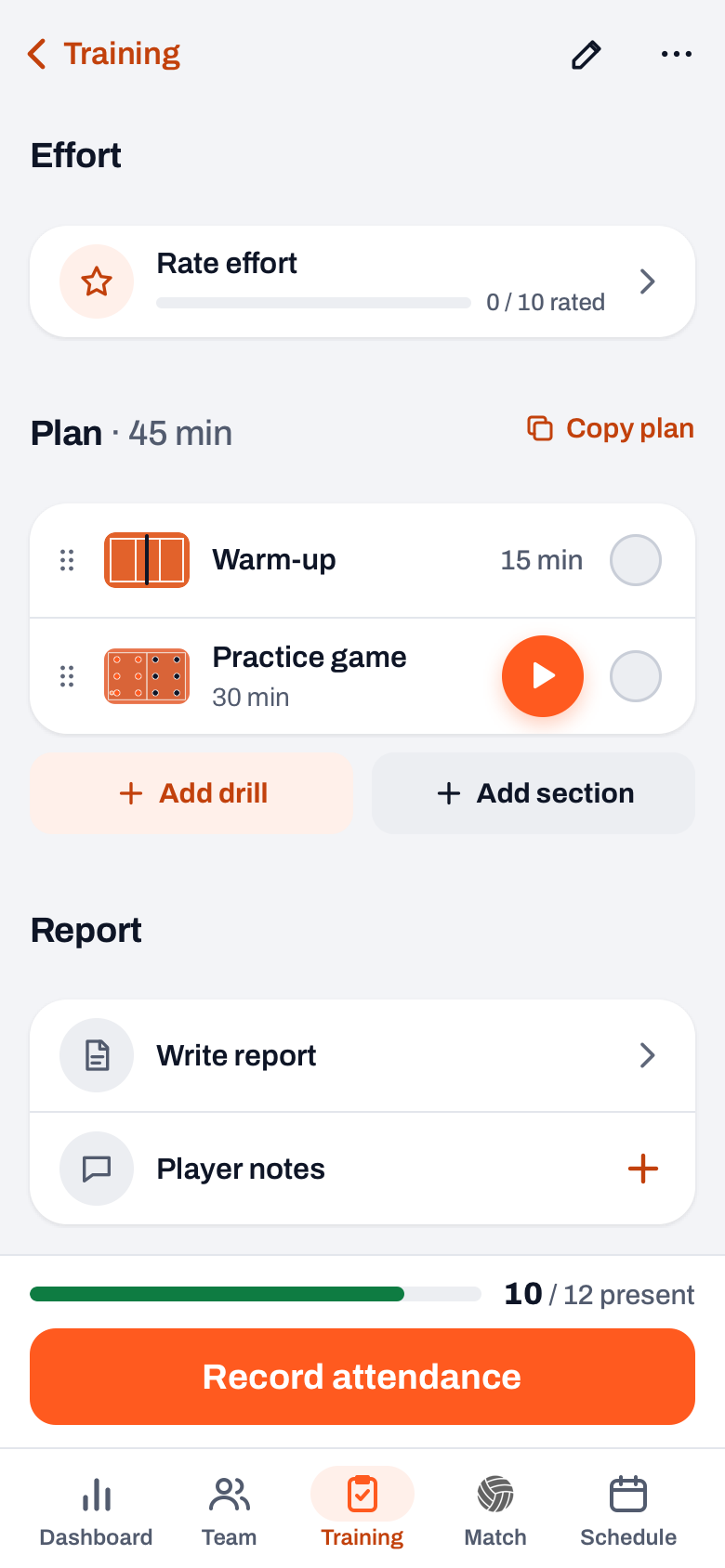
Koach does not inflate your balls. What does help is making the check a fixed part of your practice plan, so it does not only happen when the coach who remembers it happens to open the gym. In the practice detail you add a short section with + Add section, for example "Check balls" for 5 minutes, before the warm-up. With Save as template it comes back in every plan you copy from that template; how that works is in reusing your practice plan.
For away matches and tournaments the question is a different one: who brings the ball bag, the pump and the gauge? Post that on the dashboard as a Task in the announcements; whoever does it taps I’ll do it. An arrangement like that does not belong in the group chat, where it disappears under the messages; why that keeps happening is in why a WhatsApp group does not work for a volleyball team.
14 days free, no credit card. Set up your practice plan with fixed sections and see after two weeks whether it saves you work.
Try Koach with your teamWhat Koach costs after the trial is on the pricing page.
Frequently asked questions
How many psi should be in a volleyball?
Under the FIVB rules an indoor volleyball is at 4.26 to 4.61 psi, which equals 0.30 to 0.325 kg/cm². Aim for about 4.4 psi, the middle of the range, so the ball is still within the limit after a few weeks of slight pressure loss. A beach volleyball is lower, at about 2.5 to 3.2 psi.
How many bar is in a volleyball?
About 0.29 to 0.32 bar. The FIVB rules give 294.3 to 318.82 mbar, and 1000 mbar is 1 bar. Because the permitted range is so narrow, choose a gauge on which you can read hundredths of a bar or tenths of a psi.
Can you inflate a volleyball without a gauge?
Inflate it, yes; set it correctly, no. The whole permitted range is only 0.35 psi wide, and you cannot feel that with your thumbs. If you have no gauge at hand, pump in small steps and compare with a ball that was measured shortly before. Then get a needle gauge: it belongs with the ball cart.
Why does my volleyball keep going flat?
Every ball slowly loses some air, and in the cold the pressure also drops without a leak. If a ball goes noticeably flat within a few days, the valve or the bladder is usually leaking. A dry needle or one inserted at an angle can damage the valve, so wet the needle from now on and insert it straight.
Is the air pressure of a beach volleyball different?
Yes. The FIVB beach rules prescribe 0.175 to 0.225 kg/cm², or 171 to 221 mbar: about two thirds of the pressure of an indoor ball. The beach ball is also slightly bigger. So never inflate a beach ball to indoor pressure; it becomes hard and unpleasant.


Put the ball check in your practice plan
14 days free, no credit card. After a month you know whether your balls are still right.
Get started with KoachOr read first what the volleyball coaching app does.