
Teaching Kids to Set a Volleyball Without Jammed Fingers
Every youth coach knows the picture: a kid stabs at the ball with stiff, straight fingers, winces, and spends the rest of practice holding one hand against their chest. Jammed fingers are almost never bad luck — they are the predictable result of a technical fault you can see coming. Here is what goes wrong, and how to fix it step by step.
Why fingers hurt when kids set
A regulation ball weighs 260 to 280 grams and drops out of a four- or five-meter arc. If that mass lands on two or three fingertips instead of on all ten fingers at once, the entire force arrives on an area the size of a coin. The result is a sprained joint capsule: painful, usually harmless, but more than enough to make a child duck away from every high ball for the rest of the session.
Worth knowing: it is almost never a strength problem. Eight-year-olds who contact the ball cleanly with ten fingers do not end up sore. The problem is where the hands are and when they get there.
The four causes, in order of how often they show up
- The hands go up too late. The kid watches the ball, thinks about it, and only starts lifting the hands when the ball is a meter away. The fingers are still spreading out at the moment of contact.
- The hands are too low. Contact at chest or nose height instead of above the forehead. From underneath you cannot receive a ball, only stop it with your fingers.
- The fingers are straight and pressed together instead of spread into a cup. Thumbs and index fingers should form a triangle; stiff fingers mean the ball only ever touches the tips.
- Everything is done with the arms. Without bending knees, the fingers have to absorb all the give. The ball should be cushioned by legs and arms, with the hands only supplying direction.
The six-step progression
Work through this order and only move on when eight out of ten reps are good. With a group of ten kids that usually takes three to five sessions, spread over blocks of no more than eight minutes.
- Hand shape, no ball. Hands above the forehead, thumbs and index fingers forming a triangle, elbows out. Have the kids look at you through that little window: that is instantly your check on whether the hands are high enough.
- Catch above the forehead. Toss to yourself, catch with the hands in that shape above the forehead, and freeze. You walk the line and check: are all ten fingers on the ball?
- Catch and push back. Same catching action, then immediately push the ball straight back up with both arms extending. That is exactly the setting motion, just with a pause in the middle.
- Take the pause out. Toss to yourself and set the ball upward in one flowing motion, then catch it. This is where kids who are late with their hands break down first; have them shout "hands" out loud the moment the ball passes its highest point.
- In pairs. One kid throws a high arcing ball, the other sets it back, the thrower catches. Ten balls, then switch. Throwing is the hard part here: have the thrower stand close and toss genuinely high, not hard and flat.
- Rally. Set high to yourself, then to your partner. Only now does the ball stay continuously in the air.
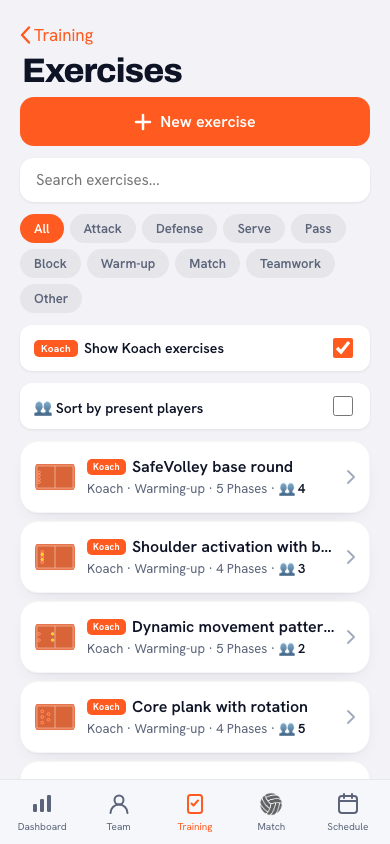
Koach ships with more than two hundred worked-out drills with animations, including this catch-and-set progression, so you can drop it straight into next week's session without rewriting anything. If you want the technique itself in full detail, that is in the article on setting technique.
Equipment and organisation do half the work
- The ball. Under ten years old, use a light or soft ball of 150 to 220 grams. That is not dumbing it down, it is safety: a lighter ball flies slower and buys kids half a second more to get their hands up.
- Toss height. Every ball goes up in a high arc, never hard. A flat, driven toss forces exactly the fault you are trying to remove.
- Group size. Two kids per ball, maximum. A kid standing fifth in a line does nothing four times out of five and loses the shape they just learned.
- Nails. Short nails, no rings. A long nail breaks on the first genuinely clean contact.
What you say from the sideline
Kids cannot process three cues at once. Use one fixed key word per block: "hands on your head", "look through your window" or "push with your legs". What does not work is the negative version: "not with your fingertips" makes a child think about precisely their fingertips. Name what you do want to see instead, and demonstrate it once in slow motion. The same holds more broadly for skill work by age group: short explanations, lots of repetition, one thing at a time.
And when a finger does go
A jammed finger gets fifteen minutes of ice and some rest; buddy-taping it to the neighbouring finger can help against bending it back during the first week. Do see a doctor if a finger is crooked, swells quickly, cannot be bent, or still hurts after a week — children have growth plate tissue in the finger bones and that is not something you want to have missed. Do not let a kid with a sore finger sit still, either: give them a role as scorekeeper or let them join in with forearm passing only, so that staying out does not become a habit. More on handling niggles sensibly is in injury prevention in volleyball.
Frequently asked questions
At what age can you start teaching kids to set?
From around eight, most children can learn the catching version and the hand shape. Setting continuously without catching usually clicks around nine or ten, which is exactly the age at which motor learning is at its sharpest.
Should I tape young players' fingers?
No, not preventively. Tape masks the problem and reduces feel in the fingers, when what you want is for a child to learn to feel where the ball lands. Tape is for recovery after a jam, not standard equipment.
Why do fingers hurt for one kid and not another?
Usually timing. Kids who bring their hands up early receive the ball on ten fingers; kids who are late catch it on two or three fingertips. Height and strength matter far less than coaches assume.


Try it yourself in Koach
Less admin, more coaching.
Get started with KoachOr read first what the volleyball coaching app does.