
How to teach kids to bump in volleyball: from catching to passing
The short answer
The best way to teach kids to bump in volleyball is in small steps: first catch the ball low, then let it bounce off a still platform of forearms, then toss and play it themselves, and only then pass back to a partner. Use a light or soft ball, work in pairs and correct one thing at a time.
How do you teach kids to bump in volleyball? Not by demonstrating it once and then putting them in a line. A child wants to grab the ball, swings the arms and plays it with the hands. Here is a progression for kids of roughly 6 to 12: from catching and bouncing to a real pass, with games and what to say about the mistakes you see every week.
Why the bump is hard for kids
When they bump, kids do something they do nowhere else: they take a ball that comes down from above low, on two straight arms that stay still. Throwing, catching and hitting are done with the hands, and that is what a child reaches for with the bump too. On top of that, a child cannot see the ball well at the moment it meets the arms down low, and a hard ball hurts the forearms. A child who got hurt twice starts dodging the ball.
That shapes the progression. First a child learns where the ball comes down and that they have to be there in time. Then that the arms form a still platform. Only after that, that the ball has to go somewhere. The technique itself, with the platform, the posture and the pass at a higher level, is in the forearm pass. Here it is about teaching it to kids.
Equipment: the right ball does half the work
- A light or soft ball. Under the rules, a match ball weighs 260 to 280 grams (rule 3.1 of the FIVB Official Volleyball Rules). For young kids a ball like that is heavy and fast. A light youth ball or a soft foam ball flies more slowly and does not hurt. Which ball is used in youth competitions varies by federation; in practice you can always go lighter.
- A balloon for the youngest. A balloon drops so slowly that a six-year-old has time to get under it. Throw away the pieces of a popped balloon right away.
- One ball for every two kids. In a line behind one tosser, a child mostly waits; in a pair, they are almost always in action.
- A low net or a ribbon. For the games, stretch a ribbon or an elastic cord just above the kids' heads, lower than a normal net. That way the ball has to go up in an arc, but a child can still reach the other side.
Teaching the bump in six steps
Only move on to the next step when most attempts succeed, and feel free to go back a step if it no longer works a week later. Each step takes a block of five to eight minutes; then you do something else and come back to it the next practice.
- Catch low. The partner tosses the ball in an arc from two meters away. The child catches it below the belly, with both arms forward and the knees bent. Catching above the chest does not count. That teaches the child to move to the ball and stay low.
- The platform. Hands on top of each other, thumbs side by side, arms straight: that is the platform. The partner drops the ball onto the platform from half a meter up, the ball bounces up and the partner catches it. The child does not move the arms. That way they feel where the ball should land: on the forearms, between the wrists and the elbows.
- Bounce and catch. The partner tosses from two meters, the child lets the ball bounce up off the platform and then catches it themselves. The child learns that the ball goes up on its own when the platform is still and the legs push a little.
- Self-toss and play. The child tosses the ball up a little, bumps it up and catches it. Then two bumps in a row, then three.
- Toss, bump, catch. In pairs, three meters apart: one tosses high and soft, the other bumps it back, the tosser catches. Tossing is the hardest part here; have the tosser stand close and really toss with an arc. Letting the ball bounce once in between gives a child who is still late a little extra time.
- Passing back without catching. Only when step 5 goes well do the two bump the ball back and forth. Then add movement: the tosser throws a meter to the side of the child, who steps first and only then plays the ball.
Kids aged six to eight often stay at steps 1 to 4 for a while, and that is fine. Older kids often move through faster, but an eleven-year-old who is new starts at step 1 too. Look at what the child does, not at their age. How to build a practice for each age group is in coaching youth volleyball by age.
Have kids freeze the platform. After each contact the arms stay still until the partner has caught the ball, like a photo. A child who swings then sees for themselves that the arms are way up. That works better than any explanation.
Games that train the platform
- The waiter. The child puts the ball on their platform and walks to the other side of the small court without dropping it. Then with an occasional small tap upward along the way. The platform learns to stay still, and it is a race.
- Hit the hoop. A hoop on the floor, the partner tosses, the child bumps the ball so it lands in the hoop. Count how many out of ten. In the Koach library the group version is Forearm pass into the hoop: nine players and a coach, nine phases, two lines that pass in turn. With young kids, make small groups instead, with a child as the tosser.
- The record. How many times can the pair bump the ball back and forth? Every practice the record goes up on a board. Kids want to see that they are getting better.
- One on one over the ribbon. A small court, the ball may bounce once and has to go over the ribbon with a bump. That is the first real game with the bump, and it can start at step 5.
- Against the wall. For kids aged ten to twelve: bumping against a wall, catching the ball after each contact or playing it straight on. In the library this is Wall passing: two players, five phases.
A game where players get knocked out does not fit here: whoever is out is no longer practicing. More game forms for this age, including overhead passing and serving, are in mini volleyball drills by level. How to teach the overhead pass without sore fingers is in teaching kids to set a volleyball.
Typical kids' mistakes, and what to say
Kids cannot remember three instructions at once. Pick one mistake and one short phrase per block, and say what you do want to see.
| What you see | What is happening | What you say |
|---|---|---|
| The ball flies far away or backward | The child swings the arms up | "Still platform, push with your legs" |
| The ball bounces off the arms at an angle | The elbows bend or the arms are apart | "Long arms, thumbs together" |
| The child hits it with the hands or a fist | They are late, the ball drops all the way to the hands | "Feet first, then arms" |
| The child plays standing upright, arms high | The knees are straight, the ball comes too high | "Sit on a little chair" |
| The child turns away from the ball | They are afraid of pain or of the ball | Softer ball, toss closer and slower |
A child who turns away does not have a technique problem but a fear problem, and an instruction does not help there. How to handle that is in helping a kid who is afraid of the ball. If kids complain about red or sore forearms, with beginners that is usually the result of the ball hitting the wrong spot; what the spot tells you and what helps is in volleyball bruises on your arms. Pain in a wrist or elbow that does not go away should be assessed by a doctor, sports physician or physiotherapist.
Passing drills for kids in Koach
The drills in the Koach library play phase by phase on a court. That helps with kids: you show on your phone or tablet where they stand and where the ball goes, instead of explaining it. If you open a drill from the plan of a practice, you go through the drills in order with Next at the bottom, with the minutes shown.
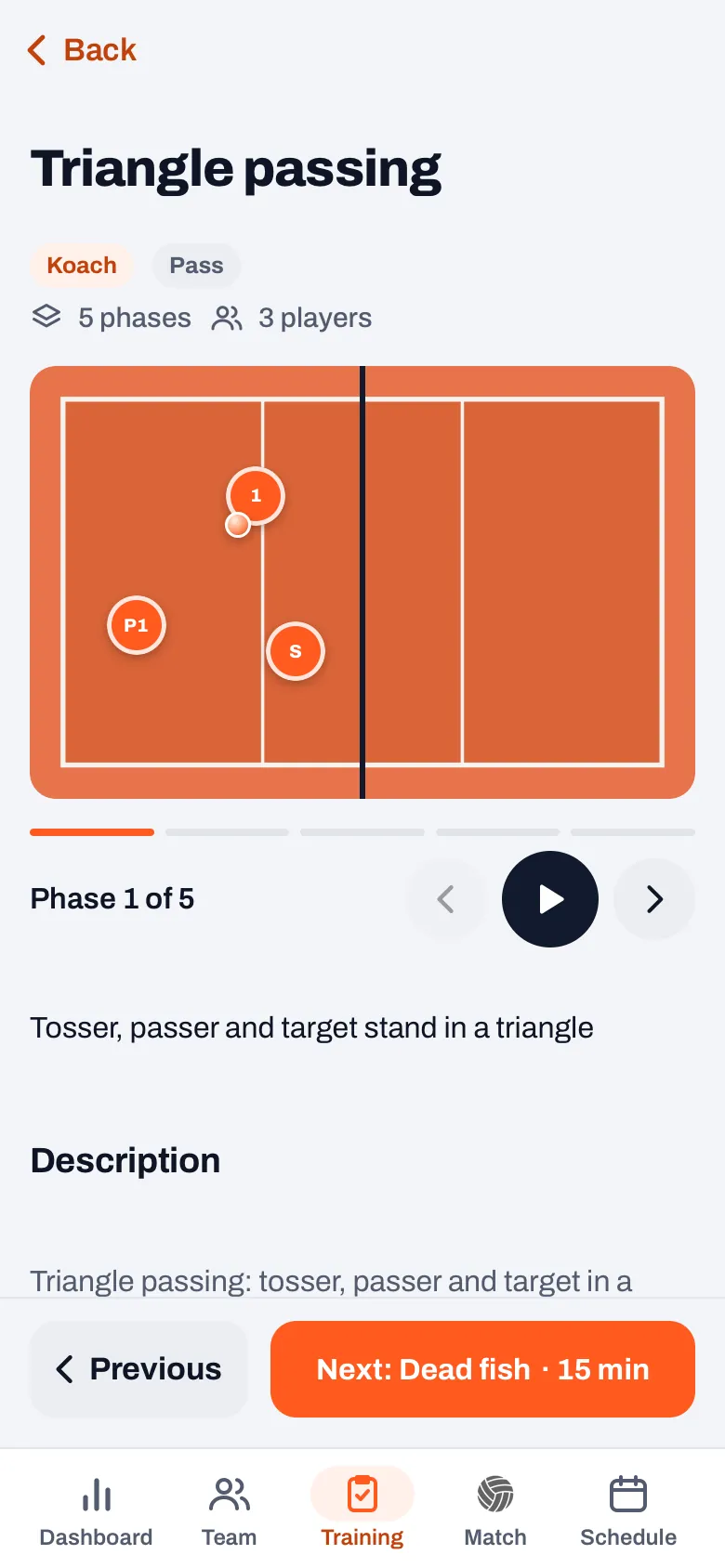
For kids aged ten to twelve, Triangle passing is a good next step: three players, five phases, with a tosser, a passer and a target, and everyone rotates after each ball. Add your own game, like the waiter, to the plan as a section with a name and minutes. If you want a child to keep practicing at home, send a drill as Homework: the player and their parents get a notification and see the drill on their dashboard, and with a tap it plays phase by phase. Parents also sign their child in or out, so you know how many pairs you will have. What Koach costs after the 14 free days is on the pricing page.
14 days free, no credit card. Set up your next youth practice and show the kids how the drill works.
Plan your youth practice in KoachFrequently asked questions
At what age can kids learn to bump?
You can start the first steps with kids of about six: catching low and letting the ball bounce off a still platform of forearms. Passing straight back to a partner usually comes later. The pace differs a lot from child to child, so look at what a child can do, not at their age. For the youngest, use a light or soft ball, or a balloon.
How long does it take for a child to learn to bump?
That depends on the child. Count in steps, not in practices: a child only moves on when most attempts succeed. Short blocks of five to eight minutes that come back every week work better than one long lesson. If a child slips back a week later, simply go back a step.
Why does my child play the ball with their hands instead of their forearms?
Usually the child is late, so the ball drops all the way to the hands and they quickly slap it away. Have them step to the ball earlier and get low, and practice the low catch and bouncing the ball off a still platform again. Say what you want to see: feet first, then arms.
Can you practice bumping at home with your child?
Yes, with a balloon or a soft ball. Toss softly and in an arc, let your child bounce the ball off a still platform of forearms and catch it themselves. Keep it short and make it a record: how many in a row? Indoors, play low and away from lamps and windows, and stop while it is still fun.

Show your youth group how the drill works
14 days free, no credit card. Every drill plays phase by phase on the court.
Get started with KoachOr read first what the volleyball coaching app does.