
Volleyball bruises on your arms: normal or a technique problem?
The short answer
Volleyball bruises on your arms are very common in the first weeks: the ball keeps hitting the same spot, often off a swinging arm or on the wrists. They fade once your platform is still and in the right place. Bruises without a clear cause or in many places at once are a matter for your doctor.
Volleyball bruises on your arms come with almost every beginner, and every parent who sees them asks whether that is okay. Usually it is: they mainly show where the ball hits you. Here you read what the bruise says about your pass, what helps and when it is better to see a doctor.
Why do you get bruises from volleyball?
A volleyball weighs 260 to 280 grams (rule 3.1 of the rules), and a serve or attack comes at you with real speed. In a forearm pass you absorb that impact with the inside of your forearms, a spot that never takes hits like that in daily life. What happens then is described by Healthdirect, the Australian government's health information service: small blood vessels under the skin are damaged, some blood leaks out and you see a red or purple mark. As it heals it turns yellow or light green, and according to the same source a bruise is usually completely gone within one to two weeks.
Beginners suffer from it most, for three reasons. They swing their arms at the ball, so the impact lands harder than it needs to. The ball often does not hit the right spot, but the wrists, the thumbs or the inside of the elbow. And someone who has just started plays more balls off their arms in a few weeks than in all the years before. You see the same in experienced players after a summer without volleyball, and in defenders and liberos who dig hard attacks all evening. For them it is mostly the speed of the ball, not the technique.
What does the bruise say about your technique?
A bruise is a print of the contact. So do not just look at whether you have bruises, but above all at where they are. The table below is coaches' practical experience, not medical research: it helps you look at your pass, not assess a complaint.
Location and cause: five patterns from practice
| Where is the bruise? | What usually happens | What you change |
|---|---|---|
| In the middle of the inside of both forearms, a few centimeters above the wrist | That is the right spot; the ball came in hard or you played a lot of balls | Nothing in the technique; build up the number of balls gradually |
| On the wrists or the hands | You are late and the ball drops all the way to your hands | Get behind the ball earlier, bring the arms together early, play the ball in front of your body |
| On one arm, or much darker on one arm | The platform is tilted, so the ball hits one arm first | Move your feet until the ball comes between your knees; for a ball to the side, drop the outside shoulder |
| In or near the crook of the elbow | Bent arms, or the ball comes too close to your body | Straighten the arms and turn the elbows toward each other; take a step back so the ball arrives in front of you |
| On the thumbs or the base of the thumb | Thumbs crossed or pointing up, hands not properly together | One hand in the other, thumbs flat and side by side |
The full story of the platform, the footwork and the most common mistakes is in the forearm pass. Where that pass fits among the other basic skills is in learning volleyball technique.
How to prevent bruises when passing
- Make one flat surface. Arms straight and together, one hand in the other, thumbs flat and side by side and the elbows turned toward each other. Then the ball hits the broad, flat inside of both forearms at once, instead of one bone or one wrist.
- Do not swing. The ball has enough speed of its own. Keep your platform still and let the little power you need come from your legs. A swinging arm makes the impact harder and the pass worse, so you lose twice.
- Feet first, then arms. If you are behind the ball in time, you play it in front of your body and between knee and hip height, where the platform is flattest. If you reach, you get the ball on the wrist or in the elbow. The stance you start from is in the ready position in volleyball.
- Build up the load. Do not start a season or a new group with a hundred hard serves. Self-tossing, short-distance passing in pairs and passing against the wall give lots of contacts at low speed; drills for that are in volleyball wall drills. Only then comes the serve from the other side, first underhand and only later hard.
- Check the ball. An overinflated ball hurts more and bounces further away. The rules prescribe a pressure of 0.30 to 0.325 kg/cm², about 4.3 to 4.6 psi (rule 3.1); how to check that without a gauge is in the right air pressure for a volleyball.
Read your arms after every practice. Red marks in the middle of both forearms, evenly spread: you are doing it right. Marks on the wrists, the thumbs or one arm: tell your coach which spot it is and ask them to watch only that for ten balls at the next practice. That turns a bruise into free feedback.
Do arm sleeves or forearm pads help?
An arm sleeve or a padded forearm protector softens the impact a little and protects the skin. That can help in the first weeks, especially with children who start dodging the ball after three practices because it hurts. The international rules allow padded protectors for protection or support, with the requirement in FIVB senior competitions that they match the color of the uniform, or are a neutral color worn the same way by all players (rule 4.5 of the Official Volleyball Rules 2025-2028). For lower competitions your own federation may have different clothing rules; more on that in volleyball uniforms and clothing rules.
Do see a sleeve as a temporary aid, not a solution. It takes away the pain, but also the signal: a player who keeps playing the ball on the wrists in a sleeve still has a pass that flies off a year later. Use it while you build up the technique, and then see whether you still need it.
What to do about a bruise, and when to see a doctor
For an ordinary bruise, cooling is enough. Healthdirect advises putting a cold pack or ice wrapped in a cloth on the spot for ten minutes, every two to four hours, during the first 24 to 48 hours. If your arm still hurts so much at the next practice that you dodge the ball, play more overhand and fewer forearm passes that evening. A player who dodges the ball drills in the wrong movement.
See a doctor if any of these apply:
- you get bruises without bumping into anything, or in places the ball does not reach;
- you bruise much faster and bigger than your teammates, or get bruises on many parts of your body at once;
- there is a lot of pain, the spot swells quickly, or you cannot move your wrist or fingers properly;
- you take blood thinners, or bleeding disorders run in your family;
- a bruise stays visible much longer than the usual one to two weeks.
Most of those warning signs come from Healthdirect and from the medical encyclopedia of MedlinePlus from the US National Library of Medicine, which also notes that blood thinners increase the chance of bruising. If you are a parent and see bruises on your child's forearms in the pattern of the pass, that is usually just volleyball. Unexplained bruises elsewhere are a matter for the doctor. Have persistent or severe complaints, such as pain in the wrist or elbow that has not gone away after a few weeks, checked by a doctor, a sports physician or a physical therapist; wrist pain when setting and passing is covered in wrist pain in volleyball.
Seeing whether your pass improves
Fewer bruises is a good sign, but the real question is whether your pass is getting better. If your team uses Koach and your coach tracks matches live, you see your errors by type under Stats on your own player profile, with Bad pass as a separate line, and on a small court per position how many errors you made there. That applies unless your coach has hidden the errors from players. Your coach can also give you a passing drill from the library as Homework; it then appears on your dashboard.
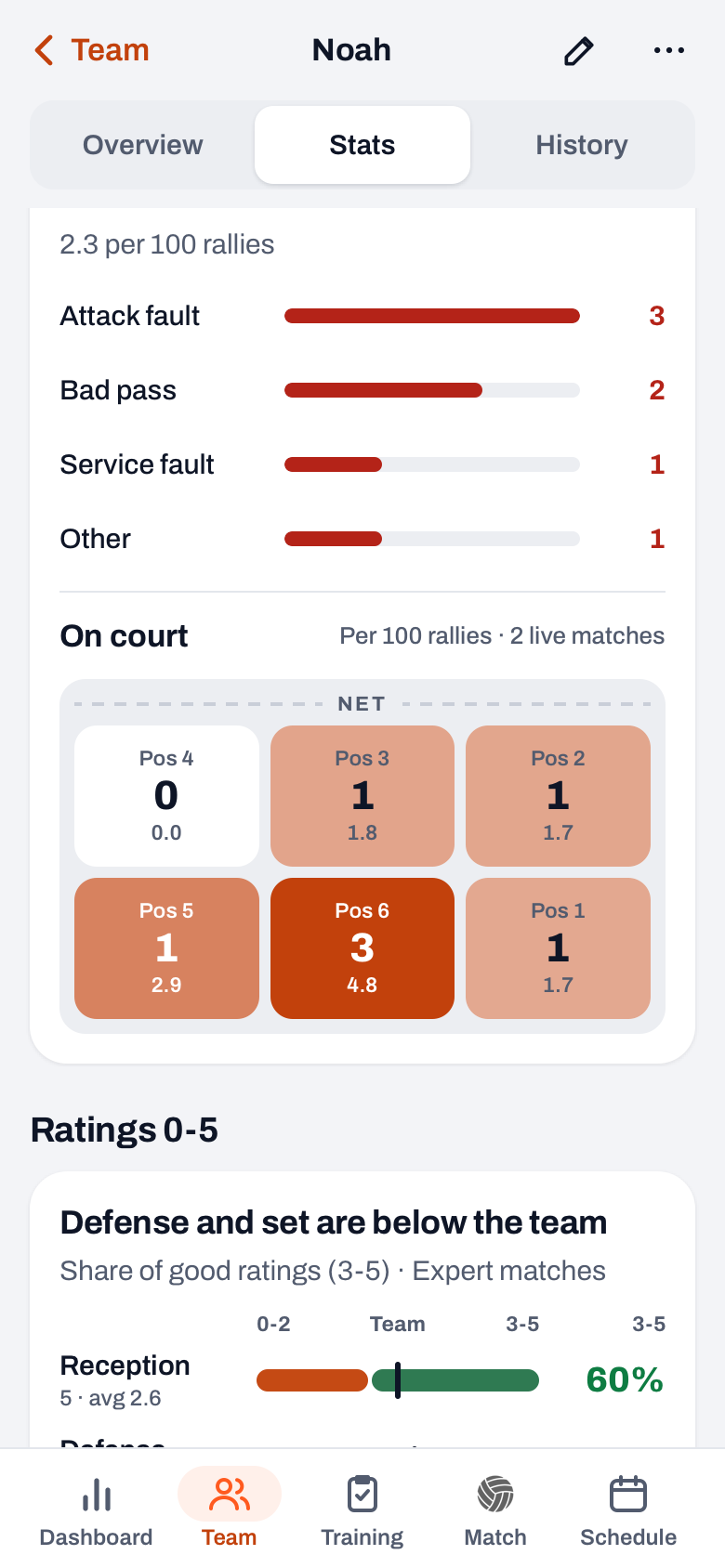
As a player you pay nothing: your account is covered by your team's subscription. Your coach tries Koach free for 14 days first; what it costs after that is on the pricing page.
14 days free, no credit card. Give your players a passing drill as homework and see after a few matches whether the bad passes go down.
Try Koach with your teamFrequently asked questions
Is it normal for your forearms to hurt from volleyball?
In the first weeks, yes. A stinging or burning pain right after a hard ball and red marks on the inside of your forearms are part of learning to pass, and they ease once your platform is still and in the right place. Have pain in a joint, such as the wrist or the elbow, that has not gone away after a few weeks checked by a doctor, a sports physician or a physical therapist.
How long does a volleyball bruise stay visible?
According to Healthdirect, the Australian government's health information service, it usually takes one to two weeks before a bruise has completely gone. First it is red or purple, then yellow or light green. If a bruise stays visible much longer, or you get bruises without a clear cause, see a doctor.
Do arm sleeves help against bruises in volleyball?
A sleeve or padded forearm protector softens the impact and protects the skin, and that can help in the first weeks. The rules allow such protectors; in top competitions they must match the color of the uniform or be a neutral color. Use one as a temporary aid: the bruises only really disappear once the ball lands on the right spot of your forearms.
Do experienced volleyball players get bruises too?
Yes, but fewer and at different moments. On an ordinary serve experienced players hardly notice, because the ball meets a still platform. Defenders and liberos who dig hard attacks do get them, as does anyone starting again after a long break. Then it is the speed of the ball, not the technique.

Track your players' passing in Koach
14 days free, no credit card. After a few matches you see whether the bad passes go down.
Get started with KoachOr read first what the volleyball coaching app does.