
Wrist pain in volleyball: setting, passing and falling
The short answer
Wrist pain in volleyball usually comes from a fall on your hand, from lots of overhead balls on a wrist that bends back too far, or from a pass that hits the wrist instead of the forearms. Have pain after a fall checked; ongoing problems go to a doctor, sports medicine doctor or physiotherapist.
Wrist pain in volleyball is less well known than a rolled ankle or a sore shoulder, but anyone who sets, blocks or dives a lot knows it. The first question is not how bad it is, but how it started: with an impact or gradually. That decides what you do. This article does not diagnose; it helps you choose the next step.
Wrist pain in volleyball: did it start with an impact or gradually?
Wrist pain in volleyball players roughly has two stories. The first starts at one moment: a fall on your hand during a dive, a hard ball against loose hands on the block, a landing where you catch yourself. The second builds up: after a week with lots of setting, after a tournament, after switching to a different ball. The first story calls for a quick check, the second for an adjustment in technique and load.
What exactly is going on can only be said by someone who examines the wrist. The UK's National Health Service lists, among other things, a fracture, a sprain, a tendon inflammation on the thumb side, a trapped nerve in the wrist and a ganglion (a smooth lump on the wrist) as possible causes of wrist pain, and advises against working out the cause yourself (NHS, Wrist pain). That applies to this article too.
After a fall or an impact: do not play on with a "sprained" wrist
During a dive, a collision or a landing backward you often catch yourself with a straight arm and an open hand. That is also how a scaphoid fracture happens, a break of the boat-shaped bone on the thumb side of the wrist. According to the American Academy of Orthopaedic Surgeons, such a fracture causes pain and swelling in the hollow at the base of the thumb, sometimes feels like an ordinary sprain, does not always show on the first X-ray, and heals worse when treated late, because the bone has a poor blood supply (OrthoInfo, Scaphoid fracture of the wrist). The same source advises having wrist pain that lasts more than a day looked at by a doctor, even if you can still play with it.
According to the NHS page on wrist pain, get medical advice straight away, from a doctor or urgent care, if any of these apply:
- the pain is severe;
- you heard a snap, crack or grinding noise when you fell;
- you cannot move the wrist or hold anything;
- your hand feels completely or partly numb.
On the sideline there is little you can do, but you can do the right things: stop playing, take off rings and bracelets before the hand swells, and keep the wrist still until someone looks at it. Taping it up and playing on is not an option: tape does not turn an unknown injury into a known one.
Pain when setting: lots of balls on a wrist that bends back too far
In an overhead set the ball pushes your hands back; your fingers and wrists give briefly before they push the ball away. That goes fine as long as the ball arrives in the window above your forehead and your legs help push. It goes wrong in four situations:
- The hands are too low. A player who sets the ball in front of their face or chest has to bend their wrists much further back. How your hands should be positioned is in overhead setting.
- The ball lands in the palm. Then the wrist absorbs what the fingers should have done.
- The set comes only from the arms. Without a push from the legs, wrists and fingers supply all the power, especially on a long set to the outside.
- Too much at once. A setter who sets hundreds of balls in one practice after a break, or a team that suddenly plays with a harder ball. Also check the air pressure of your balls: an overinflated ball rebounds harder into your hands.
What helps: hands higher, contact on the finger pads, more legs, and after a break building up the number of sets per practice gradually. With kids, a lighter or softer ball often makes the difference.
Pain when passing: the ball hits the wrist instead of the forearms
In the forearm pass the ball should land on the flat part of your forearms, a little above the wrist, with your thumbs side by side. If it hits your wrists or hands, that hurts and you get bruises. That happens when you play the ball too late or too close to your body, when your hands come apart, or when you cock your wrists up instead of letting them point calmly down. That is a matter of technique, and the fix is in volleyball bruises on your arms.
Pain when blocking, hitting and defending
- Block. If a hard attack meets loose hands, the ball pushes your wrists and fingers back. Firm wrists, spread fingers and the hands slightly forward over the net absorb that. If it is mainly the fingers, look at taping fingers in volleyball.
- Attack and serve. If your wrist hurts on the contact itself, check that you hit the ball with a firm, open hand and not with a loose wrist that snaps back. If the pain comes back with every swing, have it checked.
- Defense and diving. A player who catches every fall with one straight arm puts the whole impact on one wrist. Learn to fall with a roll over shoulder and back, or by sliding out on chest and stomach; the technique is in defense and diving.
Do not ask whether it hurts, but on which ball. Setting, passing, blocking, hitting or falling: the answer points you to the technique you need to adjust. And it is exactly what a physiotherapist or sports medicine doctor will want to know from you too.
Gradual problems: what you adjust and when to see a doctor
If the pain starts without a fall, first adjust the load: less of the action that hurts, not less of everything. A setter can do fewer sets for a week and work more on footwork and defense; a player with pain when passing adjusts their platform. Do not play through pain that gets worse during practice. A wrist brace or tape can give support with some problems, but first find out what it is. Rule 4.5 of the Official Volleyball Rules 2025-2028 forbids objects that may cause injury or give an artificial advantage, and does allow padded devices worn for protection or support. The FIVB Casebook 2025 gives a hard cast around an injured wrist as an example of what is not allowed; a padded brace is allowed, as long as it gives no extra control over the ball. In a match the first referee decides.
According to the NHS, see a doctor if the pain gets in the way of your daily activities, has not improved after two weeks of taking it easy yourself, or if you have tingling or numbness in your hand or wrist (NHS, Wrist pain). Pain that keeps coming back or gets worse should also be looked at. For athletes, a sports medicine doctor or a physiotherapist with sports experience is often the first step; how that works differs per country. With kids and teens who are still growing, the threshold is lower: their growth plates at the ends of the bones are still open and vulnerable.
Tracking wrist problems in your team
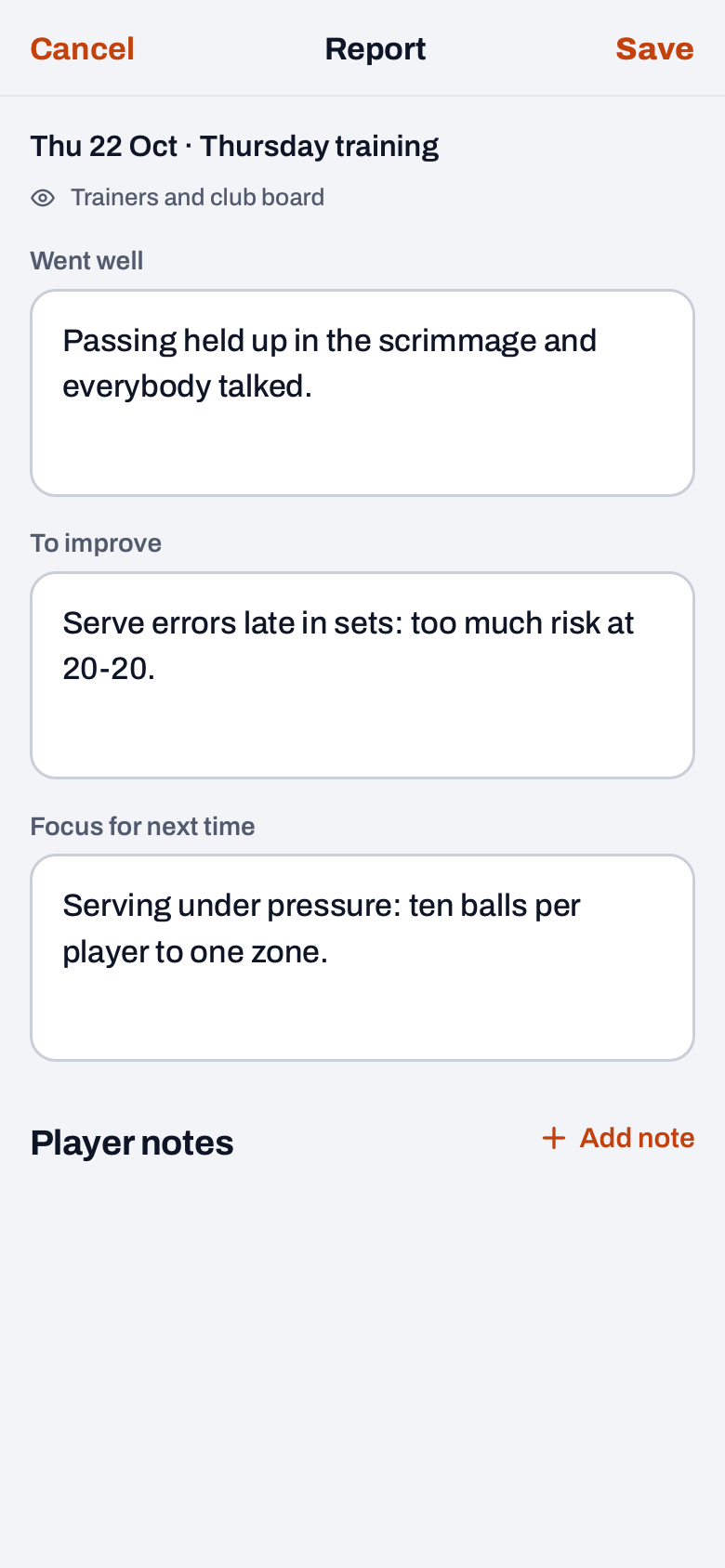
As a coach you only see a pattern once you write it down: the same setter three times in a month, or three players with sore wrists after switching to new balls. In Koach you record that after practice in the Player notes of the report, with which wrist, on which action and what you adjusted. Players and parents do not see those notes, and on the player's profile they are kept together. In the plan for the next practice you put the adjusted block for that player, so your assistant coach knows it too. If you are a new coach, starting as a volleyball coach covers what to set up from the start besides the practices.
What Koach costs after the 14 free days is on the pricing page.
14 days free, no credit card. Note after practice who had trouble where, and see after a month whether there is a pattern.
Try Koach with your teamFrequently asked questions
Is wrist pain after volleyball normal?
A tender wrist after an evening of lots of setting or after a tournament happens and usually settles within a few days. Pain after a fall, pain that keeps coming back or pain that does not ease after a few weeks of taking it easy is not normal. Have it checked by a doctor, sports medicine doctor or physiotherapist, and do not play on with a wrist that hurts on the thumb side after a fall.
Can I keep playing with a sore wrist?
Not after a fall with swelling, tenderness on the thumb side or if you cannot grip properly: have it checked first. With mild, gradual problems you can often keep training if you temporarily cut back the action that hurts. If the pain gets worse while you play, stop that practice.
Does a wrist brace help in volleyball?
A brace or tape can give support with some problems, but it does not fix the cause: poor hand position when setting or the wrong contact point when passing remains. First find out what is going on. In a match the FIVB allows a padded brace but not a hard cast; if in doubt, the first referee decides.
Why does my wrist hurt when I set the ball?
Usually because your wrist absorbs what your fingers and legs should have done: the hands are too low, the ball lands in the palm or the set comes only from the arms. Lots of sets after a break or an overinflated ball also play a part. Hands above your forehead, contact on the finger pads and more push from the legs take pressure off the wrist.

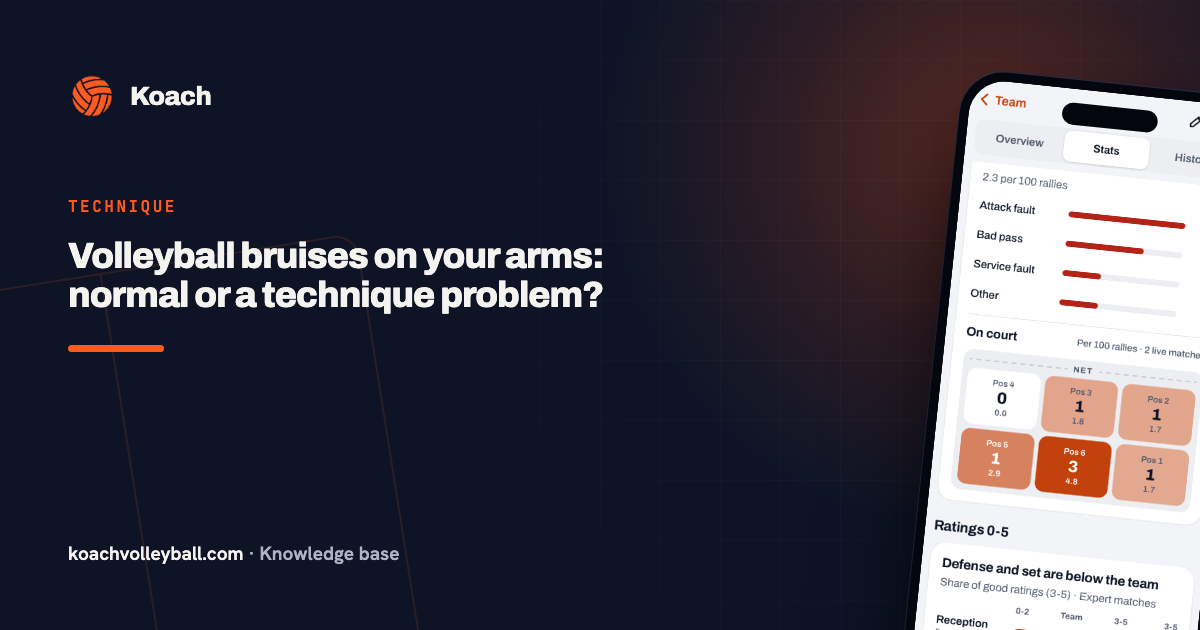

See which problems keep coming back for which player
14 days free, no credit card. After a month your notes per player are in one place.
Get started with KoachOr read first what the volleyball coaching app does.