
Finger strength for volleyball: 7 exercises for the set and block
The short answer
You build finger strength for volleyball with quick sets against the wall, setting a heavier ball, squeezing, a rubber band around the fingers and holding your weight on your fingertips, two to three times a week. It adds to technique but does not replace it: sore fingers in kids usually come from hand position.
You mostly notice finger strength in volleyball when it is missing: a set that sinks into your hands, a blocking hand that bends back. Stronger fingers do not fix a technical flaw, but they give good technique a firmer base. Here are seven exercises with sets and reps, and what you do and do not do with kids.
Why setters and blockers need finger strength
In an overhand set, the ball briefly pushes your fingers and wrists back. Your fingers give like shock absorbers and then extend again straight away, as described in overhand setting technique. If your fingers are too weak, the ball sinks deeper into your hands and the contact gets less clean; if the ball stays in your hands too long, the referee calls a lift. A setter also plays almost every second ball, so their fingers make a lot of contacts in every practice.
In the block it is the other way around: your fingers should not give but hold firm. A hard attack against spread, tensed fingers reaching over the net bounces down; against weak fingers the hand bends back and the ball goes over or past you. How your hands should sit above the net is in blocking in volleyball.
To be honest: as far as we know, how much separate finger exercises add to setting or blocking has not been studied on its own. See them as a supplement to ball work and technique, not a replacement. An overview of all the basic skills is in learning volleyball technique.
Technique first, then strength
Sore fingers are rarely just a strength problem, especially in kids. Usually the hands come up too late or too low, or the ball hits two or three fingertips instead of all ten fingers at once. Squeeze exercises will not fix that; the progression for it is in teaching kids to set. Finger exercises only help once the hand position is already right, and then mainly for players who set or block a lot: setters, middle blockers and outside hitters.
Seven exercises for stronger fingers
You do the first three with a ball, the next three anywhere, and the last one with a partner. Pick two or three per session; you do not need the whole list every week.
- Quick sets against the wall. Stand close to the wall and set the ball at a high tempo with small, short contacts above your forehead against the wall. Focus on contact with the top joints of all ten fingers, not the palm. 3 times 30 seconds, with 30 seconds of rest in between.
- Setting a heavier ball. Set a basketball or a light medicine ball straight up or to a partner a few meters away. The ball is heavier, so your fingers and wrists have to absorb more. 2 to 3 sets of 8 to 12. Only for players who already set cleanly and have finished growing; finish with ten sets with a regular volleyball.
- Holding the setting position against the wall. Place a ball above your forehead against the wall, hands in the setting shape, and press it firmly against the wall for 5 counts without your hands caving in. 6 to 8 times. This lets you feel how fingers and wrists hold firm together.
- Squeezing. Squeeze a tennis ball or a soft stress ball, hold for 2 to 3 counts and release slowly. 2 to 3 sets of 10 to 15 per hand.
- Rubber band around the fingers. Put a rubber band around your fingertips and thumb and spread your fingers as far as you can, then slowly back. This trains spreading and keeping the hand open, which you need in the block and in your setting shape. 2 to 3 sets of 15.
- Fingertip holds. Start standing against the wall, with your weight on spread fingertips, and hold for 10 to 20 seconds. If that is pain-free, do the same on hands and knees on the floor. On toes and fingertips, in a push-up position, is something for experienced, adult players.
- Blocking hands against resistance. The blocker stands with arms extended and fingers spread and tensed, at the net or against the wall. A partner pushes a ball against their hands from the front; the blocker holds firm for 3 to 5 counts without the wrists bending back. 2 sets of 6. After that you can practice it in the real movement with the Koach drill Hands over the net.
Tie the strength to the ball right away. After every set of squeezes or fingertip holds, do ten clean sets against the wall. That way what you train goes straight into your technique, and you hear right away whether the contact gets softer.
How often and how hard?
As far as we know, there is no separate guideline for fingers. The American College of Sports Medicine does advise healthy adults who are starting strength training to use a resistance at which they can do 8 to 12 repetitions, 2 to 3 times a week (ACSM, 2009). For fingers you can translate that as follows: choose a ball, band or squeeze ball with which the last repetitions feel hard but still go cleanly, and do the block two to three times a week, for example as a fixed six to eight minutes at the end of practice or at home. If it gets easy, first improve the execution or lengthen the time, and only then increase the resistance.
Your fingers may get tired; your joints should not hurt. If a finger joint hurts during or after an exercise, drop that exercise. If a finger is crooked, the player cannot bend or straighten it properly, or it stays swollen and painful, the player goes to a family doctor, sports physician or physiotherapist, and no exercise or tape will fix that. When taping does and does not help is in taping fingers in volleyball.
Finger strength in kids: what to do and what not
Strength training for kids is fine if the form suits their age and someone supervises; the international guideline on that is in strength training for young athletes. For fingers that means:
- Do: squeezing a soft ball, a rubber band around the fingers, quick sets against the wall with a light ball, fingertip holds standing against the wall. As a game: who can keep the ball up the longest with small sets?
- Don't: setting with a basketball or medicine ball, fingertip holds in a push-up position, and anything that hurts. That guideline stresses qualified supervision and a gradual increase in resistance.
Kids and teenagers who are still growing have growth plates in their finger bones. So a finger that swells after a knock or keeps hurting is something you have checked sooner than you would with an adult.
The finger block in your practice
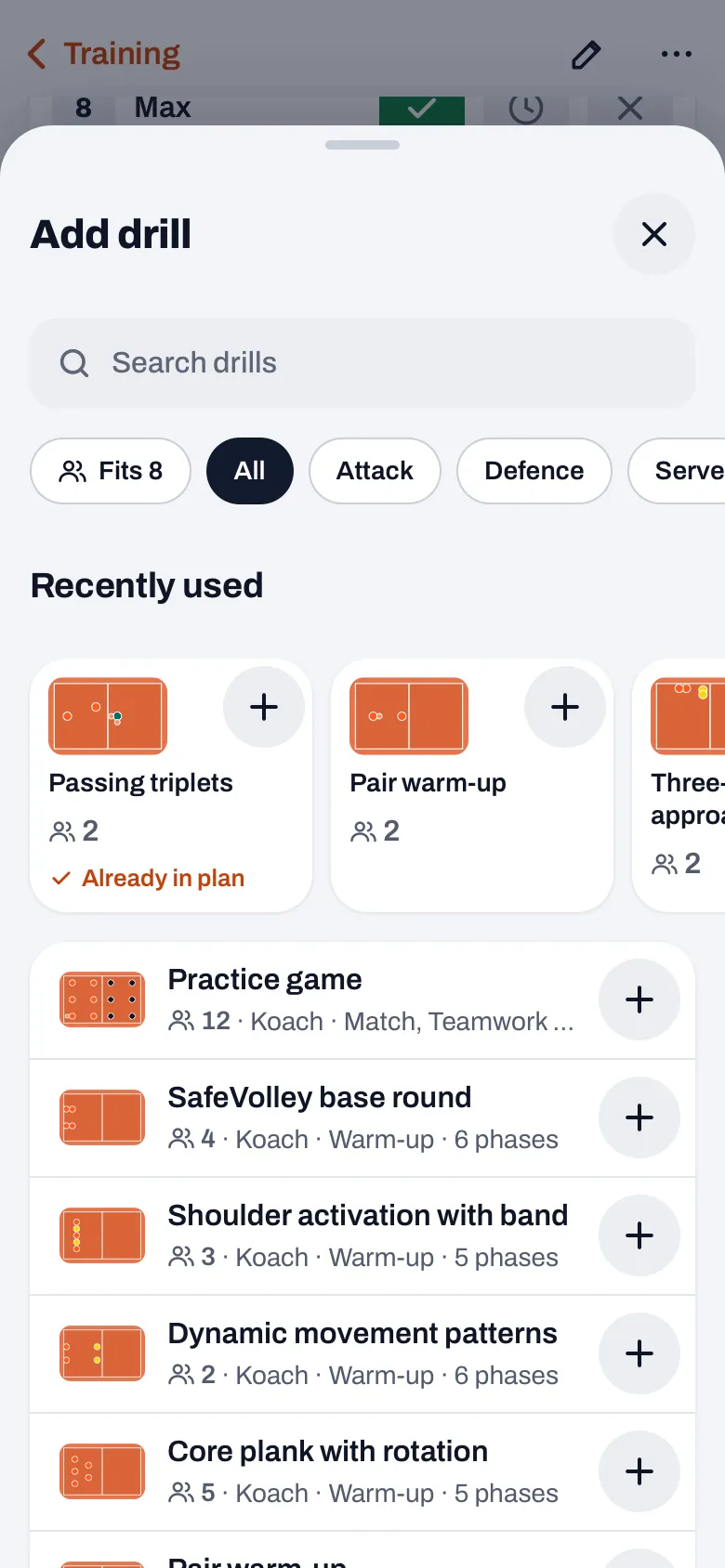
A finger block only works if it comes back every week. In Koach you put it in a practice plan with Add section, with a name such as "Fingers and hands", a duration of six to eight minutes and the exercises in the description. With Copy plan you bring it back at the next practice. With Add drill you search the library for an animated drill, such as Hands over the net for your blockers.
For home, turn the squeeze and band exercises into a drill of your own. Open it under Training in Drills and tap Homework at the bottom; in the Assign as homework sheet you pick the setters and middle blockers, or Everyone. The chosen players and their parents get a notification.
14 days free, no credit card. Put a finger block in your next practice and assign the home exercises as homework.
Plan your practice in KoachWhat Koach costs after the trial is on the pricing page.
Frequently asked questions
How do you make your fingers stronger for volleyball?
With a fixed block of six to eight minutes, two to three times a week, using two or three exercises from this list: quick sets against the wall, holding the setting position against the wall, squeezing a ball, spreading your fingers against a rubber band and fingertip holds. Experienced, adult players can also set a heavier ball. Choose a resistance at which the last repetitions feel hard but still go cleanly, and tie it straight to clean sets.
How often should you train finger strength?
Two to three times a week is a good starting point. There is no separate guideline for fingers, but the American College of Sports Medicine gives 2 to 3 sessions a week for healthy adults starting strength training, with a resistance at which you can do 8 to 12 repetitions. For fingers that fits as a short block at the end of practice or at home. Fingers may get tired; joints should not hurt.
Can kids do finger exercises for volleyball?
Yes, in a light, playful form: squeezing a soft ball, a rubber band around the fingers, quick sets against the wall with a light ball. Heavier balls and fingertip holds in a push-up position are not part of it. When kids have sore fingers, the cause is usually hand position, not a lack of strength, so look at technique first.
Which exercise helps most for stronger blocking hands?
Blocking hands against resistance: the blocker keeps their arms extended with fingers spread and tensed, and a partner pushes a ball against their hands from the front while they hold firm for 3 to 5 counts. The rubber band around the fingers trains the spreading. After that you practice it in the real movement, with the hands pressing actively over the net; strength only helps if timing and hand position are right.
Put a finger block in your next practice
14 days free, no credit card. Plan the block and assign the homework.
Get started with KoachOr read first what the volleyball coaching app does.