
Volleyball training equipment: what do you really need?
The short answer
Good volleyball training equipment starts with enough balls (about one for every two players), a properly hung net, flat cones and pinnies. After that, targets such as hoops, a block pad, resistance bands and an agility ladder add a lot. A spike trainer or ball machine only makes sense once that base is in place.
Volleyball training equipment is best bought once and bought well, but the catalogs are full of tools you rarely use. Here is what each piece of equipment adds to a practice, in what order to buy it, what you can make yourself for next to nothing, and how to use it safely.
What do you need at minimum for a volleyball practice?
A good practice runs on four things: enough balls, a net that hangs properly, something to mark zones and something to split teams. Everything after that is a bonus. If you train fifteen players with two balls, no tool will make up for the ball contacts you lose.
- Balls. The number of balls decides how often a player touches the ball. For most drills, count on about one ball for every two players, and for a serving block one ball per player, otherwise half the group is waiting. A ball that is too hard or too soft spoils every drill; how to measure it is in the right air pressure for a volleyball.
- A ball cart or a large ball bag. When the coach hits or tosses balls in, the cart stays within reach. A ball you have to fish out of a closed bag costs tempo, and in an attack or defense drill, tempo is the whole drill.
- Flat cones. Flat markers that lie on the floor are what you use on the court: for zones, starting points and target areas. Nobody rolls an ankle on them. Tall cones only go outside the running lines, as a turning point in a running drill.
- Pinnies in two colors. With those you make two teams for a game in ten seconds, and as a coach you see at a glance who belongs with whom.
What belongs in your own bag, such as a whistle, a first aid kit and something to draw on, is in what a volleyball coach needs. This article is about the equipment you build drills with.
Training equipment by goal: what each tool adds
Don't buy equipment because another club has it. Buy it because it makes a drill better that you already run. This is how the common tools relate to what you train:
| Tool | What you use it for | What to watch for |
|---|---|---|
| Hoops or small mats | A target for serve, pass and set, with a count | Remove them before anyone jumps; a hoop on the floor is slippery |
| Block pad (hand block) | Attacking against a block, learning to hit past or over hands | The holder stands firmly, on the floor or on a stable platform |
| Sturdy platform (box) | Attacking or tossing balls in from above the net as a coach | Only a box with a non-slip base, never a chair or a bench |
| Spike trainer | Repeating arm swing, contact point and jump timing without a setter | Only useful once the approach is solid |
| Agility ladder and low hurdles | Footwork, rhythm and the steps of the approach | Keep it short and sharp, then go straight to the ball |
| Resistance bands | Shoulder stability and warming up the hitting arm | Check them for small tears before you hand them out |
| Medicine ball | Throwing and rotating for power in attack and serve | Light enough that the movement stays clean |
| Tennis balls | Reaction, hands and hand-eye coordination, also for youth | Pick them up after every drill, so none rolls under a foot |
| Tarp or sheet over the net | A blind net: the ball suddenly comes over the net, which trains reaction | Fasten it firmly, don't let it hang down to the floor |
Three of these tools have their own article with drills: agility ladder drills, resistance band exercises and medicine ball exercises.
What to buy first? An order for any budget
On a limited budget this order works. Only move to the next step when the previous one is in place:
- Balls, until you have one for every two players. Every extra ball means more ball contact for everyone, every practice.
- Flat cones, pinnies and a few hoops. Little money, and every drill gets a target and a count. A pass that lands in the hoop tells a player more than "nice one".
- One or two block pads and a set of resistance bands. Attack training gets more realistic, and the shoulders get a fixed place in the warm-up.
- An agility ladder, low hurdles and a medicine ball, if you also run the physical part yourself in the gym.
- Only then a spike trainer or a ball machine. They are expensive, bulky and need storage space. When a machine pays off and when a coach with a ball cart does just as well is in a volleyball ball machine.
We leave out brands and prices: they differ too much by country and by store. First look at what is in the equipment room. Often the problem is not that there is too little, but that nobody knows what is there, or that half of it is broken.
Make it or borrow it: equipment that costs next to nothing
- Target zones with tape. Tape a box on the floor as a target for the serve or the pass. The box is flat, so nobody trips on it. Ask the facility manager which tape is allowed, because some floors keep residue.
- An empty ball cart as a target for the set. Whoever plays the ball into it from the setter's position scores. It forces a high, calm set.
- A rope or elastic cord between two posts as a low net for youth or for small courts next to the main net.
- An old sheet or tarp for the blind net from the table.
- Borrowing from the gym or the school. The storage room of a school gym often has mats, benches, hoops and light balls. Ask whether you can use them, and put them back the way you found them.
Lay out the equipment in the order of your plan. Put a small pile for each drill along the sideline, in the order you run the drills. Switching between two drills then takes seconds instead of minutes, and players don't cool down while you look for cones.
Using equipment safely in the gym
- Clear loose balls. A player who lands on a rolling ball after a jump can roll an ankle. Agree on a fixed rule: if a ball rolls onto the court, the drill stops until it is out. And after every drill the balls go back in the cart.
- Keep the zone at the net clear. Hoops, cones and block pads that are not in use lie outside the court, not under the net where players land.
- A platform must be stable. As a coach, only stand on a box made for that purpose, with a non-slip base.
- Check worn equipment. A band with a small tear can snap, a medicine ball with a crack leaks. Take it out of circulation.
- Agree who tidies up and who carries. Who takes the bags to an away match or locks the storage room after practice is a recurring discussion in many teams. That kind of agreement quickly gets lost in a group chat; why that keeps happening is in why the WhatsApp group gets stuck for a volleyball team.
Putting your equipment in your practice plan
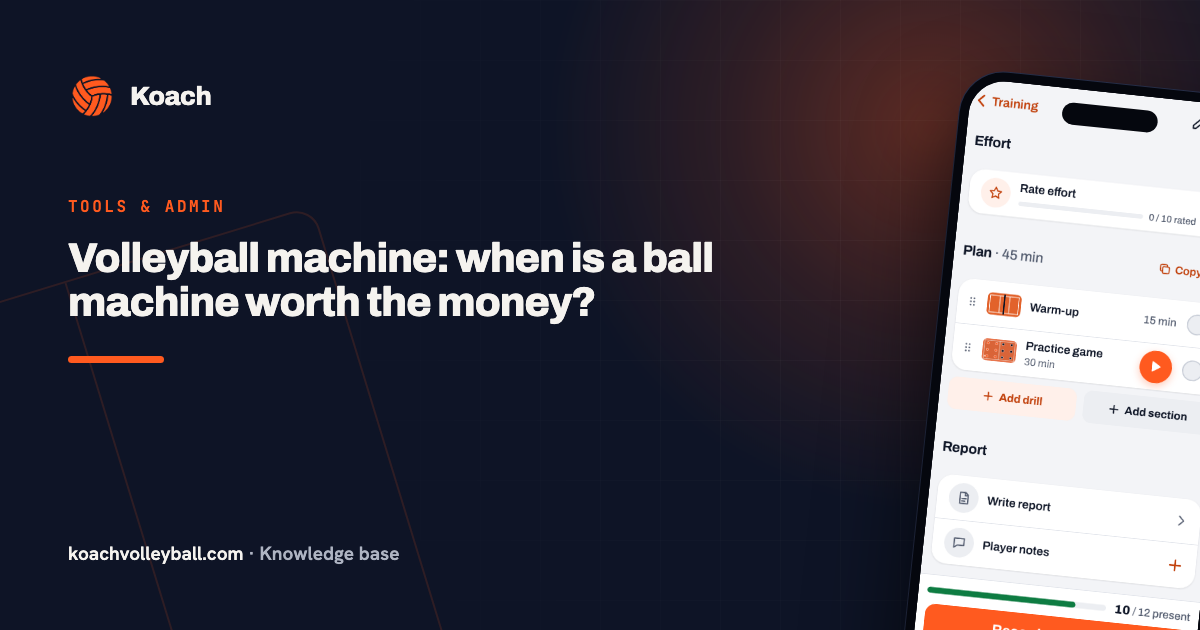
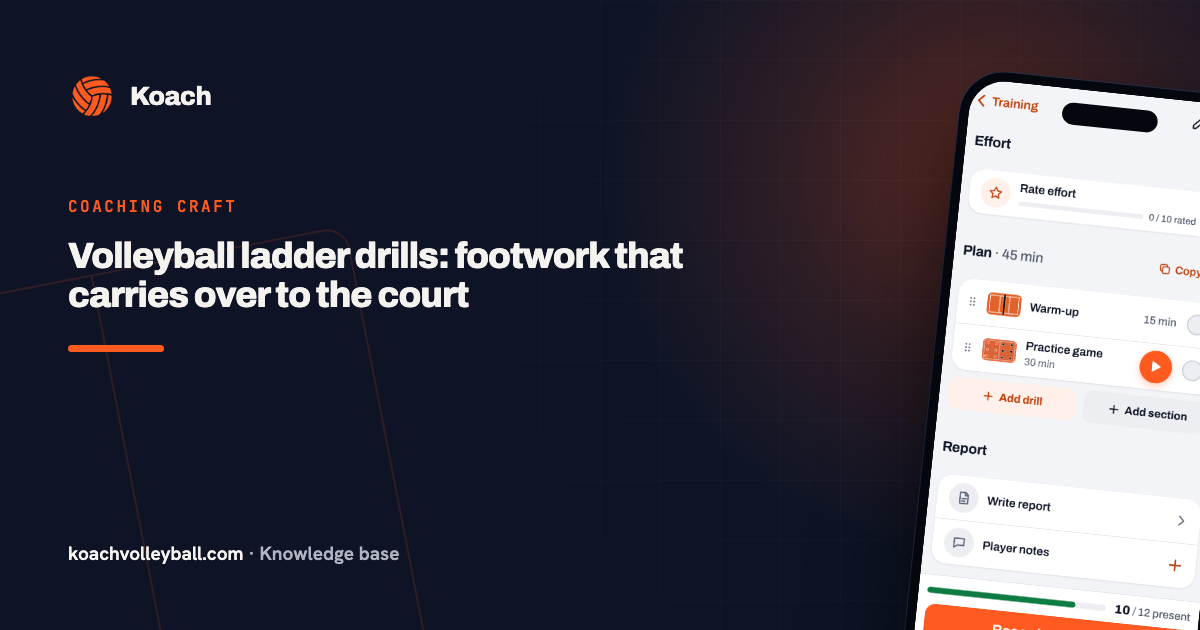
Koach doesn't lay out cones for you, but it does help you know in time what you need. In the plan of a practice you add drills from the library with + Add drill, or you create your own block with a name and duration with + Add section. For a new section you tap Add description; if you tap a section that is already in the plan, the Description field is right there. That is where you note what needs to be ready, for example "six hoops, two block pads, ball cart at the net". That way the equipment list sits where you read it the night before anyway.
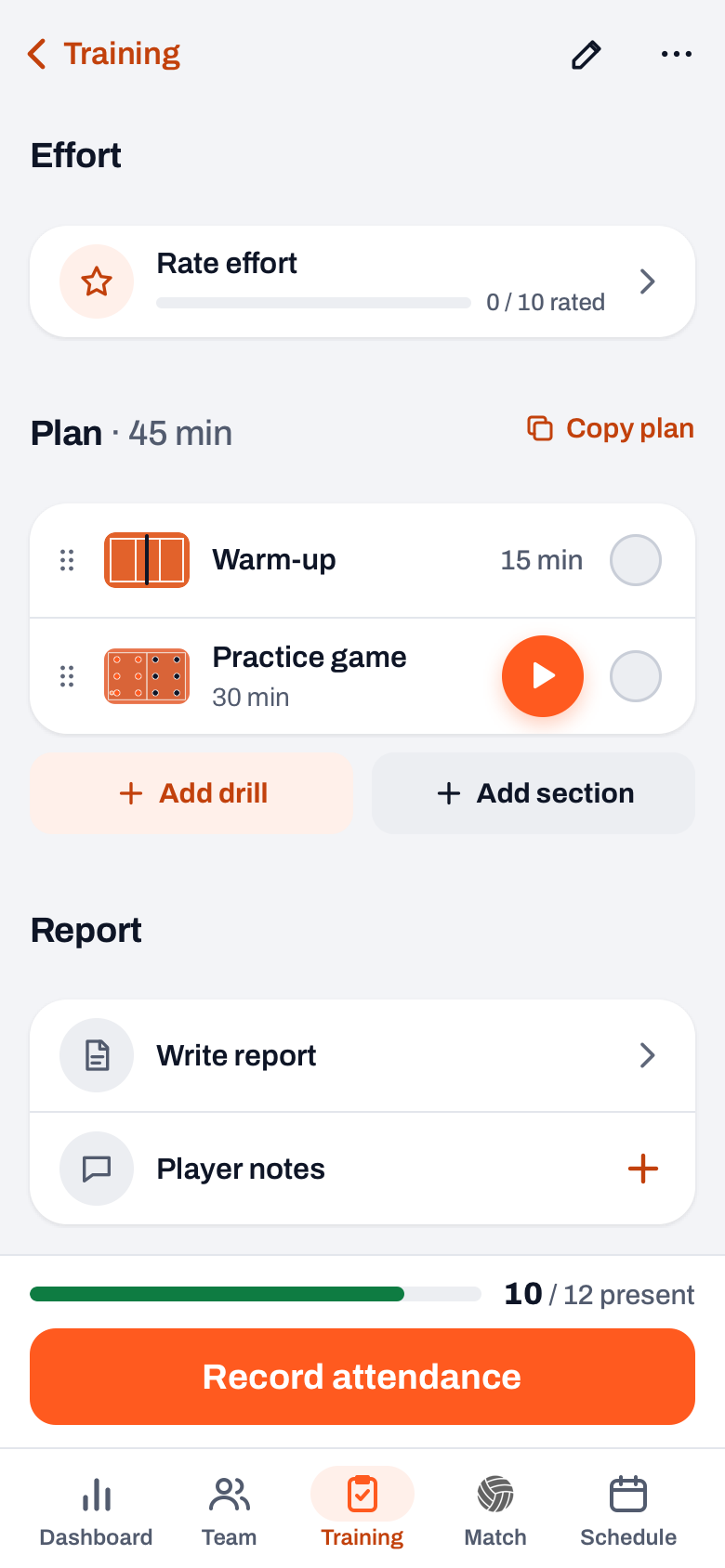
If you create a drill yourself, in the drill editor under Place you can put a Cone, Hoop, Mat, Bench or Ladder on the court next to players and balls. The setup of your equipment is then in the animation, and a fellow coach who uses the drill sees right away where everything goes. With Present players first under Filter and sort you see which drills fit the number of players that evening, and so how many balls and groups you need.
14 days free, no credit card. Put your next practice with the equipment list in the plan and see whether setting up goes faster.
Plan your practice in KoachWhat Koach costs after the trial period is on the pricing page.
Frequently asked questions
What is a block pad in volleyball?
A block pad is a firm pad with handles on the back, often shaped like two blocking hands. A coach or player holds it above the top of the net, so hitters learn to hit past, over or off a block without a blocker having to jump every time. It is also used to have defenders react to a ball that deflects off the block.
Which cones do you use in volleyball?
On the court you use flat markers: they mark zones, starting points and target areas, and nobody rolls an ankle on them. Tall cones only go outside the running lines, for example as a turning point in a running drill during the warm-up. Cones in two colors make it easy to keep two zones or two teams apart.
Is a spike trainer worth it?
Only if your players already have a solid approach and you often run an attack block. A spike trainer holds the ball still at hitting height, so a player can repeat arm swing, contact point and jump timing without a setter. For beginners and most recreational teams, the same money spent on extra balls and a block pad adds more.
What training equipment do you need for youth volleyball?
Lighter balls that suit the age group, a lower net or a tight rope, flat cones, hoops as targets and tennis balls for reaction and hand games. With young kids what counts most is that everyone gets lots of ball contact, so rather many light balls than expensive equipment. A ball machine or spike trainer is rarely needed for youth players.
Put your equipment in your practice plan
14 days free, no credit card. After a week everything is ready before the players walk in.
Get started with KoachOr read first what the volleyball coaching app does.