
Volleyball machine: when is a ball machine worth the money?
The short answer
A volleyball machine is worth the money if you have many players per coach, players who can handle a consistent hard ball, and several teams using it every week. It is strong for repetition in passing, defense and setting; it won't teach players to read a server or attacker.
A volleyball machine promises what every coach wants: the same ball a hundred times, while you stand next to your players and watch. That is true, but only for part of what you train. Here you read what a machine does better than a coach, what it can't do, when it is worth the money and what to ask before you buy.
What does a volleyball machine do?
A ball machine fires the ball out at an adjustable speed, height and direction, often with spinning wheels. With some machines you feed each ball in by hand, with others a hopper refills automatically. Some also deliver balls from above, like an attack; others only low and flat, like a serve.
That means you mainly train four things with it: passing a serve, defending hard-driven balls, setting off a consistent pass and playing free balls. So a machine is a tool for repetition, not for the game itself.
Where a ball machine beats a coach
- The same ball every time. If you want to groove a technique, many nearly identical reps help. A coach who hits fifty balls hits fifty different ones; a machine doesn't.
- More balls per minute. A machine doesn't get tired and doesn't have to bend down for the next ball. In ten minutes a player gets far more touches than in a line behind one coach.
- Your hands free to coach. If an assistant or a player feeds the machine, you stand next to the player who is passing and see the feet, the platform and the angle of the arms.
- Saving coach and players. A coach who hits hundreds of balls off a box every week puts a load on their shoulder. Researchers who looked at the use of such machines in fast ball sports name reducing injuries in players and coaches as an important reason to use them (Pinder et al., 2011).
What a machine can't do
A player receiving a serve looks at much more than the ball. They see how the server tosses, where the shoulder points and how hard the arm comes through, and start moving before the ball is over the net. A machine doesn't give that information: the ball comes out of an opening, with no body behind it. Pinder and colleagues point out that players move differently against a machine than against a real opponent, because that information is missing, and that you therefore choose deliberately when a machine fits and when it doesn't (Pinder et al., 2011). Their work is about other fast ball sports, but the principle holds just as well at the net.
- It won't teach reading. To read a server or an attacker you need people who serve and attack.
- Not every serve can be imitated. A float without spin, with its fluttering path, or a jump serve with heavy topspin can't be produced by every machine. Ask, and preferably see it in action first.
- Beginners get little out of it. Players who can't control the ball yet learn more from a soft, tossed ball that you adjust to them.
- Someone has to run it. Without a hopper or a helper, the coach feeds the machine instead of feeding balls, and then the biggest advantage is gone.
| What you want | Ball machine | Coach feeds | Players serve |
|---|---|---|---|
| The same ball often | Yes | Fairly | No |
| Learning to read | No | Partly | Yes |
| Coach can watch | With a helper | No | Yes |
| For beginners | Limited | Yes | Limited |
| Cost | Purchase and upkeep | None | None |
When is a volleyball machine worth the money?
A machine earns its money back in hours of use, not in the first few weeks of enthusiasm. It is worth the money if most of these five points are true:
- Many players per coach. One coach with twelve players and no assistant gets more out of it than a team with two coaches and ten players.
- Players who can handle a consistent hard ball. Older youth and adult players who already have a stable pass and are working on their technique under pressure.
- Several teams use it, every week. Say four teams each use it twice a week for twenty minutes: that is over two and a half hours a week, and 80 hours over a thirty-week season. If it is switched on for one team twice a month, you are counting a fraction of that.
- It can stay in the gym. A machine that has to come out of a car every time gets used less. Arrange a spot in the storage room and one person who looks after it.
- There is someone to feed it. An assistant, an injured player or a player rotation; or a model that refills itself.
If most of these don't hold, you usually get more out of the same money with extra balls and a second ball cart. If the machine is a big expense for the club, you can make it a concrete goal for a fundraiser.
Try it before you buy. Ask a club that already has one whether you can watch a practice or borrow it for an evening. After one practice with your own players you know whether you would use it every week or whether it would end up in the storage room.
Questions before you buy or rent a ball machine
- What do you want to train with it? Passing, defense, setting or balls from above: not every machine can do everything, and a stand for balls from above is sometimes an extra part.
- Which speeds, heights and directions? And can it deliver a ball without spin, the basis of a float?
- Which balls go in? Does it work with the balls you play with in your league, and do they wear out faster? See also which volleyball to buy.
- Mains power or battery? How long does a battery last, and is there a power outlet near the court?
- Weight and transport. Can one person move it, does it fit in a car, and is there room in the storage room?
- Noise and safety. How loud is it in a gym with other teams, and is there a remote control so nobody stands in front of the opening while refilling?
- Warranty and parts. Are parts and service available in your own country, and what does upkeep cost per year?
Put the answers from two or three suppliers side by side. Prices and specifications vary widely by model and by country; so compare on what you want to train with it, not on the feature list.
Cheaper ways to get more reps
- More balls and a ball cart. The cheapest cure for waiting in line. What other training equipment exists, from cones to a spike trainer, is covered in volleyball training equipment.
- Groups of three with their own ball. A tosser, a passer and a catcher who rotate. More touches per minute than one line behind the coach.
- Players serve to each other. The serve-pass format that is closest to a match, and the servers get their training in at the same time.
- Players feed. Have players hit balls from a box or bench, in a fixed rotation. The tempo is lower than with a machine, but it costs nothing and your hands are free.
What else belongs in a coach's bag, from whistle to pump, is covered in volleyball coach essentials.
The machine in your practice plan
A machine shared by several teams only works with fixed agreements: which team uses it when, who charges the battery and where it goes after practice. Put those agreements somewhere everyone can find them, and not in a group chat where they vanish under two hundred messages; why that goes wrong is covered in why the WhatsApp group gets stuck.
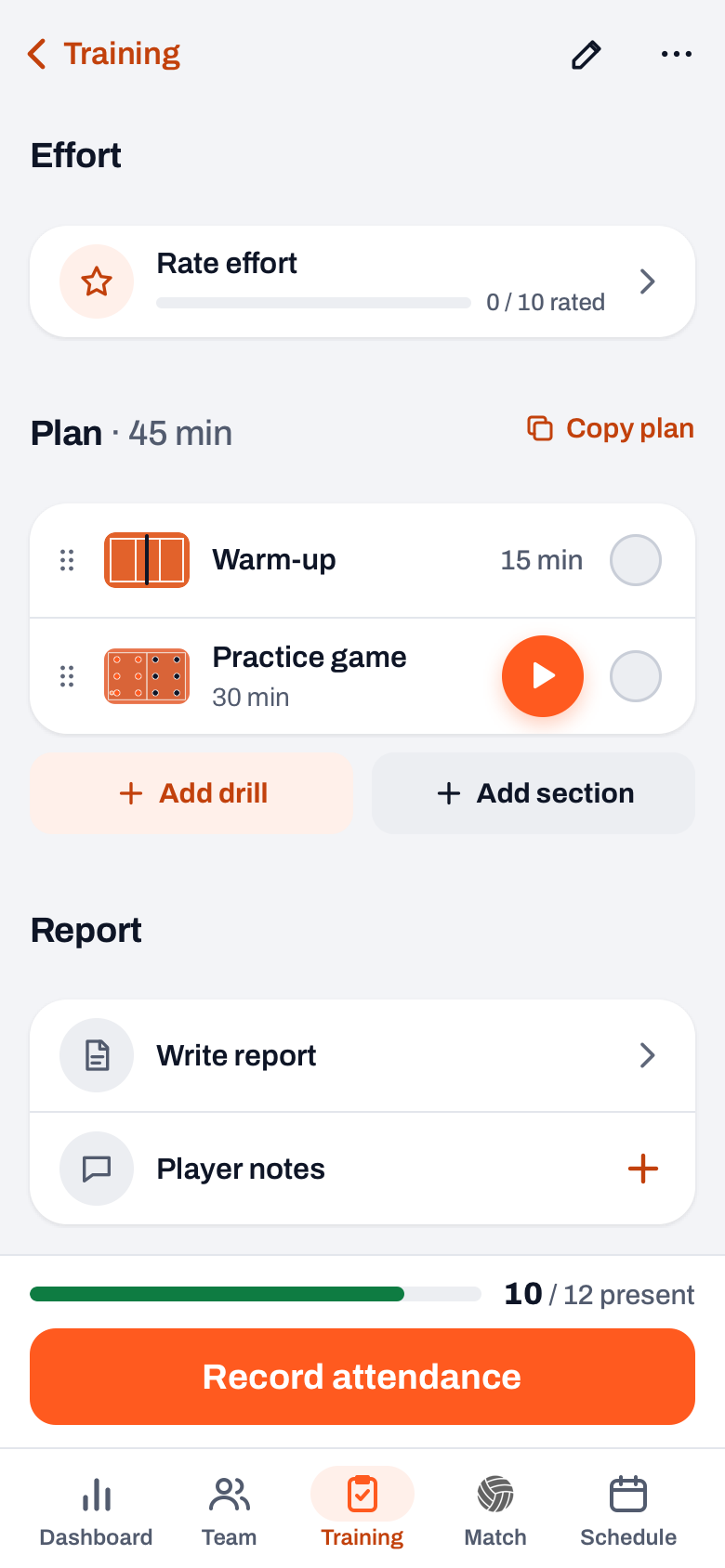
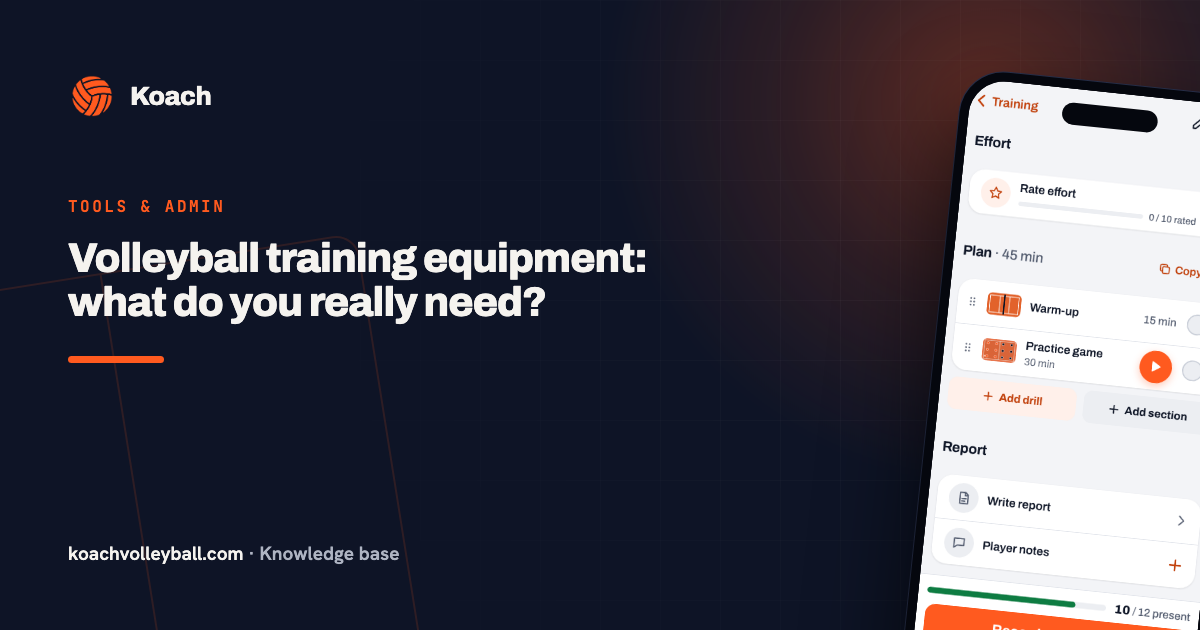
In your own practice you add the machine block in Koach as a section in the plan, with + Add section: a name, the duration and in the description the setting, the groups and who feeds the machine. A drill from the library you add with + Add drill. If the block worked, you take the plan over to next week with Copy plan. Koach doesn't keep track of equipment and doesn't control a machine; the plan just makes sure the block isn't forgotten.
What Koach costs after the 14 free days is on the pricing page.
14 days free, no credit card. Put your machine block or your passing drill in Tuesday's plan and bring it back next week with Copy plan.
Plan your practice in KoachFrequently asked questions
Is a ball machine suitable for youth teams?
For young players and beginners usually not. They learn more from a soft, tossed ball that you adjust in height and tempo for each player. With older youth players who have a stable pass, a machine can help to get a lot of reps. Then set it to a low speed and always have an adult run the machine.
Can you train serve receive with a ball machine?
You can train passing technique with it: the same ball every time, so you can work on feet, platform and angle. What you won't learn is reading the server, because a machine gives you no toss, shoulder or arm to look at. So alternate machine balls with real serves from teammates.
Can you rent or borrow a ball machine?
Often you can. Ask nearby clubs that have one, your regional association or a supplier that offers trial periods. Borrowing one for an evening with your own players tells you more than a product video: you see whether the tempo, the noise and the setup fit your gym and your team.
How do you use a ball machine safely?
Nobody stands in front of the opening while the machine is on or being refilled; use a remote control if there is one. Start at a low speed and only increase it once players have the ball under control. Place the machine so other teams in the gym don't walk into the line of fire, and switch it off when it isn't in use.

Put your next machine block in the plan
14 days free, no credit card. Next week you copy it with one tap.
Get started with KoachOr read first what the volleyball coaching app does.