
Volleyball curriculum: free club template, and how to track it
The short answer
A volleyball curriculum sets out what players learn at each age, what every team trains and how you assess them. Below you can download a free template in Word and PDF. Whether the curriculum actually happens in your teams is what Koach Club shows: the Team log lists each team's session plan, what was done and the coach's report.
Writing a volleyball curriculum is the easy part; seeing it happen in the gym is the hard part. Here you can download a free club template in Word and PDF with a pathway by age, training content and assessment, and read how to check, team by team, whether the curriculum is being followed.
Download the volleyball curriculum: free template in Word and PDF
First, what you probably came for: a club curriculum you can start on right away, free and without leaving an email address, in two versions:
- Download the volleyball curriculum template (PDF): to print and fill in by hand. Six A4 pages in portrait, with your principles, a pathway by age, training content, assessment, a checklist per team and an assessment sheet per player.
- Download the volleyball curriculum template (Word): the same curriculum as a .docx, to adapt to your own age groups and teams.
You are free to use, copy and adapt the template.
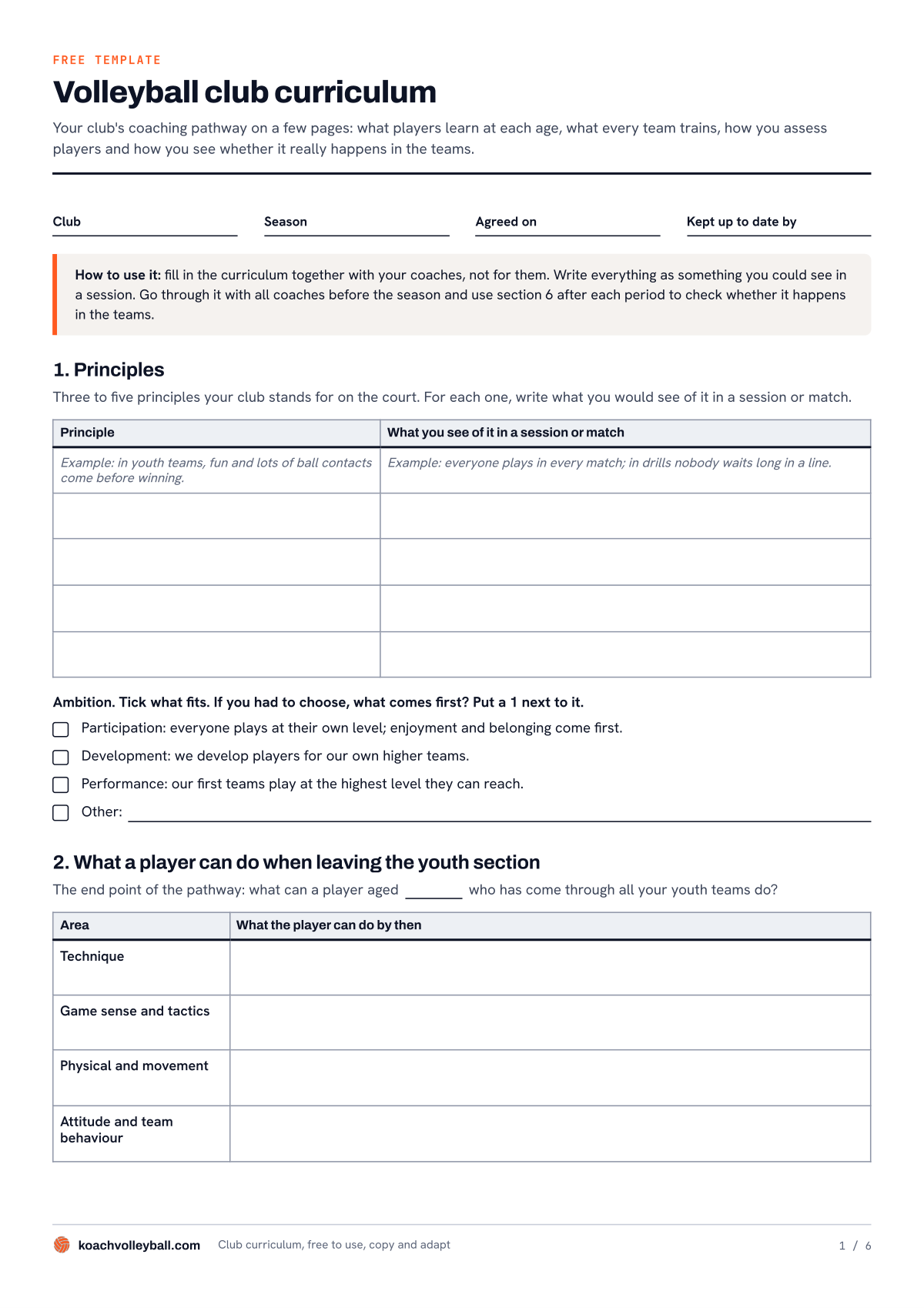
Page 1 of the PDF: the principles with an example, the ambition to tick and what a player can do when leaving the youth section.
What goes into a volleyball curriculum?
A club curriculum is your coaching pathway on paper: what a player learns with you from their first session to their last youth season, what every team trains to get there and how you track whether it works. Money, gym time and volunteers belong in the club's overall development plan. The template has six sections:
- Principles. Three to five sentences on what your club stands for on the court, each with what you would see of it in the gym. Below that you tick your ambition: participation, development or performance.
- What a player can do when leaving the youth section. The end point, split into technique, game sense and tactics, physical and movement, and attitude and team behaviour.
- Pathway by age. Six rows for your age groups, each with the game format and the same four areas, and at most three things per area that you can see in a session. What suits each age is covered in coaching youth volleyball by age group.
- Training content. For each age group: sessions per week, minutes per session, the fixed parts of every session and where the drills are kept. Next to that, a theme per period, shared by all teams of the same age at the same time. How to split a season into blocks is explained in the season plan for volleyball training.
- Assessment. A 1 to 4 scale for every point in the pathway, from "not yet" to "also works in a match, under pressure", plus the moments in the season, who assesses, what the player hears back and what you look at when a player moves up to a higher team.
- Is it happening in the teams? A checklist with twelve rows: for each team, whether there was a plan in advance, whether the theme was visible, whether there is a report and whether the assessment was on time, marked Y, P or N. Below it you agree how often someone goes to watch.
An appendix adds an assessment sheet per player: eight points from the pathway for their age, with a score, notes and an agreement for the next period. A more detailed form with its own scale is in the volleyball player evaluation form.
How to fill in the template
- Start at the end point. Fill in section 2 first and work the pathway backwards from there. Start with the youngest group and you end up with a list that leads nowhere.
- Write down what you can see. Not "good passing" but "passes a tossed ball with the forearms back to the tosser". What you can see, you can check later.
- Fill it in with your coaches, not for them. Then they see their own work in the pathway and actually use it. Take the game format for each age from your national federation. Who signs off the curriculum, and when, is covered under the technical committee.
- Pick five periods, each with one theme per age group. A handful of themes everyone knows works better than a list nobody remembers.
- Agree how you will check. Under section 6, fill in how often someone visits and where coaches record their session plan and report. That last point decides whether you can complete section 6 without calling round every coach.
Why a volleyball curriculum often stays in the binder
The problem is rarely the content. It is that a few weeks into the season nobody can see any more whether the curriculum is happening in the gym.
- You don't see the sessions. Whoever looks after the curriculum often coaches a team on the same evenings. With ten teams, one visit per team per period already fills your calendar.
- What was done isn't written down anywhere. The session plan lives in the coach's head and the report is a quick text to the assistant coach.
- Coaches change. A new coach gets the curriculum, but not what their predecessor already covered.
- Every coach starts from scratch. The theme is the same for all teams, but everyone comes up with their own session for it.
How Koach Club shows whether the curriculum happens in your teams
We make Koach, an app for volleyball coaches and their club, so read this part as an explanation of our own product. Koach does not write your curriculum and does not put your pathway into the app. What it does: coaches record for each session what they planned and what happened, and with the Club subscription the club's leadership reads along, team by team.
What the coach records for each session
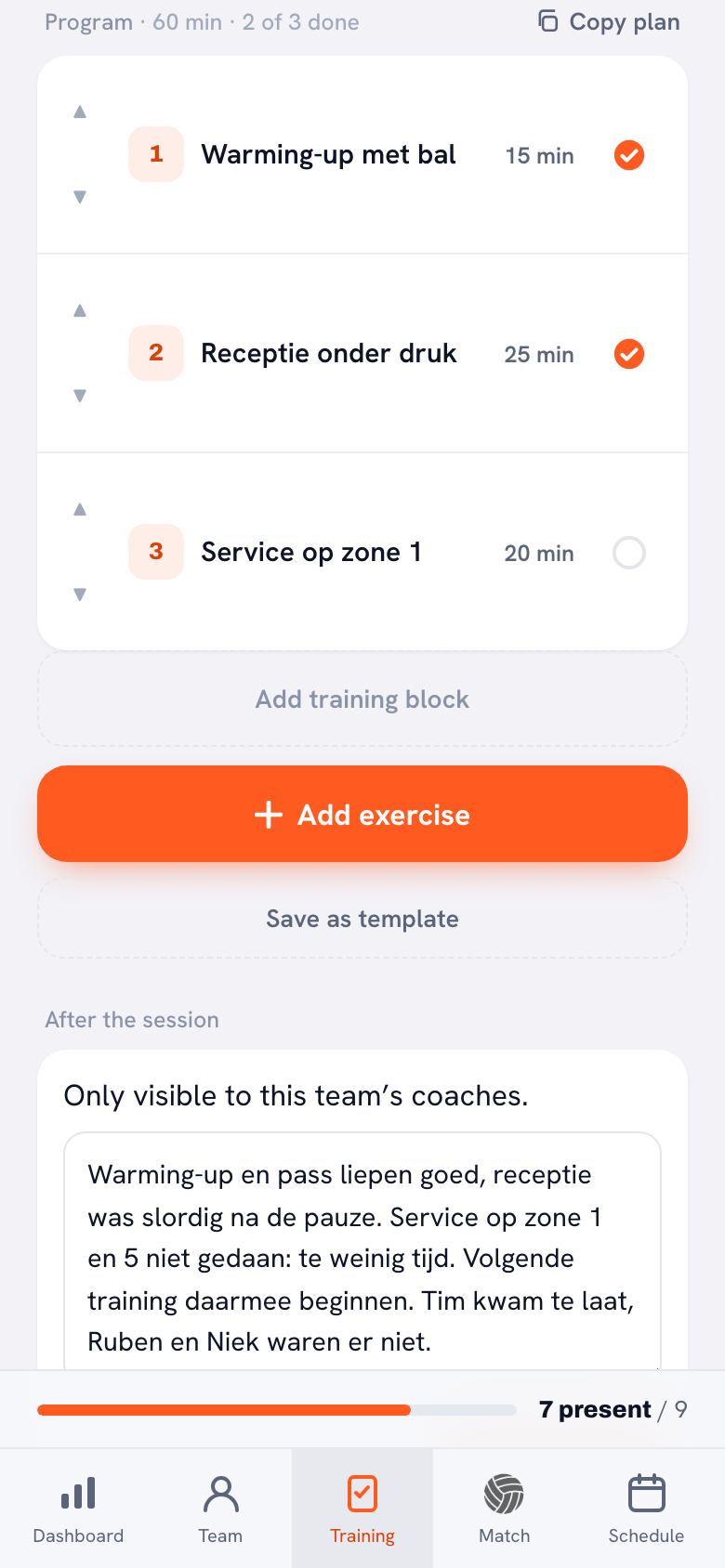
On the Training tab the coach builds the session in blocks, each with a name and a duration. When scheduling the session, or later via Edit, they fill in the Focus / note field: that is where the theme of the period goes. Afterwards they mark each block Done, Partly done or Not done, and under After the session they write a short report and the Focus for the next session. That report is visible to the team's coaches and, if the team belongs to a club, to the club's leadership.
We set up Koach Club together with you. Club has no free trial: leave your details through the form on the clubs page, and we get in touch and set up your teams and coaches with you. Coaching a team yourself? Then you can start in the app right away.
Book an intro call Start with your own teamThe Team log: three of the four questions from section 6
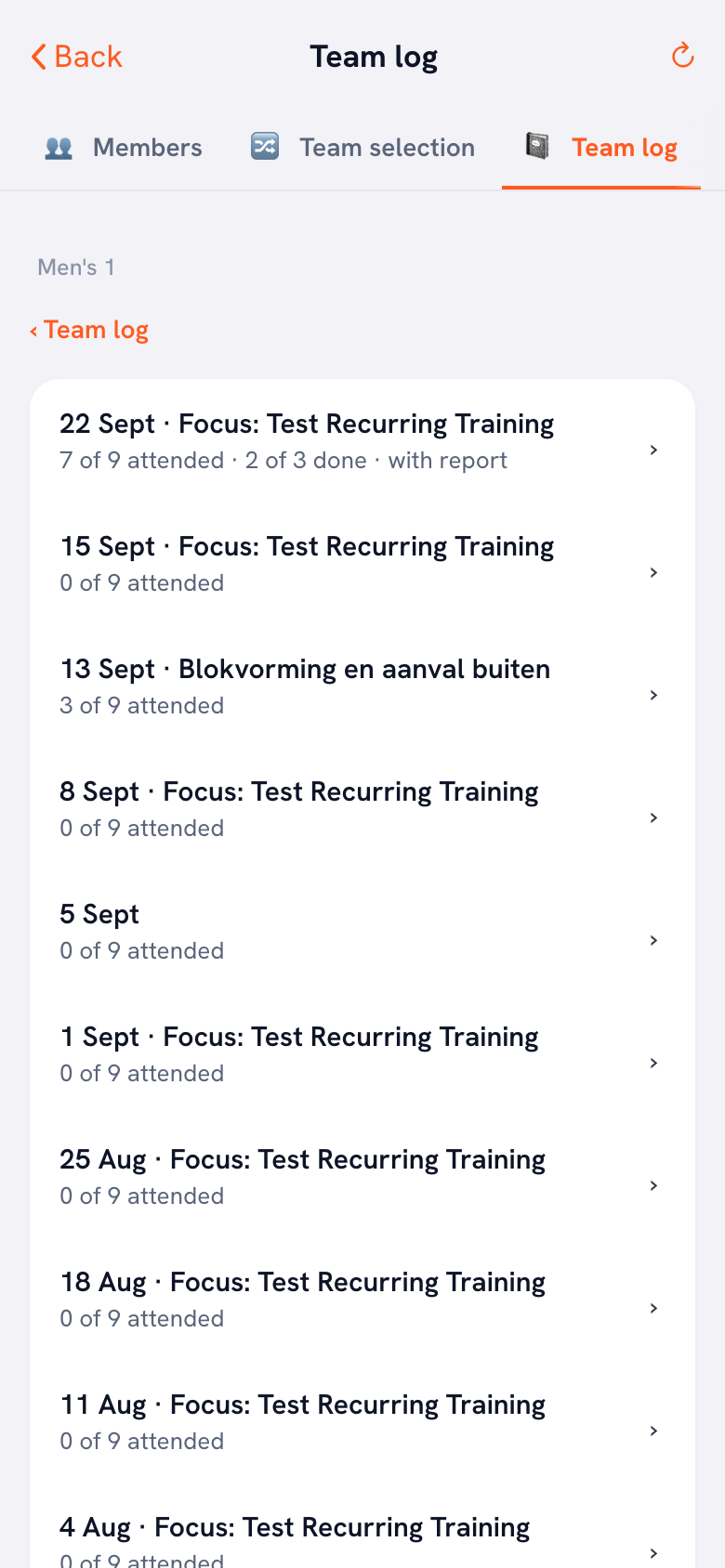
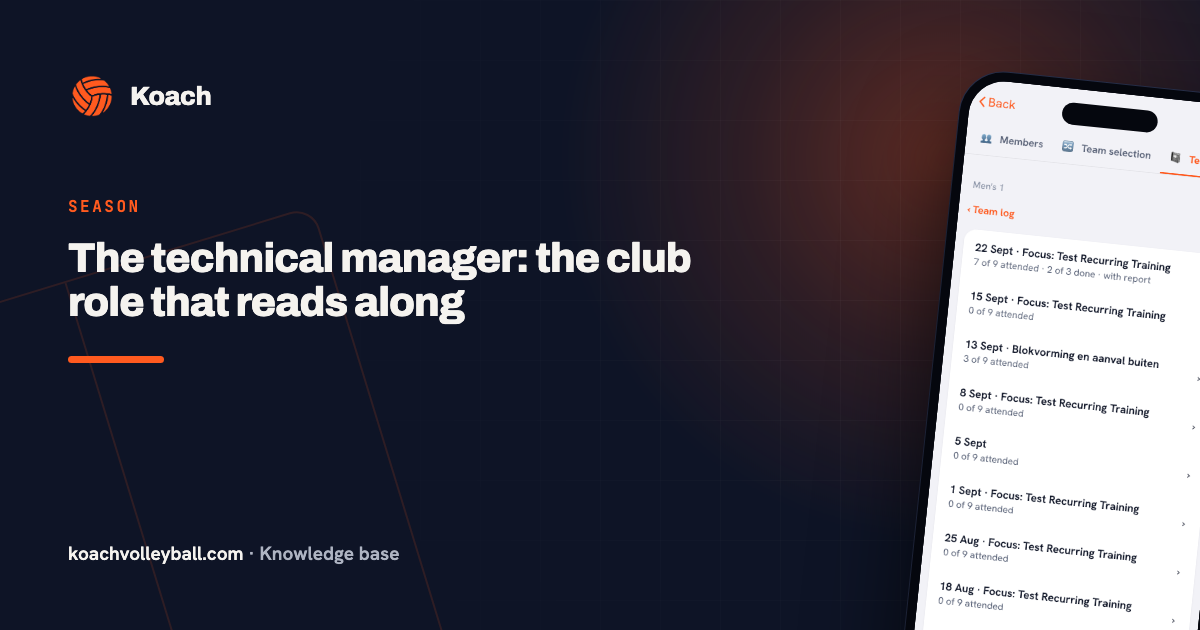
The club dashboard has a Team log tab. For each team you see the last twelve sessions held, newest first, with the date, the focus, how many players attended, how many blocks were done and whether there is a report on every row. Open a session and you read the plan with the done status, the report and the coach's notes on players. Show older sessions takes you further back, and planned sessions show how many blocks are already prepared. The club manager, the board and the technical manager, the club role that reads along in the teams can all read along without changing anything.
Hold it up against the checklist from the template: Plan made in advance shows in the blocks that are ready, Theme visible in the focus and what was done, and Report after session is right there. Only Assessment on time stays a manual job.
Signals: which teams to look at first
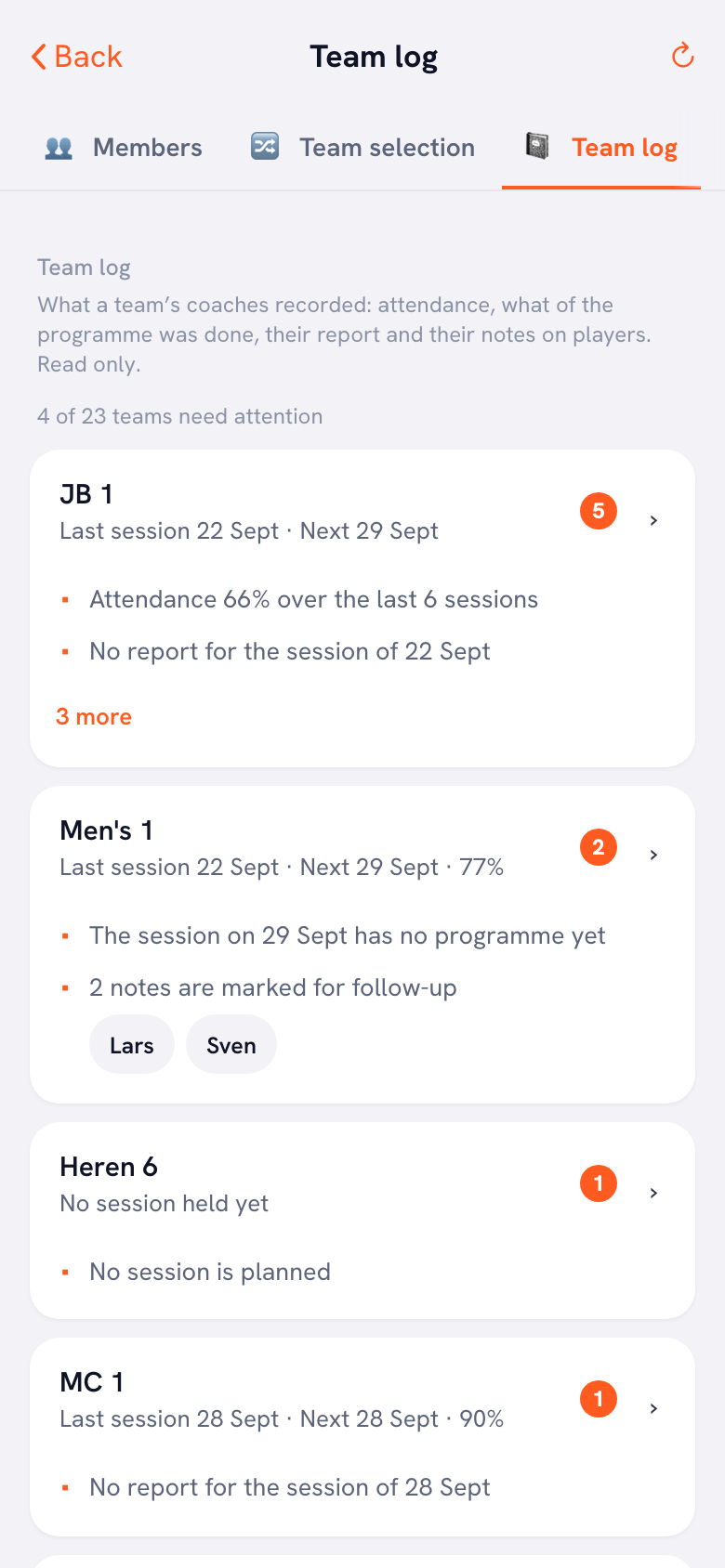
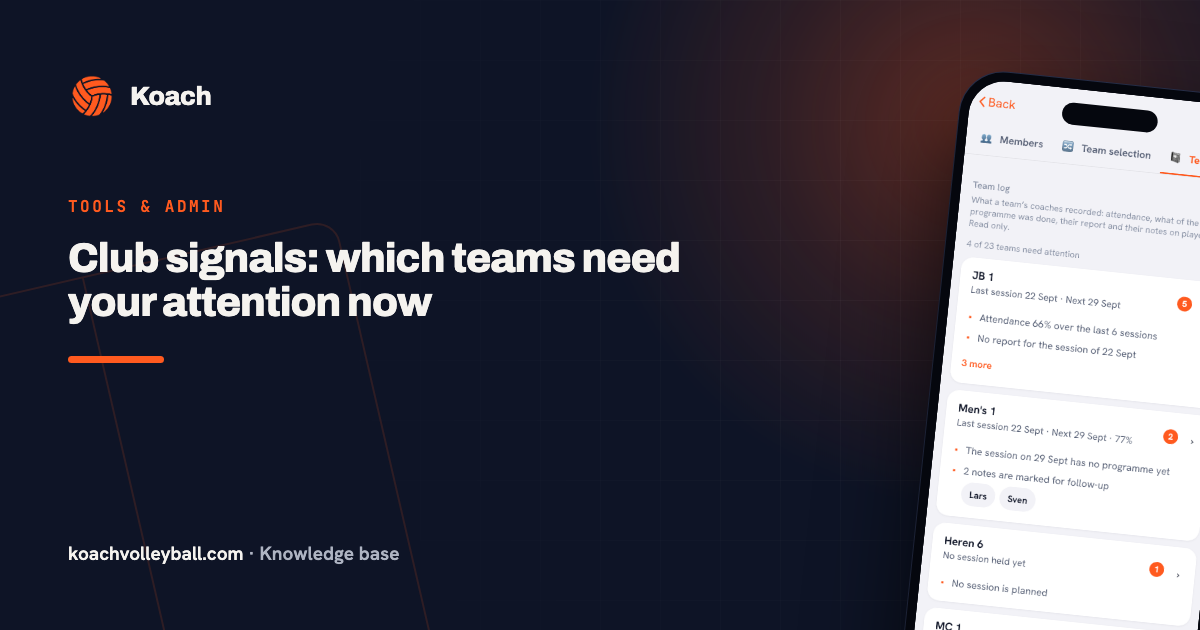
With twenty teams you are not going to open twenty logs every week. That is why the signals sit above the team list: a counter showing how many teams need attention, and for each team what stands out. Two of them tie straight into your curriculum: a planned session that has no plan yet, and a session held without a report. The others are about attendance, players who missed three sessions in a row, notes marked for follow-up and teams with no session planned. The thresholds behind them are explained in the club dashboard's signals block.
Build the training content once, for every team
Not every coach has to work out the theme of a period from scratch. A coach who has a good session for it saves it with Save as template. In a club, the other coaches find it under Copy plan in From other teams in the club, and one tap puts the blocks into their own session. Copying leaves the colleague's template untouched. That way the Where the drills are kept column from section 4 lives in the app instead of on someone's laptop.
What Koach does not do with your volleyball curriculum
- The curriculum itself is not in the app. Principles, pathway and scale stay in the document. Koach has no pathway by age and does not tick off skills per player.
- Assessment does not follow your pathway. After a session the coach gives each player who was there one to five stars on five fixed points: Technique, Game awareness, Coachability, Work ethic and Effort. Assessment against the curriculum stays on the assessment sheet; the agreement that comes out of it can go on the player's profile as a Personal goal. The Team log does not show ratings.
- A log is not a session visit. You see what the coach recorded, not how the session went, and a missing report often just means they were busy. You still need to visit; now you know which team to start with.
- It only works for teams in the app. A team that doesn't track its sessions in Koach shows nothing in the log.
Volleyball curriculum on paper or with Koach Club?
| What you want | Template (Word or PDF) | Template plus Koach Club |
|---|---|---|
| Cost | Free | €9.99 per month, or €8.33 per month billed yearly |
| Set out principles, pathway and scale | Yes | In the template; the app has no pathway |
| See whether there is a plan in advance | Ask around or visit | Per team in the Team log |
| See what was done of the plan | Ask the coach | Per block: done, partly or not |
| Read the coach's report | If they send it round | In the Team log |
| Know which teams need attention | Keep track yourself | Signals above the team list |
| Share sessions for the theme | Shared folder or email | Templates from other teams |
| Assess against the pathway | Assessment sheet | Assessment sheet; the app has five fixed points |
The template on its own suits a club with a few teams, where you can see the sessions yourself, or where the coaches don't use an app. Adding Koach Club suits clubs with several teams and coaches who keep their session plan and report in the app, or want to start doing so.
What does Koach Club cost?
The template is free. Koach Club costs €9.99 per month, or €8.33 per month billed yearly, for unlimited teams and coaches. Players and parents use Koach for free. Club has no free trial: through the form on the clubs page you book an intro call, and then we set up the club together with you. The Coach plan (€2.99 per month, one team) comes with a 14-day free trial, but without the club dashboard and Team log. All prices are on the pricing page; in the App Store and Google Play you see the price in your own currency. The rest of your pre-season to-do list is in the volleyball season checklist.
Put the period's theme in the focus. Agree with your coaches that the theme from section 4 goes word for word into the Focus / note field of the session. Then the Team log shows on one line per session whether the theme comes back, without opening the plan.
Frequently asked questions
What is a volleyball curriculum?
A volleyball curriculum is a club's coaching pathway on paper: what players learn at each age, what every team trains to get there, how and when players are assessed and how you check that it happens in the teams. It is usually drawn up by the technical committee or a director of coaching, together with the coaches. Money, gym time and volunteers are not in it: those belong in the club's overall development plan.
Is there a free volleyball curriculum template?
Yes. On this page you can download a volleyball curriculum as a PDF to print and as a Word file to adapt, without leaving an email address. It has six sections: principles, the end point of the youth section, the pathway by age, training content, assessment and a checklist per team, plus an assessment sheet per player. You are free to use, copy and adapt it.
How do you get coaches to follow the club curriculum?
Build it together with the coaches, write everything as something you can see in a session and give each period one theme. Then agree where coaches record their session plan and report, and after each period check for every team whether there was a plan, whether the theme came back and whether there is a report. With Koach Club you read that per team in the Team log instead of asking around.
Can I put the pathway or the assessment into Koach?
Not as a pathway: Koach has no skills per age to tick off. After a session the coach gives each player one to five stars on five fixed points: Technique, Game awareness, Coachability, Work ethic and Effort. The theme of a period goes in the Focus / note field of the session, and good sessions can be shared as a template with the other teams in the club. Assessment against your own pathway stays on the assessment sheet from the template.
How much does Koach Club cost, and can I try it first?
Koach Club costs €9.99 per month, or €8.33 per month billed yearly, for unlimited teams and coaches; players and parents pay nothing. Club has no free trial: you book an intro call through the form on the clubs page and we set up the club together with you. If you coach one team yourself, you can try Koach free for 14 days with no credit card, but the Team log and the signals are only in Club.

See whether your curriculum happens in every team
Club has no trial: we set up the club with you. Coaching a team yourself? Start right away.
Get started with KoachOr read first what the volleyball coaching app does.