
Volleyball player evaluation form: nine skills on a scale of 1 to 5
Three coaches watch the same player for forty minutes and then award a 2, a 4 and a 5 for passing. That is not a disagreement about the player but about what a 4 means. A form solves that — not with more boxes, but with a description behind every number.
Why a number without a description is worth nothing
All three coaches in the introduction looked carefully. The first compared her with the group in the hall that evening, the second with the team she would be moving into, the third with what he watched on television on Saturday: three yardsticks. The number that comes out therefore says more about the assessor than about the player.
A usable evaluation form repairs that in one way: behind every number stands a behaviour. Not "4 = good", but "4 = the pass stays playable, including off a heavy serve or a ball in the seam". From that moment the debrief is no longer about the scale but about the player, and on a busy evening that saves you half an hour of arguing.
More important still is what a form is not: not a report card the player takes home and not a league table for the canteen. It is a tool for lining your own eyes up with your colleague's.
The nine skills on the form
Six technical items and three that decide how the rest of the season goes:
- Forearm passing — serve receive: platform, footwork, the ball arriving playable at the setter.
- Overhead play — the set and the second ball: hands, direction, the ball that still becomes attackable out of a poor pass.
- Serving — keeping it in and placing it. Look above all at the number of errors, not at the speed.
- Attacking — approach, timing and the contact point above the head. A three-step approach that is right weighs more heavily than how hard the ball arrives.
- Blocking — hands over the net, timing, movement along the net.
- Floor defence — staying low, playing on after a mistake, balls that really should not be reachable.
- Movement and footwork — how someone moves when the ball is not coming to him. This is the row that most often predicts how fast someone learns the rest.
- Game sense — positioning, cover, calling for the ball or leaving it. Visible in small game forms, invisible in queue drills.
- Coachability and team behaviour — what happens after you have said something, and what someone does after somebody else's mistake.
Why nine? You will not fill twelve or fifteen rows fairly in a forty-minute block: towards the end you start guessing, and a guess looks like a score but is not one. Fewer rows make the terms so broad that they say nothing — "technique: 3" helps nobody. With the youngest groups, who play on a small court, you drop blocking and attacking and are left with seven.
What deliberately does not appear on it: height and effort. Height is not a skill but a circumstance, and anyone who puts it in as a row counts it twice — it is already baked into attacking and blocking. Effort you do not measure in two hours but over weeks; a short score after every practice is a fairer instrument for that.
The scale: what 1 to 5 mean
One ladder that works for all nine rows:
- 1 — not yet. The execution does not come off; when it goes well once, that is chance.
- 2 — at rest. Works on a tossed ball with no pace, disappears the moment the game starts.
- 3 — in a normal rally. Works at the level of this group. This is the middle and should be the most common score.
- 4 — under pressure. Works on a heavy ball, in a tight situation or at 22-22 as well.
- 5 — a weapon. The opponent adjusts to it: the serve goes somewhere else, the block shifts.
That "at the level of this group" in the 3 is the most important agreement on the whole form. A 3 in a recreational team means something different from a 3 in a first team, and that is fine as long as you use one form per group and never compare scores between groups. A player who moves to another level does not change skill but changes yardstick.
Two rows you write out in full, because that is where assessors diverge most. Passing: 1 touches the ball and the direction is luck; 2 plays a tossed ball back neatly but not a serve; 3 gets a normal serve playable somewhere near the net; 4 keeps a heavy serve or a ball in the seam playable too; 5 gives the setter his whole attack back on virtually every serve. Coachability: 1 does not hear the correction or pushes it away; 2 nods and then does the same thing; 3 adjusts as long as you are standing there; 4 applies it of his own accord in the next drill; 5 asks for the correction himself and passes it on to a teammate.
The sheet itself: nine columns and one sentence
One sheet per assessor per block, landscape, with the players underneath each other and the nine skills as narrow columns beside them — abbreviated to PAS, SET, SRV, ATT, BLK, DEF, MOV, GME and COA, with the descriptions on the back. On the left the bib number, not the name: with twenty unfamiliar players, assessing by name simply does not work, and a number also keeps your judgement more honest.
On the right one wide column headed what stood out, with room for exactly one sentence. That is the most valuable box on the sheet, because it holds what no number can carry: "dares to take the hard ball", "stops talking the moment it goes against him", "left-handed". In the final weighing that sentence is often decisive, and in the conversation with the player it is the only thing he really remembers.
Beyond that there is only a header: date, group, block and the name of the assessor. That last one is not a formality — in two weeks' time you will want to be able to ask what exactly somebody saw.
Adding it up is the trap
The temptation to put a total at the bottom and sort on that number is strong. Do not simply do it: a sum of nine scores treats blocking exactly as heavily as passing, and with a fourteen-year-old that is demonstrably nonsense. Anyone who does want to sort has two honest options.
- Two totals instead of one. Add the six technical rows as "now" and movement, game sense and coachability as "later". A player with 14 now and 14 later is a different story from a player with 20 now and 8 later — and that is what the discussion should be about.
- Weight beforehand, not afterwards. Agree before the day which three rows count double. If you are looking for a passer-hitter, that is passing, floor defence and movement. Weightings you think up only once you see the scores are justifications.
Never give half points. A 3.5 suggests a precision that is not there, and it almost always arises because you do not dare to choose. If two players end up exactly level, you use the tie-break you fixed in advance — with youth players the month of birth is a defensible and easily explained one.
Filling it in in the hall: per block, not at the end
- Score in the break after each block, not while you are watching. Anyone writing is not watching. Reckon on eighty to ninety seconds per player and set an alarm on your phone.
- Never at the end of the evening. What you saw in the last twenty minutes overwrites everything before it. That is not sloppiness but how memory works; a sheet per block is the remedy.
- Leave a box empty if you did not see it. An empty cell is information: this player did not block once in this block. A filled-in guess is not.
- Do not assess and organise at the same time. On a tryout day one person guards the clock and the groups, so the assessors only have to watch and write.
Which drills you run that evening is a craft in itself: there are forms in which the level becomes visible by itself without it turning into a test. Without such drills, six of the nine rows stay empty — game sense and coachability simply do not show up in a line waiting for the ball.
Test the form on your own team first. Fill it in on an ordinary Tuesday evening about players you have known for two years. Within ten minutes you know which rows you cannot score, which description is unclear and whether you use the whole scale or put everything on 3 and 4. That quarter of an hour stops you standing there on the day that counts with a form that does not work.
Two assessors, and the difference of two points
One assessor with a form is better than one assessor without, but two is a different order of thing. Start with ten minutes of calibrating: watch three players together, fill in the nine rows separately and lay them side by side. Almost always it turns out that one reads the 3 as "average for this group" and the other as "good enough for next year's team". You take that difference out before the day, not after it.
During the day everybody scores silently and separately. As soon as assessors confer along the way you no longer have two measurements but one opinion in duplicate. When comparing afterwards, one simple rule applies: one point of difference is noise, you do not discuss it. Two points or more is the most interesting information of the whole evening — you have literally seen something different, and that is a question to talk through instead of averaging away. Splitting a 2 and a 5 into 3.5 throws out exactly the information you came for.
If you are on your own, fill in the same sheet on two different evenings. Weaker than a second pair of eyes, but it takes out the day-to-day form — the biggest source of noise there is.
What happens with the form after the day
Transfer the nine scores and that one sentence to the player himself within two days, as a single dated note in his profile. In Koach those notes sit with the player, with the name of whoever wrote them behind the date; with two assessors you can see afterwards who thought what. They are visible to the coaches of the team, and within a club a club manager or board member reads them through the team log. If someone moves to another team, the notes travel with him. The loose sheet you will lose, the note you will not.
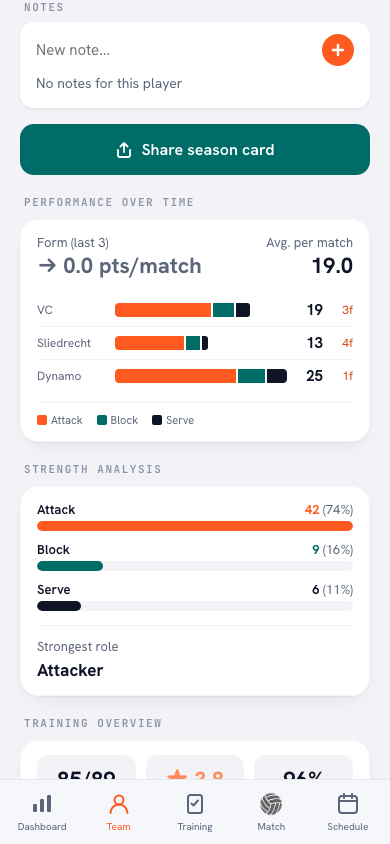
That second measurement is where the form really does its work. Fill in the same sheet again around the winter break, with the same descriptions. The rows that have moved up a point are the proof that your training worked; the rows standing still are your training plan for the second half of the season. That is also exactly the material with which you back up a promotion recommendation: not "I think he is ready", but two measurements six months apart.
Do not give the sheet to the player. Give him two things out of the evaluation talk: one row that is a 4 and why, and one row that is a 2 with what you are going to do about it. Nine scores at once lands with nobody, and least of all with a twelve-year-old. With players who are not selected you do the same: one strength, one development point, and what the route is — how to have that conversation is in turning a player down after selection.
Finally: these are judgements about people, often about minors. Keep them in one agreed place within the club rather than in the camera rolls of four coaches, do not share them outside the coaching staff and delete them once they have served their purpose.
Frequently asked questions
Why a scale of 1 to 5 and not 1 to 10?
A ten-point scale suggests a precision that is not there when you are watching with the naked eye: you cannot describe the difference between a 6 and a 7, so everybody scores differently. With five steps you can put a behaviour behind every number, and only then do scores from different assessors refer to the same thing. An even scale of 1 to 4 forces a choice, but you lose the useful middle.
May I show the evaluation form to the player or the parents?
You have to be able to explain every decision, but the raw sheet is the wrong instrument for that: nine loose numbers without explanation mainly work defensively. In the conversation give two points — one strength, one development point with a route — and keep the form to hand as your own backing. If someone formally asks to see what has been recorded about them, discuss that with the committee; that right exists.
What do I do when two assessors score very differently?
One point of difference is noise; you need do nothing with it. From two points onwards you go back to what each of you saw — usually it turns out that one was watching a different block or had a different description in mind. Do not average those scores: the average of a 2 and a 5 hides exactly the information you were assessing for.
Can I use the same form for youth and seniors?
The nine rows and the five steps stay the same; only the meaning of the 3 shifts, because it always sits at the level of the group in front of you. That means you can compare scores within a group but never between groups. With the youngest players on a small court you drop blocking and attacking and keep seven rows.
How often do I fill in a form like this?
Twice a season is enough: a baseline in the first weeks and the same measurement around the winter break. A selection moment adds one round to that. Measuring more often mainly produces admin, because skills do not move up a point in three weeks.
How many players can I assess in one evening?
With nine rows per player and eighty to ninety seconds of writing time per block, sixteen to twenty players per assessor is the maximum. Above that the quality drops sharply: the last names almost always get the average of the row above. If there are more, split into two groups or plan a second evening.
 Tracking player development in volleyball: from gut feeling to insight
 Determining a player's strongest role with data
 Backing up promotion advice: ready for a higher team?
 Volleyball skills checklist: free PDF and Excel by level
 Volleyball tryout app: score tryout day, then build your teams
 Volleyball player report card: free end-of-season template
Try it yourself in Koach
Less admin, more coaching.
Get started with KoachOr read first what the volleyball coaching app does.