
Determining a player's strongest role with data
Every coach has had that nagging thought: is he actually playing in the right spot? Usually it stays a feeling. With a season of data you can investigate the question seriously — and sometimes the answer surprises you.
The three data layers under a role decision
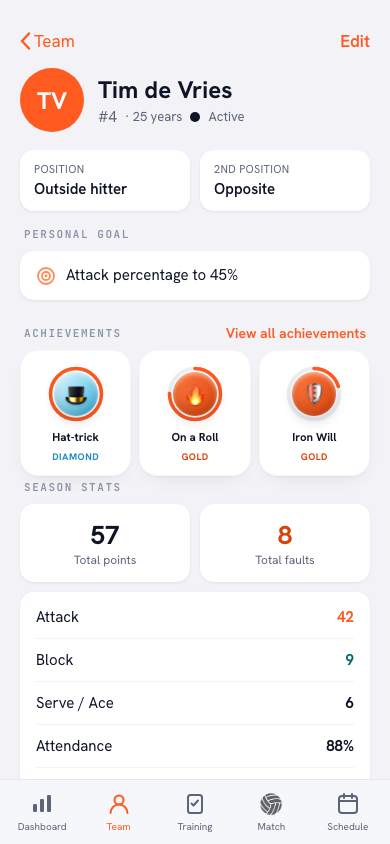
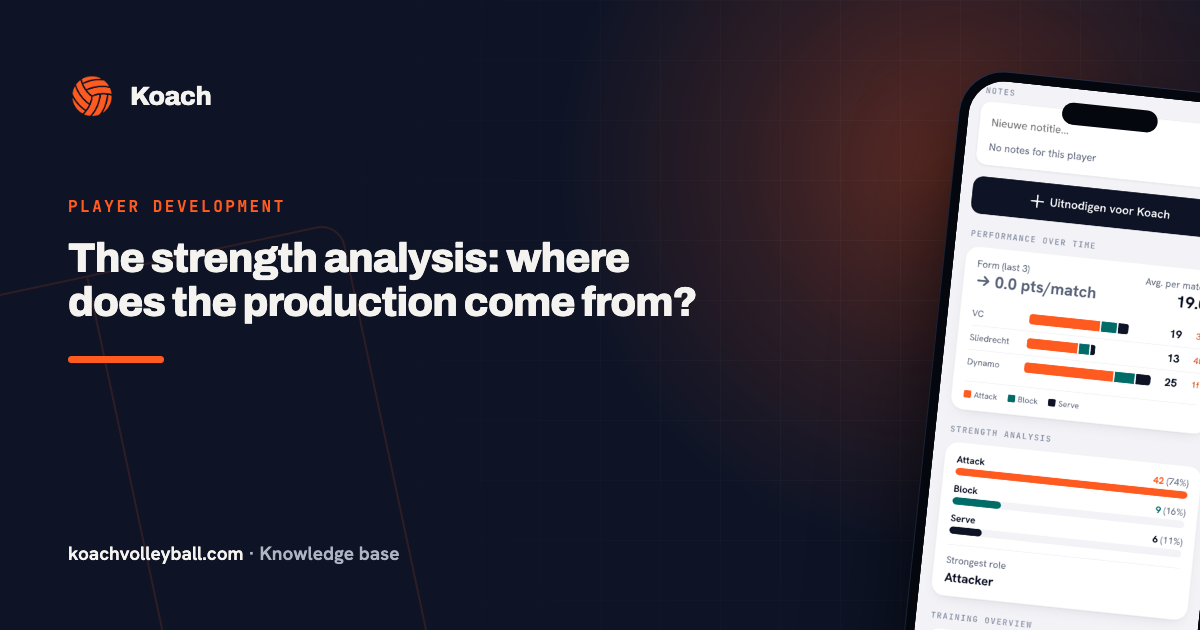
- The production profile: the strength analysis shows where someone's points come from. An outside hitter whose block share keeps growing may be knocking on the middle's door.
- The error load per situation: do they make their errors under pressure (passing duties) or in the finishing phase? An attacker with a low error load but modest production may be a born middle blocker — solidity over volume.
- The substitute appearances: have they ever played another position — a practice match, an emergency fix, a tournament? Those small samples are gold: what did their numbers look like there?
The experiment: small, honest, measured
Data suggests; the court decides. Test a role switch in three steps: first one block per practice in the new position, then a set in a practice match, only then a real match. Just keep recording everything as usual — after four weeks you have an A/B comparison no gut feeling can deliver. And discuss the experiment with the player beforehand: a role switch quickly feels like a demotion, unless they know it is a study with them as co-researcher.
When you should not switch
Not every data anomaly is a moving notice. A good reason to stay put: the player is happy and the team is humming. Role switches cost automatisms, confidence and sometimes a season — the expected gain has to be worth that. Rule of thumb: switch when you have structurally skewed data plus a motivated player plus a team need. Two out of three is a conversation; three out of three is a plan.
Also look at what the team is missing. A player's strongest role is sometimes not their best position, but the position where the team needs them most. Data about your roster gaps (see building your roster) belongs in the same trade-off.
Frequently asked questions
How much data do I need before a role switch can be justified?
At least half a season in the current position plus a few measured samples in the new one. One good substitute appearance is an anecdote; a month of experimenting is evidence.
What if the player does not want to switch?
That weighs heavily: motivation is half of any position. Share the data, name the team interest and let it sink in — a forced role switch rarely produces the player the numbers promised.
Can I already assign a youth player a 'strongest role'?
Carefully: until around age fifteen, broad development matters more than optimal allocation. Use the data to see talents, not to lock them in — the strongest role of a 14-year-old is 'learn everything'.
Try it yourself in Koach
Less admin, more coaching — starting at your next practice.
Get started with KoachOr read first what the volleyball coaching app does.