
Volleyball team handbook: free template in PDF and Word
The short answer
A volleyball team handbook puts one team's rules and expectations on paper: who is who, how to report an absence, what counts as late, how playing time works, who drives and how you communicate. Below you can download a free template in PDF and Word. In Koach you then put those rules to work, with absences and reasons, a driving rota and announcements.
A volleyball team handbook records what your team agrees at the start of the season, so nobody can say halfway through that they didn't know. Here you can download a free template for players and parents, read how to fill it in and see which rules an app can then run for you.
Download the volleyball team handbook: free template in PDF and Word
First, what you are probably looking for: a team handbook for one volleyball team, ready to fill in, free and without leaving your email address.
- Volleyball team handbook (PDF): to print and fill in with a pen. Four A4 pages with ten sections, from who is who to transport and communication, and a signature list for 15 players on the last page.
- Volleyball team handbook (Word): the same ten sections and the signature list, ready to adapt. Delete whatever doesn't fit your team and type in your own rules.
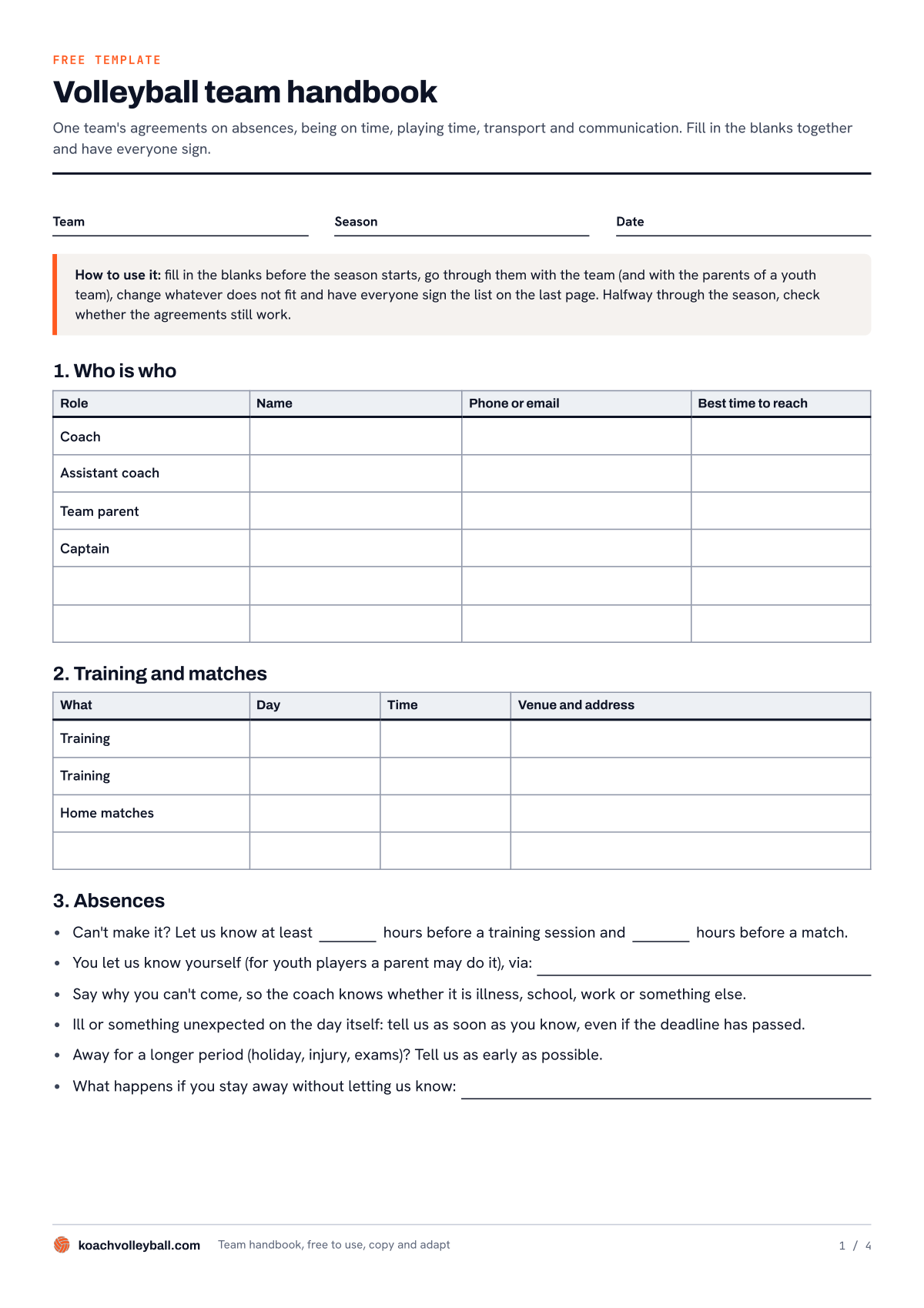
You are free to use, copy and adapt the template. It is made for one team. If you need rules for the whole club, such as gym keys, volunteer shifts and expenses, you are looking for a club handbook instead.
What goes in a volleyball team handbook?
A team handbook is not a thick rulebook. Think of it as your team rules and expectations on a few pages. It answers the questions that come back every season: what time do I need to be there, what do I do if I can't make it, who is driving to the away match? The template has ten sections for that.
- Who is who. Coach, assistant coach, team parent and captain, with phone or email and the best time to reach them.
- Training and matches. Day, time and venue with address, for training sessions and home matches.
- Absences. How many hours in advance, through which channel, that players say why, and what happens if someone stays away without letting anyone know.
- Being on time. How many minutes before training and before a match players are changed and in the gym, how they let you know they are running late, and after how many late arrivals there is a talk.
- Playing time. Three options to tick (roughly equal over the season, more for players who train more often, or the strongest lineup in deciding matches) or your own choice, plus the rule that the coach picks the lineup and parents cheer.
- Transport to away matches. By a driving rota, taking turns or your own way, where and when you leave, how to swap and what you agree on fuel costs.
- Communication. Where the schedule lives and that it is the one that counts, where announcements come, when the coach can be reached and what the group chat is for.
- Team tasks. Washing the match shirts, bringing balls and the first aid kit, helping at home matches, and who arranges it.
- Our own agreements. Room for whatever belongs to your team alone.
- Agreement. A signature list that every player signs, with a parent or guardian signing too for players under 18. That page turns the handbook into your team contract.
How to fill in your team handbook
The blanks are for the numbers and channels you choose yourself. Three things help.
- Pick deadlines you can check. An absence deadline of a set number of hours only works if you can see afterwards when someone dropped out. If you can't see that, every late absence turns into an argument about who is right.
- Fill in the blanks together. How to run that conversation with your team is covered in the first team meeting; the team handbook is what you have on paper after that evening. With a youth team the parents are at the table too, because they report the absences and they drive.
- Have everyone sign, and check back halfway. The signature list makes the rules everyone's, not just the coach's. Halfway through the season you check whether they still work, and a new player reads and signs at that point. Where the handbook fits in your preseason prep is in planning your volleyball season.
Why a team handbook on its own is not enough
A signed handbook does nothing on a training night. The rule "let us know at least so many hours in advance" only works if there is one place where players report an absence and where the coach can see when it happened. Otherwise absences come in through the group chat, a private message and a parent on the sideline, and you keep track of it all in your head. The same goes for lateness, playing time and driving: the rule is on paper, and someone keeps track by hand.
The handbook on paper or in Word, with the group chat next to it, has real advantages: it costs nothing, everyone can take part and nobody has to install anything. For a small team where everyone knows each other well, that is often enough. Once the team grows, or parents are involved, you want the rules to actually happen somewhere. We make Koach, so read the table with that in mind.
| Rule | Handbook only | With Koach |
|---|---|---|
| Reporting an absence before the deadline | Messages to the coach, who keeps track | Can't make it with a reason, time-stamped in the history |
| Being late | A tally sheet you keep yourself | Late per training session and the Often late block |
| Playing time | Your own count, or your memory | Rallies played per player when you score live |
| Driving to away matches | A rota you make and update yourself | Driving rota, shared out by distance driven |
| Announcements and tasks | The group chat | Announcement, poll or task for the whole team |
| Getting the rules signed | Yes | No |
How Koach puts your team handbook to work
In Koach your team, your training sessions and your matches live in one app. Players and parents get their own free account. That puts the rules from the handbook where they actually happen.
Absences, with a reason and a time stamp
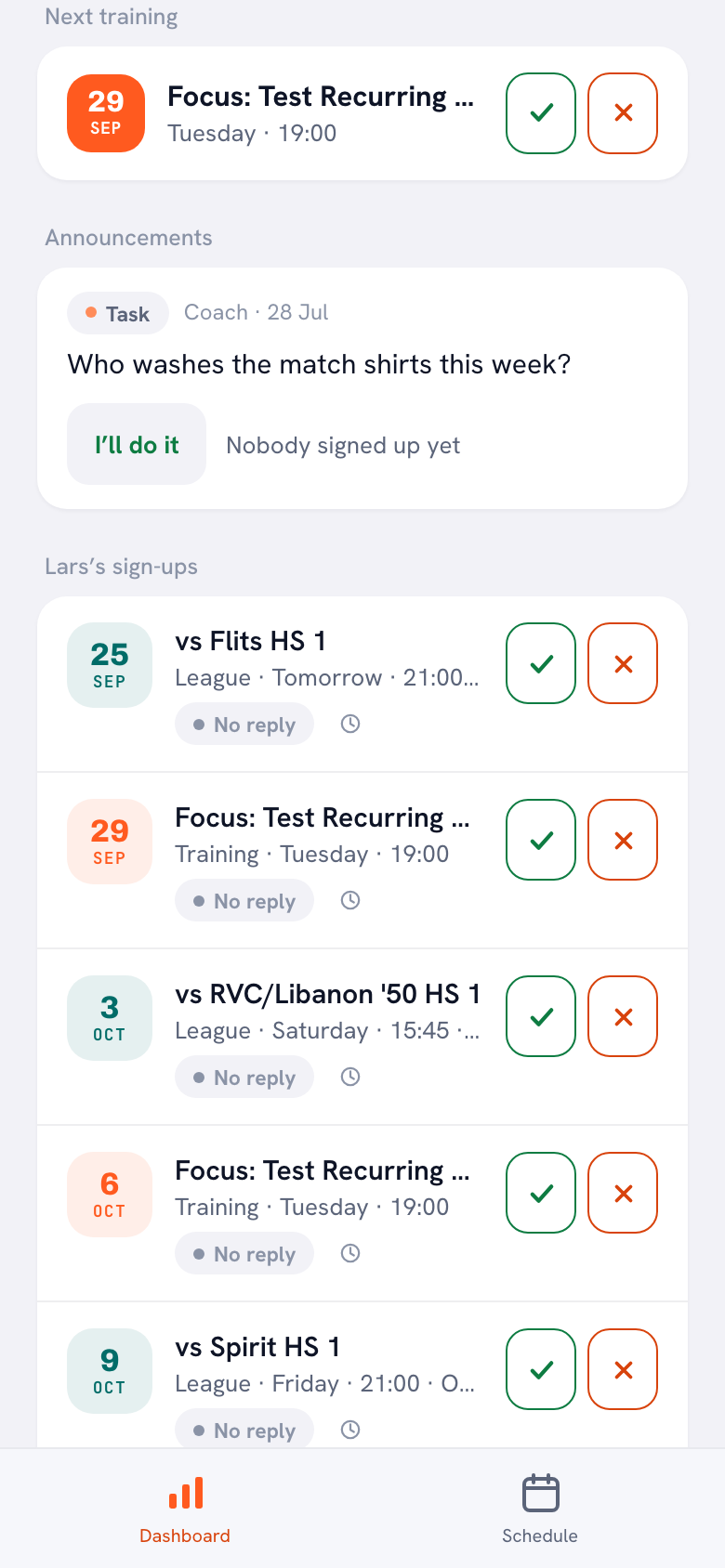
A player taps Can't make it on a training session or match; a parent signs their child out on the card with the child's name, such as Emma’s sign-ups. The app then asks Why can’t you make it? The reason is typed in by hand and optional, so say in the handbook that you expect one. Behind the clock icon is the History: who signed up or out when, and whether that was the player, a parent or the coach. That shows you whether an absence fell within your deadline. The app doesn't stop anyone from dropping out later: the deadline stays an agreement, and what happens next is your call.
14 days free, no credit card. Add your team tonight and see after one week who reports absences on time.
Try Koach with your teamBeing on time, and running late
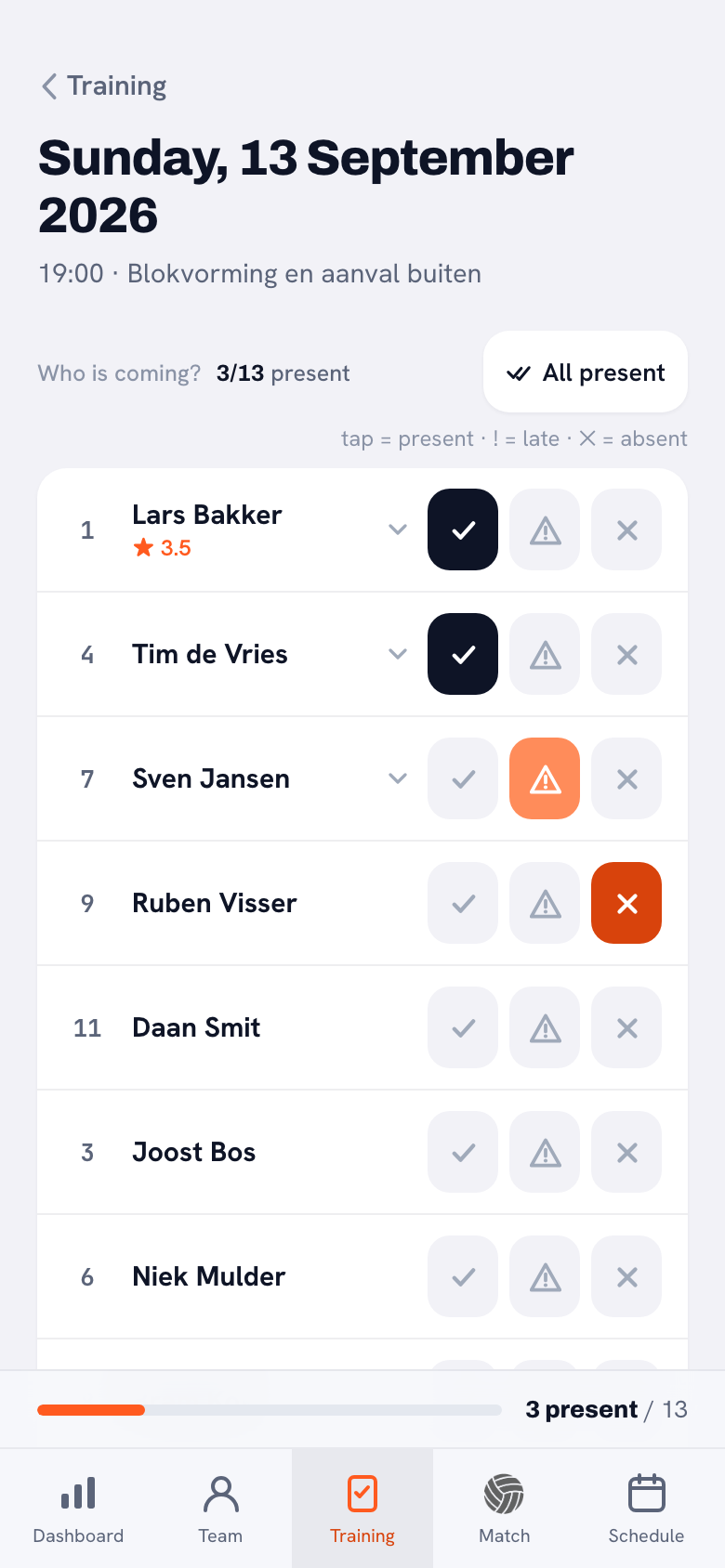
At every training session you tap for each player whether they were present, late or absent (a check mark, an exclamation mark or a cross), or you tap All present and then change only the exceptions. Players who will be late can say so on their sign-up with Add a note; the app itself suggests "For example: I’ll be a bit late". Your dashboard has the Often late block: the players who were late most often (five at most), each with how many times out of how many sessions. That shows you who is getting close to the number in your handbook, without a tally sheet. How to have the conversation after that is in logging late arrivals.
Playing time you can show
If you score a match live, Koach counts the rallies each player played: per match under Playing time and across the season under Playing time this season on your dashboard. Players see their own playing time too. Whichever option you tick in the handbook, you can show how the split really turned out. How to back up that choice is in sharing playing time fairly.
Transport: the driving rota
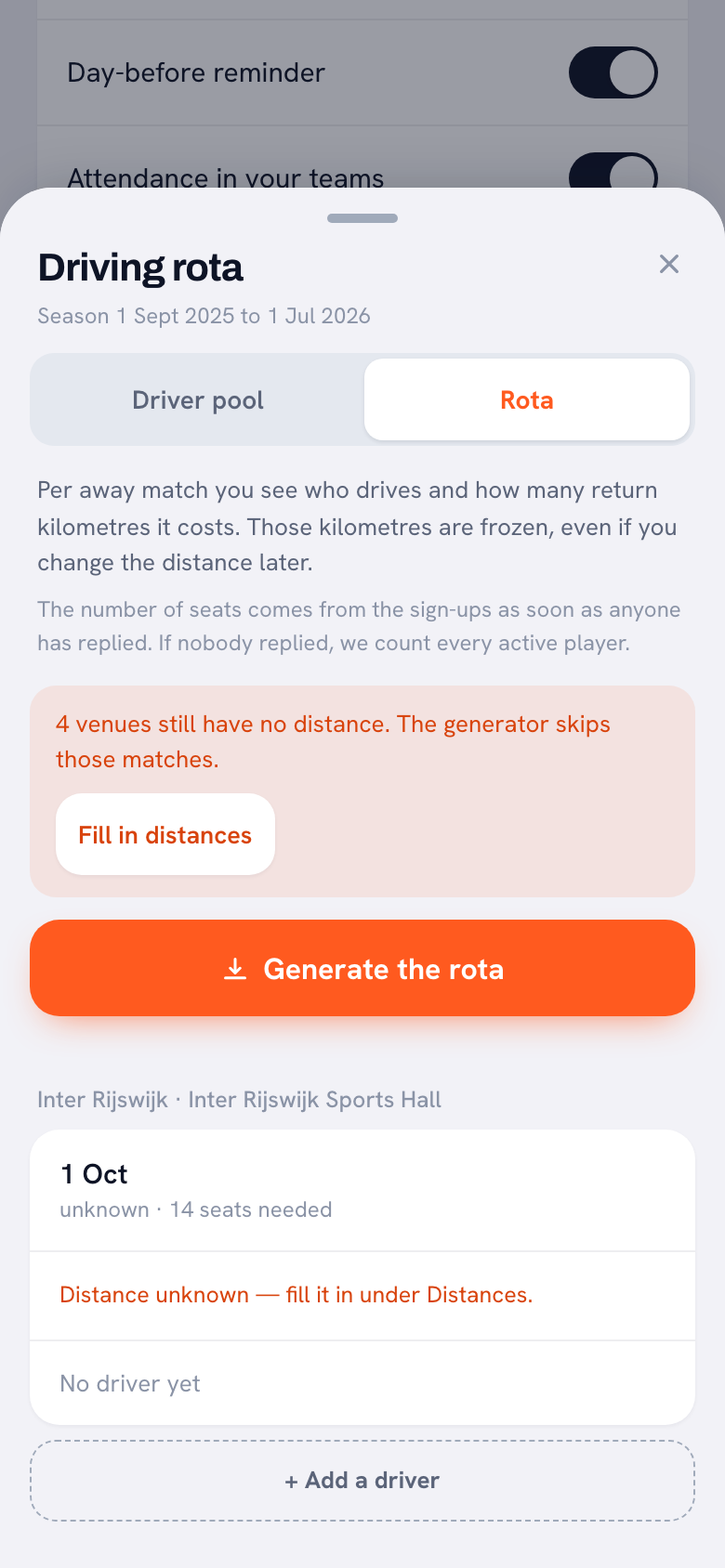
If your handbook goes for a driving rota, Koach builds it for you. In the Driver pool you add who can drive and how many seats they have. With Generate the rota the app shares out the away matches: whoever has driven the shortest total distance goes first. A parent you make Team parent sees who is coming to matches and can create and adjust the rota. Tournaments are deliberately left out, because a tournament day is one trip for the whole day; you arrange that transport separately, just as the template suggests. Setting it up is covered in the driving rota for away matches.
Communication and tasks
Under Announcements you post an Announcement, a Poll or a Task. With a task, such as washing the match shirts, someone taps I’ll do it and the whole team sees who has picked it up. The Schedule in the app then becomes the schedule your handbook says counts. With Sync calendar you share a link that lets players and parents add that schedule to the calendar on their own phone. In the iPhone and Android app they get a push notification when the schedule changes or a new team message comes in.
What Koach does not do
- No signatures. The handbook itself isn't in the app. You keep the PDF or Word file and have it signed on paper.
- No penalties. The app doesn't enforce deadlines. What happens after a late absence or the third late arrival is up to you.
- No chat. There are no private messages or replies. The group chat stays, for whatever your handbook says it is for.
- No money. Koach doesn't handle payments, so no fuel costs either. That agreement stays on paper.
- No push in the browser. Push notifications only come through the iPhone and Android app.
Who is it for, and who is it not for?
The template on its own is enough for a team where everyone knows each other well and there are few away trips: fill it in, talk it through, sign it, done. Adding Koach makes sense if you coach a youth team with parents, if absences now come in through three different channels, or if the driving causes the same grumbling every season. Koach is built for indoor volleyball with six players on court; for beach volleyball it is no use to you.
What does it cost?
The template is free. You can try Koach free for 14 days, with no credit card and every feature. After that you choose Coach for €2.99 per month (one team, two coaches) or Club for €9.99 per month (unlimited teams and coaches). With a yearly plan you pay €2.49 or €8.33 per month. In the App Store and on Google Play you pay the store price in your own currency. Players and parents get their own account for free. All prices are on the pricing page.
Write the app straight into your handbook. Under Absences, put: through Can't make it in Koach, with a reason. And under Communication: the schedule is in Koach. Then everyone knows from the first training session where to look, and you no longer have to count up what the app already shows.
Frequently asked questions
What is the difference between a team handbook and a club handbook?
A team handbook covers one team: who the coach and the team parent are, how to report an absence, what counts as late, how playing time works and who drives. A club handbook covers the whole club, such as gym keys, volunteer shifts, expenses and the confidential contact person. So a team can easily have its own handbook alongside the club's. For club matters, simply point to the club handbook instead of copying it.
Should players and parents sign a volleyball team contract?
It isn't required, but a signature makes the rules everyone's and not just the coach's. That is why the template has a signature list for 15 players, which turns the handbook into a simple team contract. For players under 18, a parent or guardian signs as well, because on a youth team the parents report absences and drive. If a player joins halfway through the season, have them read and sign it then.
How long should a volleyball team handbook be?
Short enough that everyone can read it in a few minutes. The template is four A4 pages, including the signature list, and each section answers one question that keeps coming up during a season. Whatever doesn't fit your team, you delete in the Word version. Nobody reads a long document, and then it won't help you when a disagreement comes up mid-season.
Can I edit and share the team handbook template?
Yes. You are free to use, copy and adapt the team handbook, including for other teams in your club. The Word version is made for that: fill in the blanks, delete the sections that don't fit and add your own rules under Our own agreements. The PDF is for printing and filling in with a pen.
How much does Koach cost if I want the app to run these rules?
You can try Koach free for 14 days, with no credit card and every feature, including absences with a reason, the driving rota and announcements. After that Coach costs €2.99 per month for one team with two coaches, or €2.49 per month on a yearly plan. Club costs €9.99 per month for unlimited teams. Players and parents have a free account, and the template costs nothing.

Put your team in Koach tonight
14 days free, no credit card. After the first week you can see who reports absences on time.
Get started with KoachOr read first what the volleyball coaching app does.