
Volleyball scorekeeper duties: before, during and after the match
The short answer
A volleyball scorekeeper's duties centre on the official scoresheet: before the match the teams and lineups, during it the score, serving order, substitutions and timeouts, and afterwards the result and the signatures. The scorer sits opposite the first referee and reports any error in order or count straight away.
Your name is on the rota for volleyball scorekeeper duties and you have never done it before. No need to panic: the job is mostly paying attention and writing things down in a fixed order. Here is what you do before, during and after the match, how you work with the referees and where it usually goes wrong.
What does a scorekeeper do at a volleyball match?
The scorekeeper keeps the official record of the match. In the international rules the role is called the scorer; every federation has its own word for it, but the job is the same. The scorer sits at the table opposite the first referee and works most closely with the second referee. The duties are set out in the official rules of the world federation, in the rule on the scorer (FIVB Official Volleyball Rules 2025-2028, consulted in October 2026). An overview of the rules of the game is in volleyball rules at a glance.
Running the scoreboard is something else. Under the FIVB rules the assistant scorer does that, next to the scorer at the same table; if there is no assistant, the scorer often does it as well. The scoresheet remains the first job. Who is allowed to score, whether you need a course or licence and whether the scoresheet is on paper or on a tablet is decided by your federation or league. That differs by country and sometimes by division, so check your own regulations.
Before the match: scoresheet, players and lineup
- Arrive in good time. You want the scoresheet ready before the teams start warming up, not in between the first points.
- Fill in the header. Date, venue, competition and the two teams, in the places the scoresheet shows.
- Copy the players. Shirt numbers and names from the rosters the teams hand in, with the captain and the liberos marked separately. Have captains and coaches sign where the scoresheet asks for it beforehand.
- Record the toss. Who serves first, who chooses which side.
- Copy the lineup for each set. The serving order comes from each coach's lineup sheet. This is the moment most mistakes are made.
How to fill in the scoresheet box by box, with the header, the set boxes and the signatures, is in how to fill out a volleyball score sheet. This article is about the role around it.
During the match: score, serve, substitutions and timeouts
- The score. You record every point and check that the scoreboard shows the same score. How scoring works is in scoring in volleyball.
- The serving order. You track who is due to serve. If the wrong player serves, you report it to the referees immediately after the serve.
- Timeouts. Under the FIVB rules each team has two per set, of thirty seconds. You record them with the score and speak up if a team asks for one it no longer has.
- Substitutions. Under the FIVB rules a team may make six substitutions per set. You record who goes off, who comes on and at what score. Libero replacements do not count towards that and you do not record them as ordinary substitutions. If there is an assistant scorer, they keep track of the libero replacements on a separate sheet.
- The end of a set. You tell the referees when a set is over, and in the deciding set when a team reaches its eighth point: then the teams change sides. You also keep an eye on the break between sets.
- Anything unusual. Sanctions and anything else the referee asks you to write down, such as an injury or an interruption.
Youth competitions and lower divisions sometimes differ, for example with shorter sets or a different substitution rule. What applies to your match is in the competition's regulations, not in the international rules.
After the match: result, remarks and signatures
After the last point you record the final result and the set scores. If there is a protest, it goes in the remarks box with the first referee's permission, brief and factual. Then everyone signs: under the FIVB rules first the scorer, then the captains, then the referees. Do not let anyone leave before the scoresheet has been signed. Before you sign yourself, check that the sets and the totals add up; a signed scoresheet is the result.
How do you work with the referee?
The second referee is your point of contact. Before every set they use your scoresheet to check that the players on court are in the right rotation. If something does not add up, or you are unsure, raise your hand or use the buzzer if there is one. Shouting across the court helps nobody. You decide nothing: you report, the referee decides. Everything the second referee does is in second referee duties.
Common scorekeeper mistakes
- The scoreboard falls behind. Compare the score at every timeout and every change of sets, out loud with the second referee.
- Losing the serving order after a substitution. The substitute takes over the place in the order of the player who went off.
- Missing a third timeout or a seventh substitution. Count on the scoresheet, not in your head.
- Recording the libero as an ordinary substitution. Then your substitution count is wrong.
- Signing without checking. Or not getting signatures because everyone is already heading for the changing room.
Official scoresheet or an app?
An app does not replace the official scoresheet where the federation or league requires that scoresheet. The scoresheet, on paper or on a tablet, is the result; an app on the bench is for the coach. What exactly the difference is in a dispute is in electronic scoresheet or score app. For a friendly, a tournament without a scoresheet or a youth match where nobody asks for one, an app or a score card is enough.
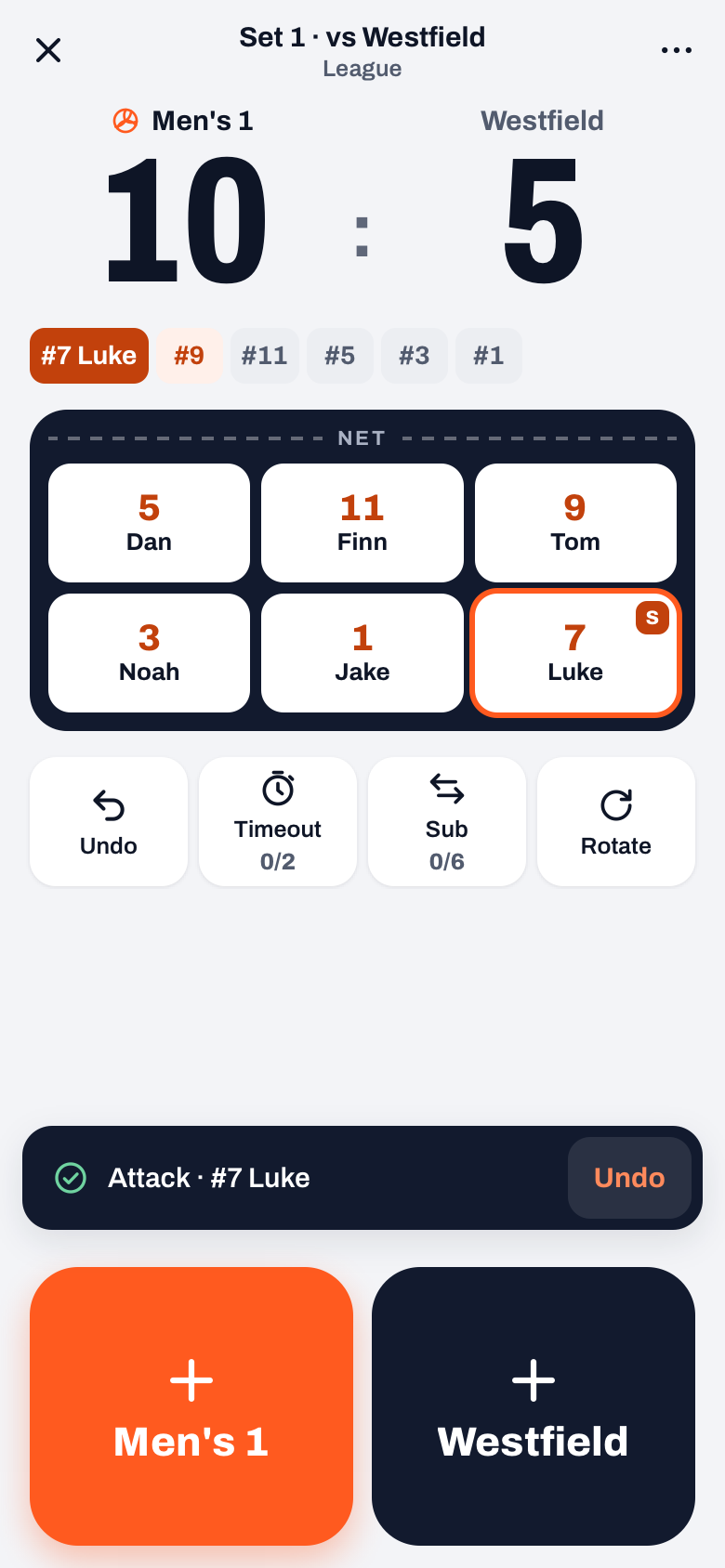
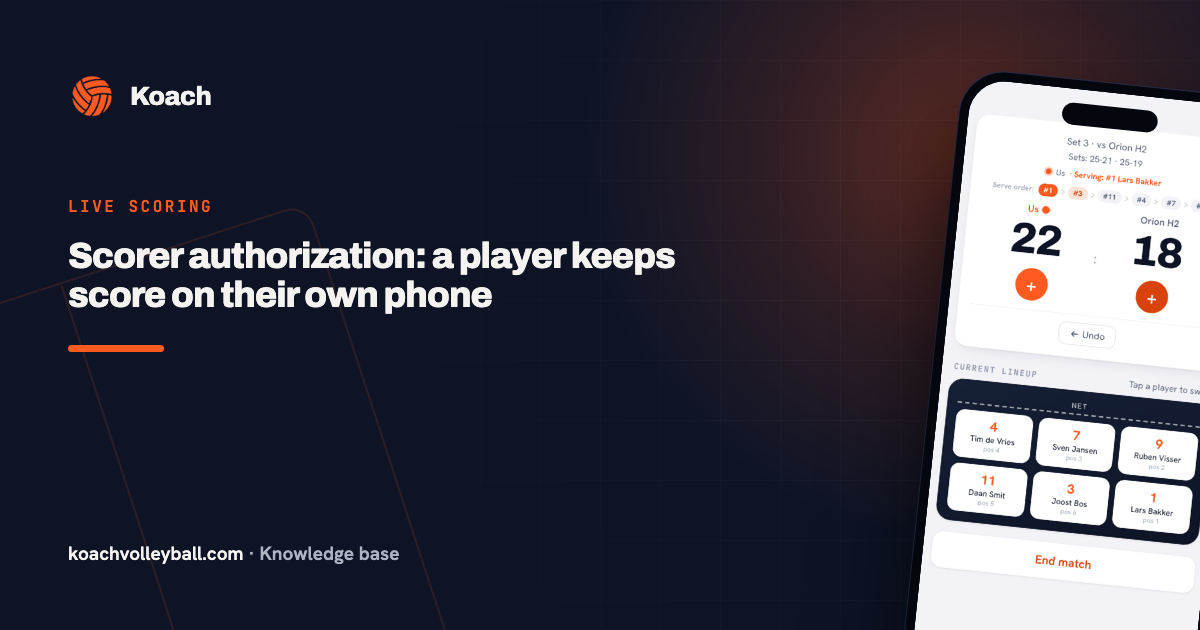
If you also want to keep score for your own team, someone on the bench does that in Koach in Simple mode: on the coach's phone, or on their own phone if they are in the team as a coach. Each rally is one tap on the button with your team's name or the opponent's. The serving order is at the top, and below the court Timeout and Sub keep count per set. Undo reverses a wrong tap. The coach can also appoint a player as Score keeper, who then keeps the score on their own phone; see letting a player keep score. That score keeper screen counts points and sets, but not substitutions or timeouts: it is a statistic for the team, not a scorer for the match.
14 days free, no credit card. Have someone on the bench keep score on Saturday and see afterwards what the numbers tell you.
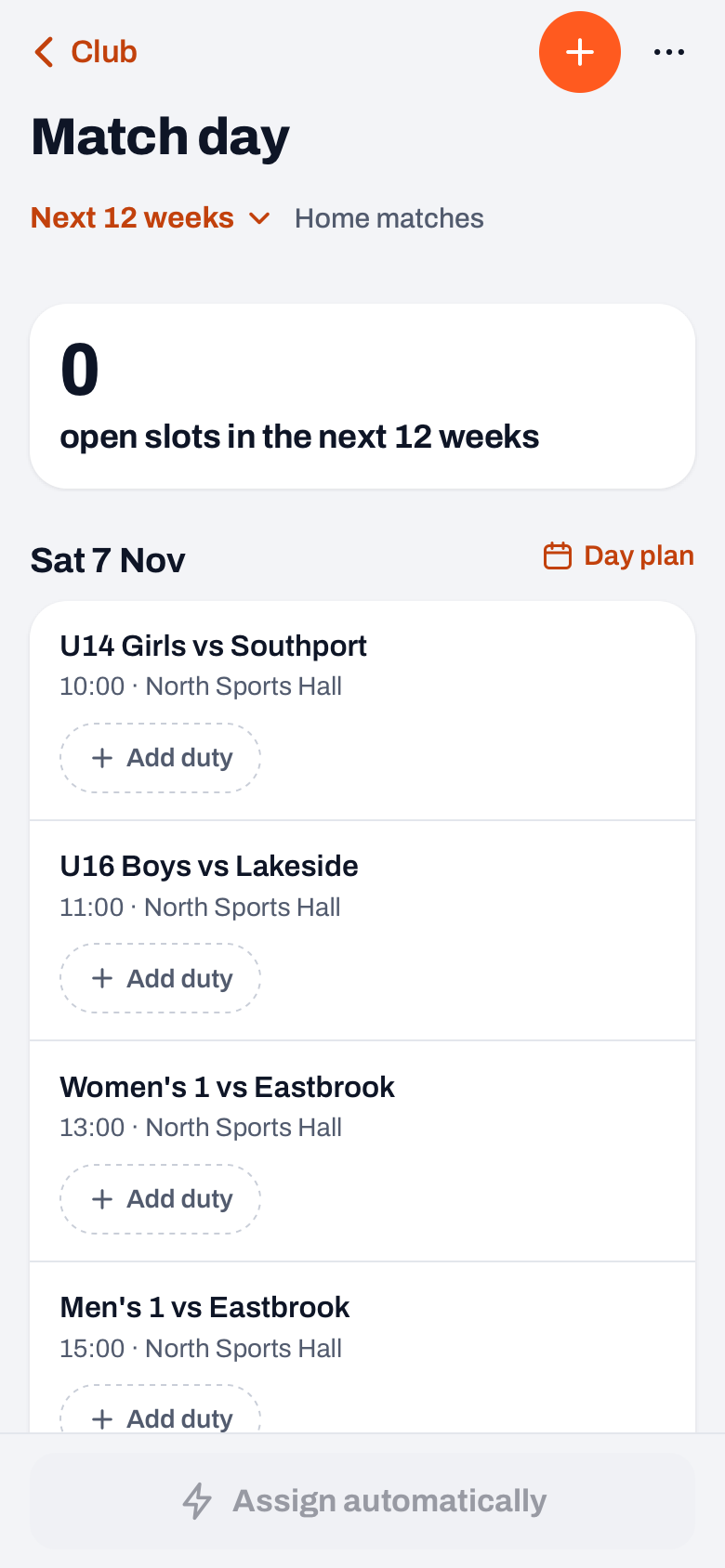
Try Koach with your teamAt a club that plans its home matches in Koach, the scorer is a duty attached to the match. In Match day in the club dashboard every match gets a referee and a scorer, and anyone on the officials list with the Scorer switch on can be assigned automatically. You then see your duty in your schedule. How the board plans such a day is in organising a home match day; that part belongs to the Club plan, see the pricing page.
Say the score out loud at every timeout. Then look at the scoreboard and at the second referee. If all three match, you know you are right; if they do not, you notice it at 12-10 instead of at set point.
Frequently asked questions
Do you need a course to be a volleyball scorekeeper?
That depends on your federation and your division. In lower divisions and youth volleyball, players or parents often keep score after a short explanation; in higher divisions the federation sometimes requires a course or licence. Check your competition's regulations, or ask your club's match secretary.
What is the difference between the scorekeeper and the scoreboard?
The scorekeeper keeps the official scoresheet: score, serving order, substitutions, timeouts and signatures. The scoreboard only shows the score to players and spectators. If they differ, the scoresheet counts, which is why the scorekeeper regularly compares the board with their own score.
Can the scorekeeper use an app instead of the scoresheet?
Not where the federation or league requires an official scoresheet. That scoresheet, on paper or on a tablet, is the result. An app such as Koach can run alongside it for a team's statistics, but it does not replace the scoresheet.
How many timeouts and substitutions does a team get per set?
Under the FIVB rules, two timeouts of thirty seconds and six substitutions per set. Libero replacements do not count as substitutions. Youth competitions and lower divisions sometimes have their own rules, so check your competition's regulations.
Is keeping score in Koach free?
You can try Koach free for 14 days, with no credit card, and keep score of every match in Simple mode during that time. The player account is free, so a player the coach appoints as Score keeper pays nothing. What the subscriptions cost after that is on the pricing page.
Have someone keep score on Saturday
14 days free, no credit card. After one match you know whether it works.
Get started with KoachOr read first what the volleyball coaching app does.