
Volleyball score card template to print, or score in an app
The short answer
A volleyball score card template is a simple sheet you print for each set: a row from 1 to 25 per team to cross off, a box for the serve, the time-outs and the set score. It is not an official scoresheet. If you want the sets and the serving order to keep track of themselves, score the match in Koach on your phone.
You need a volleyball score card for a scrimmage, a tournament or a game at the end of practice, not the official scoresheet from your league. Below you will find what belongs on a printable score card and how to use it, and when an app on your phone gives you more than paper does.
What a volleyball score card is, and what it isn't
A score card is your own tally sheet. You use it for matches that don't need an official scoresheet: a scrimmage against a club down the road, a tournament where the organizers only want the final result, a school tournament, a rec night or a game at the end of practice. You cross off the points, keep track of who is serving and write down the score after each set. That is all it has to do.
What a score card is not: the official scoresheet used in league play. That form has fixed boxes for the lineup in each set, substitutions, sanctions and signatures, and it is the record that counts if there is a dispute. If you have to fill in that form, read how to fill in the official scoresheet step by step. This article is about the simple sheet next to it, or in its place when nothing official is needed.
What goes on a volleyball score card template?
You make the card yourself: by hand, in a word processor or in a spreadsheet. One landscape page per set is enough, or two sets on one page if you write small. These are the boxes you need:
| Box on the card | What goes in it |
|---|---|
| Header | Both teams, the date, the set number and which team serves first |
| Point row per team | The numbers 1 to 25, plus a few empty boxes in case it goes to 24-24 |
| Serve | A box per team where you add a tick or the server's jersey number every time the serve changes sides |
| Your team's serving order | The six jersey numbers in the order they serve |
| Time-outs | Two boxes per team, with the score when the time-out was called |
| Substitutions | Number out, number in, and the score |
| Set score | The final score of the set and the match score in sets |
If you play a deciding set to 15, make a shorter point row for that set. That way nobody keeps counting to 25 by mistake. How the scoring itself works, with the two-point margin and the deciding set, is covered in how volleyball scoring works.
How to use the score card during a match
- Fill in the header before the first serve. Also write down which team serves first, because the whole set depends on it.
- After every rally, cross off the next number in the row of the team that won the point. The last number crossed off is the score.
- Mark every side-out. When the receiving team wins the rally, it gets the serve and rotates one spot. If you note that down, you still know whose turn it is after an argument.
- Write down time-outs and subs with the score. Then you can look back later and see when a set turned.
- Close out the set. Write down the final score, draw a line through the numbers you didn't use and start a fresh card.
Agree beforehand who keeps score. A coach who also has to coach misses points. Hand the card to a sub on the bench, a parent or a teammate who is sitting out that set, and check the score against the gym scoreboard at every time-out, if there is one.
Where a paper score card falls short
Paper costs nothing, needs no battery and works in every gym. For a final score, that is enough. It gets tricky as soon as you want to know more than the result:
- The serving order gets lost. After a sub or a messy rally nobody is quite sure who is serving, and a crossed-off number won't tell you.
- You don't know who scored the points. The card says 25-21, not how many of those points came from the other team's errors. To track that on paper you need a second sheet next to it, such as a printable volleyball stat sheet, and someone to fill it in.
- The card disappears. It stays in a bag, gets wet or ends up in the recycling. If you want to look up the set scores of that scrimmage a week later, they are gone.
- You can't keep score and coach at the same time. If you are looking at your card, you are not watching the court.
The score card as an app: how it works in Koach
We make Koach, so read this part as the maker's explanation. In Koach the score card is a screen on your phone. For a match that isn't on your schedule, go to the Match tab and tap Start a friendly match. Enter the opponent's name and put your six players in their spots. If someone from another team is playing with you, add them under Fill-ins / guests. At the bottom, under First serve:, choose who serves first, pick the Match format and tap Start match. The date is set to today automatically. How to put a friendly on your schedule ahead of time is explained in creating a friendly match.
14 days free, no credit card. Score your next scrimmage in the app and put the set scores next to your paper card afterwards.
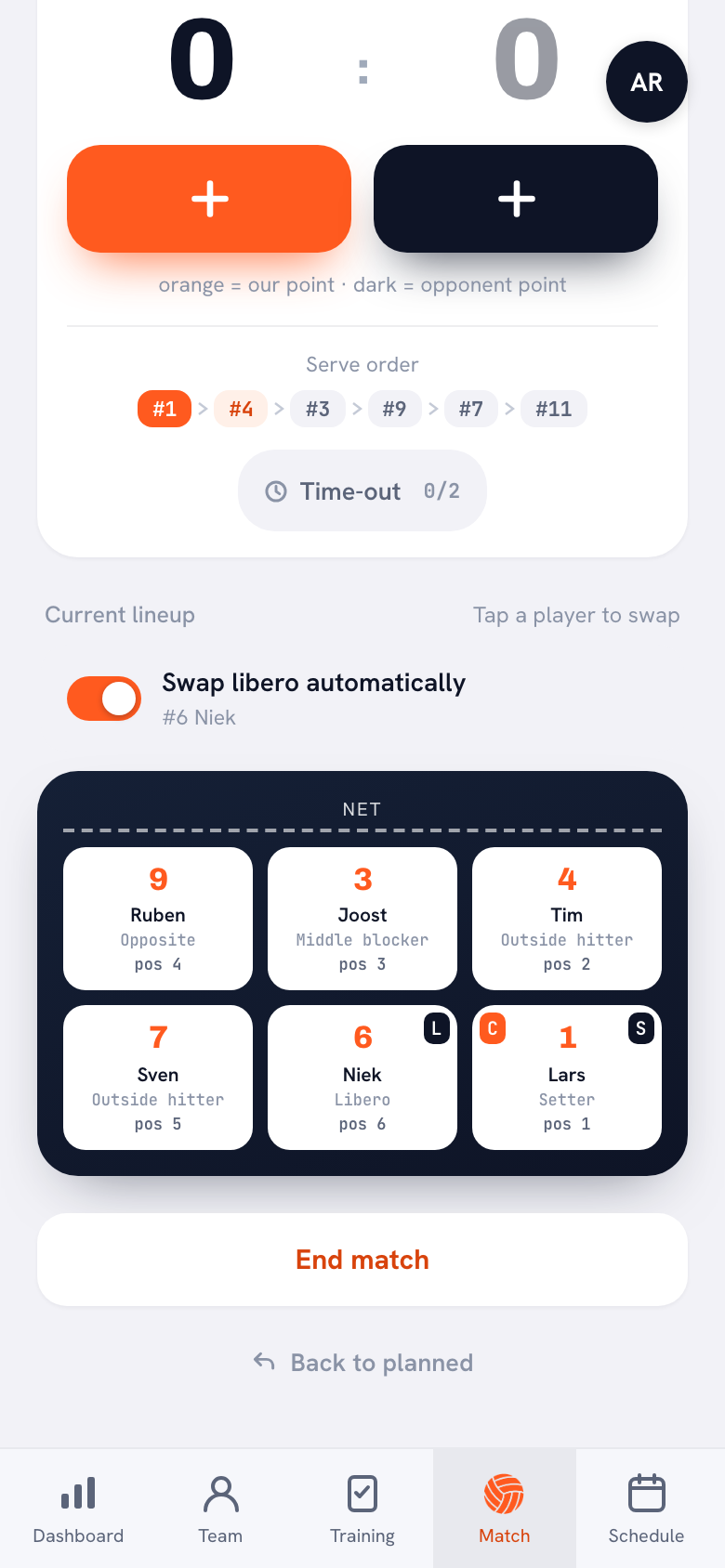
Score your match in KoachAfter every rally, tap the orange plus for your point or the dark plus for the opponent's. The app then asks who scored and how, or what went wrong; that is where your stats per player come from later. What the app then keeps track of on its own:
- The score and the set scores. Once a set is decided you see Set won or Set lost with the final score, and the Set break opens, where you start the next set. The results of earlier sets sit above the score of the current set.
- The serving order. Above the score you see who is serving, below the plus buttons the order of your servers, and the rotation moves along when you win the serve back.
- Time-outs and subs. The Time-out button counts up to two per set, and the app counts your substitutions per set.
- The deciding set. It goes to 15, and the app tells you when the teams switch sides.
- A mistake. Undo takes back the last point.
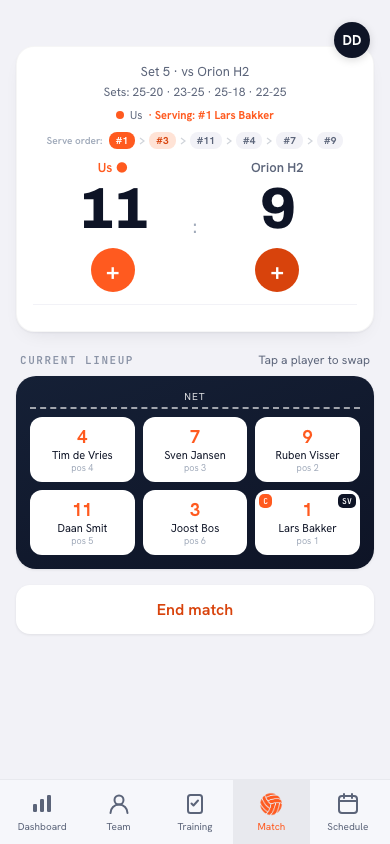
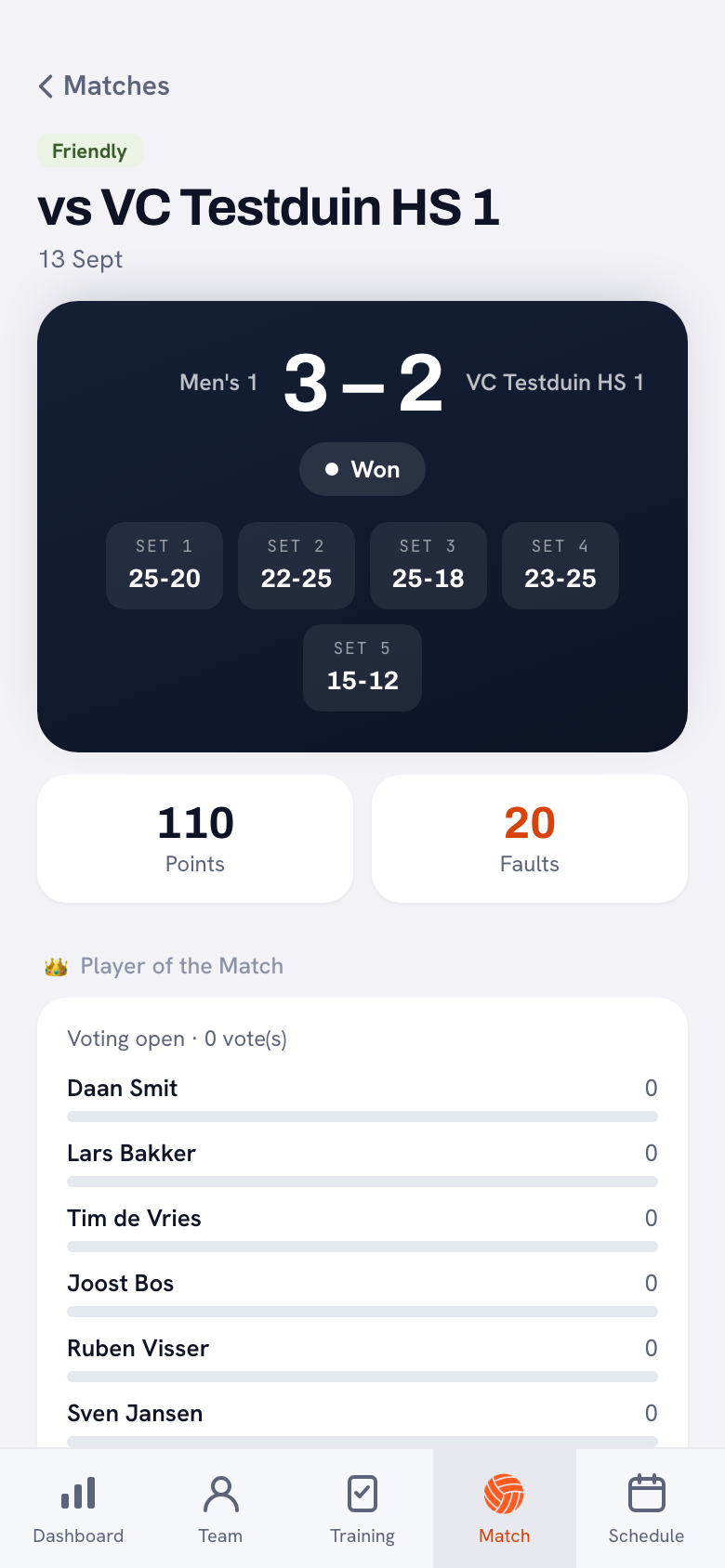
If you play a fixed number of sets, as you often do in a scrimmage, you stop whenever you like: End match is always there, even in the middle of a set. If you play shorter sets, say to 21 or on a timer, close a set with End set, even if nobody has reached 25. Playing best of 3 at a tournament? Choose Best of 3 as the match format; the match is then over at 2-0 and the third set goes to 15. Afterwards the match is in your match overview with every set score, and when you open it you see the label Friendly. What you get from the point-by-point input, with points and errors per player, is covered in tracking a volleyball match live. The scoreboard buttons step by step are in keeping score with a scoreboard app.
Paper or app: the differences side by side
| What you want | Paper score card | Koach |
|---|---|---|
| Cost | Nothing | 14 days free, then a subscription |
| Works without a phone or battery | Yes | No |
| Score and set scores | Yes, by hand | Yes, automatically |
| Your team's serving order | Yes, if you keep track | Yes, automatically |
| Opponent's serving order | Yes, if you keep track | No |
| Time-outs and subs per set | Yes, by hand | Yes, for your own team |
| Who scored and how | No | Yes, per player |
| See the result later | As long as you keep the card | Yes, in your match overview |
| Counts as an official scoresheet | No | No |
If you only want a scoreboard on your phone and not a coaching app, there are free apps that do exactly that. One example is Volley Scoreboard: a free download for iPhone and iPad, with ads and a paid Premium upgrade inside the app. According to the App Store it tracks the score, time-outs, rotations and lineups with substitutions, lets you pick the team names and the scoreboard colors, and is available in twenty languages (checked in October 2026). A strong pick if you want a clear scoreboard on your phone at no cost. Koach is not a standalone scoreboard but a coaching app: after the match, the scrimmage is saved with your team, with the points per player, next to your practices and your other matches. If you want the score visible to the whole gym, on a big screen or a board on the wall, read digital volleyball scoreboard.
Which score card is right for you?
- Paper fits when you only need the result: a rec night, a school tournament, a game at practice. Or when nobody wants to tap through a whole match on a phone.
- A free scoreboard app fits when you just want a clear scoreboard on your phone, at no cost, and don't need stats per player.
- Koach fits when you coach a team and want a scrimmage to give you something too: the set scores saved, the serving order without arguments, plus points and errors per player.
- Koach does not fit beach volleyball or four-on-four: the app is built for indoor volleyball with six players on the court. And the app does not replace the official scoresheet from your league.
What does a score card app cost?
A paper score card is free, and that remains the best answer if all you want is the result. You can try Koach free for 14 days, with every feature and no credit card. After that you choose Coach for €2.99 per month (one team, two coaches) or Club for €9.99 per month (unlimited teams and coaches). With a yearly plan you pay €2.49 or €8.33 per month. If you subscribe through the App Store or Google Play, you see the price in your own currency. Koach has no free-forever version; players and parents do use the app for free. All prices are on the pricing page.
Run the test at your next scrimmage. Have someone on the sideline keep the paper card while you score the same match in the app, or hand your phone to a sub. Put the set scores side by side afterwards: then you know which one to bring next time.
Source: Volley Scoreboard on the App Store, checked in October 2026. Prices and features can change; check them yourself before you choose.
Frequently asked questions
Where can I find a printable volleyball score card template?
The quickest way is to make one yourself in a word processor or spreadsheet. Add a row with the numbers 1 to 25 for each team, with a few empty boxes after it, and add boxes for the serve, the time-outs, the substitutions and the set score. For the deciding set, make a shorter row to 15. Print one page per set, or two sets on one page.
Is a volleyball score card the same as the official scoresheet?
No. The official scoresheet is the formal record of a league match, with the lineup for each set, the substitutions, the sanctions and the signatures of the referee and the captains. A score card is your own tally sheet for a scrimmage, a tournament or a game at practice, and it carries no weight in a dispute.
How do you keep score in volleyball on paper?
After every rally, cross off the next number in the row of the team that won the point; the last number crossed off is the score. Mark every side-out, write down time-outs and subs with the score, and note the final score after the set. Have someone keep score who is not playing or coaching at that moment.
Is there a free app to keep score in volleyball?
Yes. The app stores have scoreboard apps that are free to download and track the score and the time-outs; some show ads or have paid extras. Koach does something different: the match is saved with your team, with the set scores, the serving order and the points per player. You can try Koach free for 14 days with no credit card; after that Coach costs €2.99 per month for one team.
Can I score a match in Koach without scheduling it first?
Yes. On the Match tab, tap Start a friendly match. Enter the opponent, place your six players, choose who serves first and the match format, and start. The date is set to today and the match is labeled Friendly automatically. Afterwards it shows up in your overview with every set score.



Score your next scrimmage in Koach
14 days free, no credit card. After one match you know whether you still miss the paper card.
Get started with KoachOr read first what the volleyball coaching app does.