
Digital volleyball scoreboard: on the wall, portable or run from a phone
Two kinds of people end up here. One is due in the hall in half an hour and wants the score visible tonight, using whatever happens to be lying on the table. The other sits on a facilities committee and has to work out what a proper board will cost the club. This piece covers both, because the first question is the same either way: what is that board actually meant to do?
A board shows the score, a scorer records what happened
The confusion starts with the word itself. Three different jobs get muddled together in a sports hall, and anyone who tries to squeeze them onto one device usually ends up doing two of them badly.
- The board is communication. It is there for the players on court, the coach on the bench and the parents in the stand. It proves nothing, it only tells. A board that is wrong is annoying, not fatal.
- The official record is admin. That is the score sheet, or the digital version of it, that the referee signs off, and in a dispute that is what counts — not the board. Weighing up paper against a digital version is covered in digital match sheet or scoring app.
- Scoring for your own team is something else again: not just the score, but who won the point and how. That leaves you something at the end of the match you can still use a week later.
This article is about the first one only: getting the score visible to a whole hall. If what you actually want is the digital replacement for the score pad on the table, then a score counter app is the piece you need.
Five questions before you buy or install anything
Clubs buy boards that then spend their life in a cupboard, because nobody asked five questions first. They take a couple of minutes and they save you a bad purchase.
- From how far away does it have to be readable? There is a simple test no product photo will ever give you: print a digit at the height you are considering, tape it up where the board would go, and stand on the back row of the stand. If you cannot read it, it is too small — however bright the display.
- Who operates it? This is the question that gets skipped most often. A board does not run itself: somebody has to tap after every rally, and that person is doing nothing else for the whole match.
- Where does it live when nobody is playing? In a shared hall that is a real question: a trolley with a board on it goes walkabout, and the remote goes even faster.
- Where does the power come from? Is there a socket near the scorer's table? An extension lead running across a walkway is not a solution but a trip hazard, and your facilities manager knows it too.
- What happens when the network drops? Sports hall wifi has a reputation, and mobile coverage inside a concrete box is no better. If you pick something that runs online, assume it will drop out halfway through the second set.
And one question that only applies to the fixed option: are you even allowed to attach anything to that wall? In a council-owned or rented hall the owner decides that, not your committee.
Route 1: a fixed board in the hall
This is what most people picture when they hear "digital scoreboard": a large electronic panel on the wall above the court, with digits you can read from the back of the hall. It is by far the most expensive route — a fixed board costs several times what a portable one does, and mounting and sometimes cabling come on top of that.
What you get for it is that "where is the board" never gets asked again. It hangs there, everybody can see it, and the controls are usually a small box or a wireless console at the scorer's table.
The drawbacks match. You are tied to one hall, so it does you no good at an away match or a tournament somewhere else. Mounting it is building work and therefore needs the hall owner's permission. And the controller is often a box of buttons nobody remembers the meaning of — tape a note to it listing the four things you actually need to do, because the volunteer sitting there on Saturday has never seen the thing before.
Route 2: a portable board that travels
Between "nothing" and "an installation on the wall" sits a middle option that often gets overlooked: a free-standing digital board on a tripod or on the table, usually running on a battery, with a remote alongside it. They cost a good deal less than a fixed installation and buying one does not have to go past the hall owner, because you are not screwing anything to anything.
In practice it means three things. One: it travels. To a tournament, to the second hall, out to the beach courts. Two: it is smaller, so the digits are smaller, so the readability test from the last section is not a formality here but the heart of your decision. Perfectly readable from the bench and unreadable from the stand is the mistake people make most. Three: it has to be stored somewhere and somebody has to charge it. Agree that when you buy it and write the person's name down, or in three months it will be nobody's job.
For most clubs that want "something" without starting a project, this is the sensible route: you buy one, you test it from the back row, and if it disappoints you have not put a hole in the wall.
Route 3: a screen or projector, driven from a phone or tablet
The route with nothing to buy: you use what is already there. A laptop and a projector, a television in the bar with an HDMI cable, or simply a tablet standing upright on the scorer's table. On that screen you put a scoreboard — there are free web pages that do nothing but show two big numbers with buttons underneath.
Getting this working tonight is entirely realistic. But the caveats are not small ones:
- Nothing is saved. Close the tab, or let somebody refresh the page, and the score is gone. Most free versions have no undo and no history; you type the score back in and hope you remembered it right.
- No statistics come out of it. A scoreboard shows the score and nothing else. Who won the point, which rotation you were in, how many service errors there were: none of it goes anywhere.
- The screen goes to sleep. A tablet or laptop dims by itself and then blanks. Turn the screen lock off before the match starts, not after it has happened for the third time.
- Somebody still has to keep tapping. Without a volunteer sitting at that device for the whole match, the board falls behind within a few rallies — and a board that lags is worse than no board at all, because people start trusting it.
- A tablet flat on the table is not a hall board. A few metres away you already cannot read it. This works when the scorer's table is the board; it does not work for the stand.
- The device is tied up. If your scoreboard is running on the laptop, nothing else is. If you also wanted to film or stream, you need a second device — see livestreaming with a phone.
So use this route deliberately: as a stopgap for tonight, or as a settled choice in a hall that already has a screen and where the spectators sit close by.
Who operates it, and what is left after the final rally
Every route above ends with the same person: somebody who keeps tapping for the whole match. Which is exactly where a second question turns up. If somebody is pressing a button after every rally anyway, could that same press not produce more than a number on a wall?
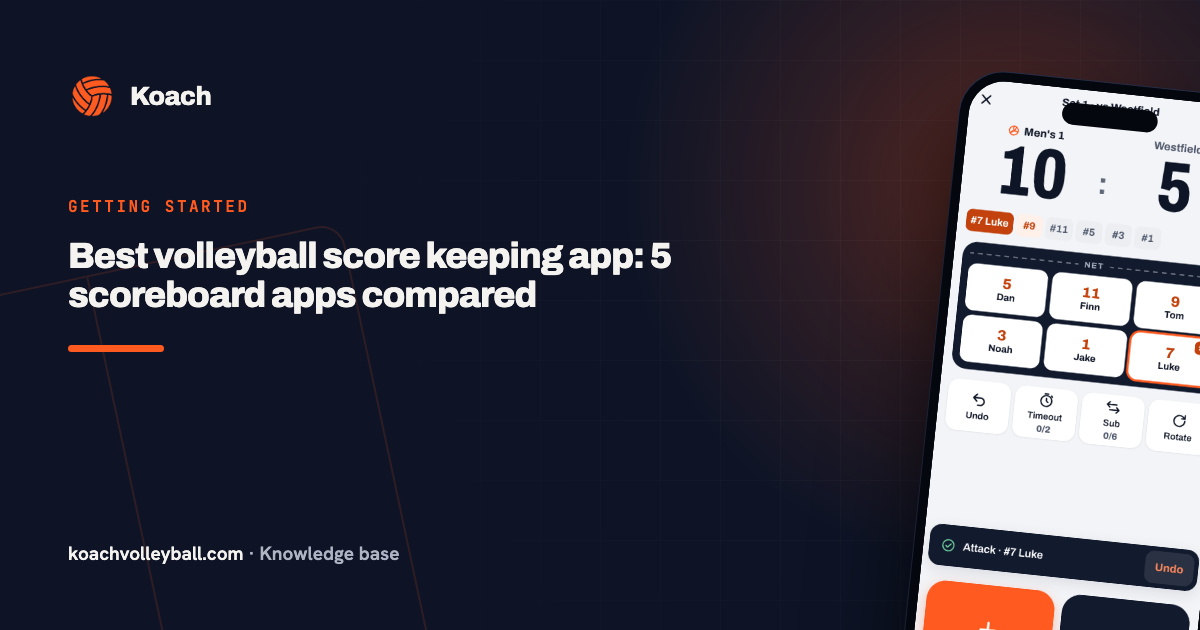
It could, but it is a different job. A scoreboard is for the hall; scoring in an app is for the team. In Koach the coach or an authorised player taps the big button of the team that scored after each rally, and the point is on the board straight away. Then a drawer slides up asking how. For a point to us that is How did we score?: attack, block, ace or an opponent's error, with only the players on court at that moment underneath, so you point out straight away who it was. For a point to the opposition the drawer asks Why did they score?, with the kinds of error. No time? Tap Skip and the point simply stays. Under the scoreboard sits the serving order; after every point a message appears with Undo, and the Undo button in the row takes back a mis-tap in the middle of a rally (see fixing a wrong point).
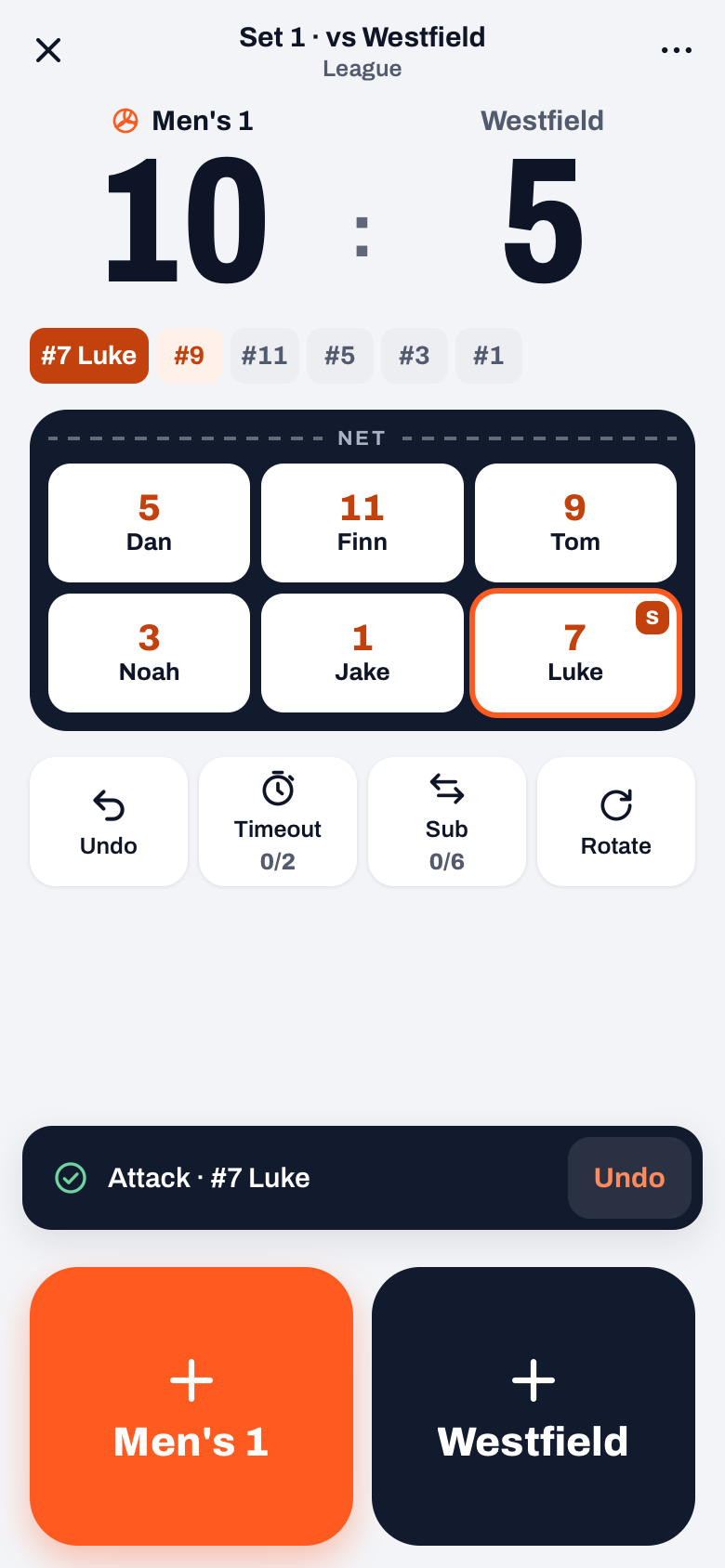
Be honest about the limit here: this is not a hall board. It stands upright on a phone in one person's hand, unreadable from the stand, and there is no display you can throw on a projector. If you want both — a board for the hall and a record that leaves you something — then in practice that is two people side by side at the scorer's table: one working the board and one scoring. How that scoring works and what comes out of it is in tracking a match live. Who that second person could be — a substitute, a parent — is in handing off live scoring.
The difference is in what is left over. The board is blank after the final rally. From the scoring you get a match report: the set scores, the points per player, the errors by type. That is the reason not to leave that job to a web page with no memory. And since sports hall wifi is the weakest link in this whole story, it is worth knowing that the scoring carries on when the network drops — see scoring live without wifi.
Choosing: two routes for two kinds of hurry
Due in the hall in half an hour? Use what you have. A laptop on a projector or a tablet upright on the table, a free scoreboard page on it, screen lock off, and one person who stays put for the whole match. Expect nothing from it afterwards. If you do want something to keep, put a second person next to them with a phone, scoring.
Sitting on a committee with a budget? Answer the five questions above first, readability test in front. Then choose between portable and fixed, and let two things settle it: do you play in one hall or several, and are you allowed to touch the wall. If in doubt, start portable — it is the cheapest way to find out what you really need, and it is not wasted if you later mount something after all. Whichever route you take, sort out the operating: who taps, where the instructions live, who charges it.
In short: a board shows the score to the hall, a scorer records what happened — two jobs, and usually two people. Test readability from the back row before you buy anything, and for every route agree who is going to keep tapping for the whole match.
Frequently asked questions
Can I put the scoreboard from my phone onto the TV in the hall?
With a cable, usually. Wirelessly, often not. Casting to a television requires both devices to be on the same network, and that is exactly the problem in a sports hall: guest wifi frequently blocks devices from talking to each other, and mobile data does not help here. An HDMI cable between a laptop and the screen is dull, but it works every time. If you want it wireless, test it once on a weekday evening in that same hall — not half an hour before the first match.
Does a free scoreboard in the browser work without internet?
Once the page has loaded it usually keeps working, because the counting happens in the browser itself. The risk is the reload: if the network drops and somebody refreshes the page, it will not come back and your score is gone. So open the page while you still have a connection, leave the tab alone and turn off the screen lock. And jot the set scores on paper after each set — it costs three seconds and saves your evening.
Do we still have to fill in the official score sheet if we have a digital board?
Yes. A board is communication to the hall and carries no status whatsoever; if there is a discrepancy, what counts is the official sheet signed off by the referee. Some federations now work with a digital match sheet on a tablet, but that is a separate application your federation specifies, not something you choose yourself. The board in the hall and that sheet are entirely unconnected.
How big do the digits need to be for a hall with a stand?
There is no number that holds for every hall, because it depends on viewing distance, lighting and contrast. So run the test instead of doing the sums: print a digit at the height the board offers, put it up where the board would go and stand on the furthest seat. If you hesitate even for a second, go bigger. Bright light from above and a glossy display can make a board that looks ample on paper unreadable in practice.
Try it yourself in Koach
Less admin, more coaching.
Get started with KoachOr read first what the volleyball coaching app does.