
Ball to the head: concussion in volleyball
A hitter swings through from two metres out and catches the blocker flush on the ear. She stays on her feet, laughs it off and picks up the next ball. There is no doctor in the hall, no parent, and the only person who has to decide something right now is you. Volleyball counts as a non-contact sport, and that is exactly why almost no club has a plan for this.
Why there is no protocol on your gym wall
Concussion is associated with rugby, ice hockey and football — sports where body meets body. Volleyball isn't on that list, so virtually no club writes a protocol for it. Yet the mechanism is perfectly ordinary in our sport: hardly ever a collision, nearly always the ball. A hard-driven ball from close range into the blocker's head, a serve into the face of a passer who looks up too late, a stray ball from the next court during hitting warm-up, or two heads meeting over a ball that drops exactly between two players.
Then look at when it happens. Not in the fifth set with a full stand, but on a Tuesday evening in the attacking block and in the warm-up, with twenty balls flying around the hall at once. That is precisely when there is no medical cover, no parent in the hall, and one adult on the sideline: you. This article gives you a plan for that moment. It is emphatically not a diagnosis article — establishing whether there is a concussion is a doctor's job, and a doctor is the exit in every scenario below.
Recognising it: losing consciousness is the exception
The most stubborn misconception is that someone has to have been knocked out first. That isn't true: in most concussions the player was never unconscious for a moment. The international consensus on concussion in sport (Patricios et al., British Journal of Sports Medicine, 2023 — the Amsterdam consensus) therefore describes a set of signs of which one is already enough to take the player off. For people without a medical background there is a one-page tool that goes with it: the Concussion Recognition Tool 6, CRT6 for short, free and written explicitly for coaches, parents and team managers.
What you can see from the outside:
- The player stays down or gets up strikingly slowly.
- A blank, absent look — the classic "where am I" second that lasts just a little too long.
- Clumsy movement, unsteadiness, trouble with balance, or a player who has to hold on to the net post.
- Reacting in a confused way, answering slowly, or an answer that doesn't match the question.
- Falling without breaking the fall.
What the player can tell you — and note that you have to ask about this actively, because almost nobody reports it spontaneously during a practice:
- Headache or "pressure in my head", neck pain.
- Nausea, vomiting, light-headedness or dizziness.
- Blurred or double vision, sensitivity to the hall lighting or to noise.
- Sluggish, tired, "like I'm in a fog", trouble concentrating or remembering.
- More emotional, more irritable or more restless than you know this player to be.
- The sentence you should take most seriously: "I just don't feel quite right."
Two things to remember. Symptoms can come up only after minutes or hours, so "she carried on playing afterwards" proves nothing. And this is a list for taking someone off the court, not for establishing anything: you don't need to know what it is, only that this child is not going back into the hall tonight.
The five minutes after the blow
Always do these six steps in this order. Together they take less time than a time-out.
- Stop play and don't leave the player alone. A team that plays on while you are looking at someone on the floor puts pressure on you. So blow the whistle, at practice too.
- Ask about the neck first. "Does your neck hurt? Does anything feel odd in your arms or legs?" If the answer is yes, or if the player is still down, you do not move them yourself. Then you wait for professional help.
- Run through the red flags (the list below). If one of them is there, you stop here and call.
- Ask the memory questions. Four short questions, out loud, and you pay just as much attention to how quickly the answer comes as to what is said.
- Work through the symptom list. Not "are you all right?", because everyone says yes to that. Instead: "do you have a headache, do you feel sick, is your vision normal, does the noise in here sound normal?"
- Note the time and what happened. One line is enough, but do it right away — in two days' time nobody will remember whether it was the third or the fourth drill.
The memory questions come from the CRT6 and are meant for players from around thirteen. In a match: "Which hall are we playing in?", "Which set is this?", "Who scored the last point?", "Who did we play last week?" At practice there is no score, so ask instead: "Which drill did we do before this one?", "Who was in your group?", "How did you get here?" One wrong or hesitant answer is enough. With younger players these questions work poorly — there, ask about the symptoms and trust what you see.
Red flags: here you don't wait
With any one of these signs you call your country's emergency number immediately and stay with the player:
- Neck pain or pain when the neck is touched.
- Weakness, tingling or a burning feeling in arms or legs.
- Double vision or vision dropping out.
- Severe headache, or a headache that gets worse quickly.
- Repeated vomiting.
- A seizure or convulsions.
- Loss of consciousness, however brief.
- A player who becomes increasingly drowsy or harder to keep awake.
- Increasing restlessness, agitation or aggressive behaviour that doesn't fit this player.
No red flag, but you do suspect something? Then no ambulance is needed, but a doctor is: same day to the family doctor or, outside surgery hours, to an out-of-hours service. That is the standard route, not excessive caution — after all, you cannot rule out that something is wrong.
If in doubt, sit them out — and not back that same day
This is the one rule you should know by heart, and it appears in roughly the same wording in every sports-medicine guideline: if in doubt the player comes off, and on the same day they do not return to the court — not in set four, not for the last twenty minutes of practice, not even if they feel perfectly fine after a quarter of an hour. Symptoms that seem to be gone after ten minutes come back that evening, and a second blow within the same period makes recovery longer.
Just as important is who decides. You have one switch and it only goes one way: off. Going back on is never your decision and never the player's own. Someone who has just taken a blow to the head is the worst-informed person in the hall about their own condition — that isn't a character trait, that is what the injury does. With youth players the same applies to the parent who thinks it isn't so bad; how to have that conversation without a row is in dealing with parents on the sideline. Say it briefly and without leaving room: "She took a ball to the head and I'm not letting her play again today. That isn't my judgement, that's the rule."
The rules side is simpler than coaches think: you just substitute the player, and if you have no substitutions left there are still options — the three-minute recovery time and the exceptional substitution are covered in injury during a match. Important with that: those three minutes are not thinking time. They exist to get someone off the court, not to see whether it might be all right after all.
What you tell the parent
With youth players your role doesn't end at the sports hall door. The parent collects a child who usually looks normal again, and unless you say so that child goes home to their phone and to school tomorrow as usual. So say four things in as many words:
- What happened and at what time. "At quarter past eight she took a hard-driven ball flush on the head. She wasn't knocked out, but afterwards she had a headache and was shaken up for a while."
- That a doctor needs to look at this today. Family doctor or out-of-hours service — not "if it hasn't gone by tomorrow".
- The red flags, out loud. "If she starts vomiting, if the headache gets worse, if she becomes drowsy or acts strangely: call the emergency number straight away."
- That someone stays with her for the first few hours and that she isn't driving or cycling home herself tonight.
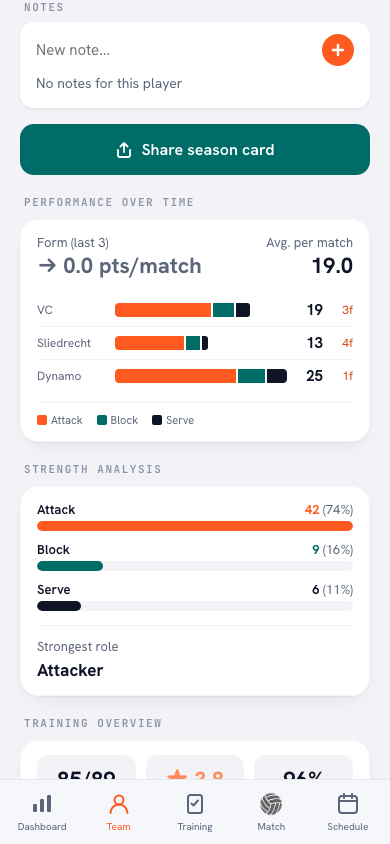
Send one message the next day, and make sure you can actually reach that parent at all: an up-to-date emergency number per player is the kind of admin you never think about until you need it — see which player details you keep as a coach. In Koach that number sits with the player, so in the hall you are on it within ten seconds.
Then record what happened: date, time, mechanism, which symptoms you saw, what you did and who you called. That isn't bureaucracy but the basis for the return — the doctor will ask about it and in three weeks' time you still need to know when step one began. A short dated player note is enough for that.
Back to school first, then the hall
Clubs skip this part as a matter of course, while with youth players it is the most important part. A concussion mainly affects the ability to concentrate, and you notice that first in the classroom: an hour of maths is heavier on a recovering brain than an hour of walking. The Amsterdam consensus therefore runs two tracks alongside each other — return to school and return to sport — with one hard order of precedence: only once a player can attend school full time does unrestricted sport belong at home. So someone attending half days does not start a full practice, however fit they look.
Return to school goes in four steps, each of at least a day:
- Daily activities at home that don't provoke symptoms.
- Schoolwork at home, in short blocks with breaks.
- Partly back at school, for example half days or with rest moments.
- Fully back at school.
Two nuances coaches often get wrong. Complete rest in a darkened room is outdated: the consensus advises relative rest for the first 24 to 48 hours, and after that carefully getting moving again, as long as symptoms don't rise sharply. And a child who gets symptoms at school takes a step back — that is normal and not a failure.
The six steps back onto the court
The return-to-play schedule from the Amsterdam consensus has six steps, with a minimum of 24 hours per step. Translated into volleyball:
- Daily activity that doesn't provoke symptoms. No sport yet.
- Light to moderate exercise without a ball: walking, easy work on a stationary bike, later brisk running. No chance of a blow to the head.
- Sport-specific work alone: running, approach rhythm without a ball, footwork, movement patterns. Still nothing that can come near a head.
- Training formats without collision risk: technical work with a ball at an easy tempo, but not at the net, not in a blocking duel and not in a defensive drill where two players dive for the same ball.
- Full practice — and this is the step a doctor has to clear first.
- Match.
The working rule at steps 2 and 3: a mild increase in symptoms of at most two points on a scale of ten, which subsides within an hour, is acceptable. More than that means a step back and another attempt after 24 hours. On the timeline: the consensus describes most adult athletes recovering within roughly two weeks and most children and adolescents within roughly four weeks. So faster is possible, but with youth players four weeks is not an alarm signal. Some federations also apply their own protocol with a prescribed minimum period for youth; that differs per country, so check it with your own federation.
What you arrange before the season
- Print the CRT6 and put it in the first-aid bag. One page, free to download, available in many languages. In the moment itself nobody reads an article.
- Keep emergency numbers up to date for every player, seniors included.
- Agree who decides. Normally the coach; if the coach is also the parent of the player involved, the team manager. Write it into your club handbook, then nobody has to invent it on the spot.
- Make reporting normal. At the start of the season say in as many words that a blow to the head is always reported and that nobody suffers for it in the lineup. In a team where playing through pain is the norm, you never hear about it — the same habit that makes the difference in injury prevention.
- Take the risk out of your warm-up. No hitting with balls coming from two directions, no players walking across the hall with their backs to the hitting lines, and balls cleared away before the attacking drill starts. How to build that sequence is in building a warm-up.
This costs you half an hour in September. On the evening it happens you are sorted in five minutes — and that is exactly the time you have then.
Important: this article describes how you act and refer on as a coach, not treatment advice and not a way to establish or rule out a concussion yourself. With any suspicion of a head injury: the player comes off and sees a doctor the same day; with a red flag, call the emergency number immediately. The return to the court is determined by the treating doctor, not by the calendar and not by you.
Frequently asked questions
Can a player carry on after a ball to the head?
The moment you have any doubt that something is wrong, no: the player comes off and does not return to the court that day. That applies at practice just as much as in a match. Symptoms often only appear after minutes to hours, so feeling fine straight after the blow tells you nothing.
Is there always a loss of consciousness with a concussion?
No, in most concussions the athlete was never unconscious for a moment. Far more often you see confusion, a blank look, slow answers, headache, nausea or dizziness. Waiting for a loss of consciousness before taking someone off is exactly the mistake you want to avoid.
When do I call the emergency number and when a doctor?
Call the emergency number for neck pain, tingling or weakness in arms or legs, double vision, severe or rapidly worsening headache, repeated vomiting, a seizure, loss of consciousness, or a player who becomes increasingly drowsy or agitated. Without those signs, but with a suspicion: a doctor the same day.
How long before a player can play volleyball again?
The international consensus describes most adult athletes recovering within roughly two weeks and most children and adolescents within roughly four weeks. The return runs through six steps of at least a day each, and from full practice onwards a doctor's clearance is needed. Some federations also apply their own minimum period for youth — check that with your own federation.
Does a youth player have to be back at school first?
Yes, that is the order set out in the Amsterdam consensus: only once a youth player is attending school full time does unrestricted sport belong at home. Concentrating costs a recovering brain more than moving does, so a child attending half days should not be starting a full practice.
Who decides whether the player can take part again?
Not the coach and not the player. You only decide about taking someone off; the treating doctor decides about the return. A player who has just taken a blow to the head is poorly placed to judge their own condition — that is a consequence of the injury, not a question of toughness.