
Osgood-Schlatter: can this player jump tonight?
A thirteen-year-old points at his knee after the warm-up. It has hurt for three weeks, he hasn't mentioned it because he wants to play on Saturday, and the attacking block starts in eight minutes. You have no diagnosis and you aren't going to make one — you need a decision for tonight. This article is about that decision.
Two complaints that seem to sit in almost the same place
Plenty of coaches write down "knee pain" and immediately think of jumper's knee, because that is the best-known knee complaint in the volleyball world. In a growing child that is often the wrong turning. The two sit a few centimetres apart, but they are different tissues, a different age group and a different timeline — mix them up and you steer the load the wrong way.
Osgood-Schlatter sits on the bump of the shin bone, two to three centimetres below the kneecap, where the patellar tendon attaches to the bone. In a child who is still growing, that attachment point is a growth centre and therefore the weakest link: the tendon there is stronger than the piece of bone it pulls on. So the complaint doesn't start in the tendon but on the bone underneath it. Jumper's knee sits in the tendon itself, directly below the lower edge of the kneecap, and occurs at any age — including in the fully grown senior.
Five things that let you get a sense of the difference in the hall:
- Have the player point at it with one finger, not with a flat hand — a flat hand covers both spots. A finger on the bump of the shin bone points towards Osgood-Schlatter, a finger in the tendon just below the kneecap towards jumper's knee.
- Look at the age. Osgood-Schlatter belongs to a body that is still growing: the years around the growth spurt, on average earlier in girls than in boys. In a player who hasn't grown for two years it is practically never the first thought.
- Ask about kneeling. With Osgood-Schlatter the bump is often thicker and tender: kneeling on a hard hall floor or a ball against that spot hurts. That hardly fits jumper's knee.
- Watch the pattern within a session. A tendon complaint classically fades during the warm-up and comes back towards the end; complaints at the attachment respond more directly to the jump itself and to deep knee bend.
- Look at the course of it. Ladenhauf et al. described Osgood-Schlatter in Current Opinion in Pediatrics (2020) as a complaint linked to growth that usually resolves as the skeleton matures, with load management as the core of the approach. Jumper's knee doesn't go away by itself when a child finishes growing; there something has to change in the build-up or in strength.
That last point is why the distinction matters to you. In a growing player with complaints at that attachment, the clock is your ally and you adjust the load until the body catches up. With a tendon complaint, time is not an ally and something has to change in the build-up; that is in injury prevention in volleyball. And straight away the most important limitation: this distinction is meant for your planning, not for a diagnosis. The two can exist alongside each other, and other causes look exactly the same in the hall. Establishing what it is, is for a doctor or physiotherapist.
Why volleyball players in particular get this
This complaint isn't bad luck but a dose that is set wrong, and sporting children get it far more often. Kujala et al. found in the American Journal of Sports Medicine (1985) 21 per cent in sporting adolescents against 4.5 per cent in non-sporting peers of the same age — almost five times as many. No argument for children to stop playing sport, but every reason to know what you are doing once it appears: in a jumping sport you are by definition in the risk group.
In volleyball the nature of the load comes on top of that. A session with attacking and blocking series stacks up maximal jumps faster than you think — further on you count that up drill by drill — and every approach ends with a braking step in which the thigh muscle has to decelerate the whole body; that muscle pulls, via the patellar tendon, on exactly the bump where it hurts. The sting is that this coincides with the months in which the child is growing fast and coordination lags behind the new height; what else changes then is in what a growth spurt does to a youth player. And it is about the whole week, not just your session: the squad session on Wednesday, Sunday's tournament and the PE lesson all count just as heavily, as worked out in how often 10- to 14-year-olds can train.
The Tuesday-evening question: three sentences and a number
You don't need a protocol but a fixed twenty-second routine. Three questions, to be said word for word:
- "Point with one finger to where it is."
- "From nought to ten: how much does it hurt right now, standing still?"
- "And how much did it hurt this morning when you got out of bed?"
On that number you hang three zones, agreed with the player and the parents before you need them. Note: this is a working arrangement for organising the evening, not a medical threshold. If a physiotherapist or doctor is involved, their limits apply.
- 0 to 3 — green. Joins in like the rest, but you keep asking for the number every session: the value is in the series, not in the individual measurement.
- 4 to 5 — amber. Joins in with a jump ceiling. Everything that happens on the floor carries on as normal; maximal jumps you count and cap, for example at fifteen across the whole evening, spread through the session rather than in one block.
- 6 or higher — red. No jumps and no approaches. The player does stay in the hall with a real job: serving without a jump, setting, feeding, or reading the opposition during match play.
Two rules override the number. If the player limps or is visibly moving differently, the score is irrelevant and it is red. And if the pain climbs during the session — started at 3, halfway through 6 — you stop the jumping at that moment, regardless of where you started.
The next morning is your real measuring point
You don't know what a session cost afterwards but the day after. The rule: the score on getting up must be back at the level from before the session. If it is higher, yesterday was too much and the jump ceiling drops by around a third next time — from fifteen to ten. If that happens twice in a row, you go back to red and refer on.
It is the only measurement that is genuinely useful to a coach, and even then only if you take it the same way every time: the same question, the same moment. Improvise it and the player starts guessing. So fix it into your routine: on arrival, together with taking the register.
Which drills in your session are the most expensive
If you are going to manage the dose you need to know where the bill sits, and it is rarely where coaches expect it.
- Approach series and attacking lines. Per jump the most expensive format in your whole session, because the braking step of the approach sends a large deceleration force through exactly that muscle and tendon. Four balls per turn, three rounds: twelve maximal jumps in ten minutes, and that is usually only one block of the evening.
- Blocking drills at the net. Lighter per jump, but the numbers climb fast: a run along the net with six blocks, repeated five times, is thirty jumps in six minutes. Coaches rarely count this because it looks calm — see blocking: technique and timing.
- Jump-power blocks and jump serving. Deliberately maximal, and therefore the first thing you scrap on amber.
- Anything where the child lands on the knee or kneels. Defending with a dive, starting from the knees, setting while kneeling. Costs not a single jump and still often produces the complaint afterwards: direct pressure on the painful spot.
- Long low positions and deep lunges. Calm-looking work that keeps the thigh muscle pulling for a long time. Don't ban it, but do count it.
Almost everything can be swapped without the player missing anything. Instead of the attacking line: attacking from standing off a high feed — the arm swing, the timing and the direction all stay, only the jump disappears. Instead of the blocking run: block footwork along the net, with the hands above the net only on the last step. Instead of the jump serve: an overhand serve from the floor into a target zone. Instead of the plyometrics block: core stability, single-leg balance and landing technique from strength training for volleyball players. The player isn't training less, he is training differently — and that can be explained without sounding like a punishment.
An evening on amber, written out
This is what ninety minutes look like for the player sitting on four or five, while the rest train on:
- 0 to 15 minutes — warm-up. Joins in fully, just no jump series at the end. How to build that is in building a warm-up.
- 15 to 35 minutes — technical block on the floor. Passing, setting, serving. Zero maximal jumps, and for this player the most valuable part of the evening.
- 35 to 55 minutes — attacking block. Two rounds of four balls, so eight jumps, and after that switch to attacking from standing.
- 55 to 80 minutes — six against six. This is where the jumps you aren't steering sit. Put him in the back court or let him play two of the four rally blocks: count on seven jumps.
- 80 to 90 minutes — cool-down. Joins in as normal.
The bottom line: fifteen maximal jumps against the forty to fifty of his teammates, with all ball contact intact. That is the difference between training on and limping on. And once more: this is a session plan, not a treatment plan — if a physiotherapist is involved, this is the overview you use to ask whether the ceiling is right.
The referral threshold: where your judgement stops
You establish nothing. The name Osgood-Schlatter belongs in the mouth of a doctor or physiotherapist, not in yours and not in the team chat. What you do do is know the point at which you stop waiting. Send the player on with any of these signs:
- Pain at rest or at night, or pain that keeps the child awake.
- Swelling, warmth or redness around the knee.
- Pain that started at one moment: a bang, a jolt, a mis-step during a jump or landing — a different story from a complaint that built up over weeks.
- A knee that gives way, locks or feels unstable.
- Limping that lasts longer than two or three days.
- Pain somewhere other than on that bump: higher, at the side, or radiating upwards.
- Fever, feeling ill or unintended weight loss alongside it.
- No improvement at all after two to three weeks with a lowered jump ceiling.
How you reach such a professional differs by country and sometimes by insurer: directly to a physiotherapist, via the family doctor, or via a club or sports physician. Ask the parents rather than assuming. Hand over what you have noted — since when, where the finger points, which numbers, how many jumps — and no judgement. Once somebody is involved, their ceiling beats yours. Don't invent exercises, tape or supports of your own: that isn't your trade.
What you say to the player and the parents
The biggest risk with this complaint isn't the knee but the silence: a thirteen-year-old who thinks that speaking up will cost him his place trains on until he can't any more. Take that fear away in three sentences, preferably before anything is going on:
- "I'm not taking you out of training, I'm going to count your jumps."
- "Every Tuesday I'll ask for your number, and that number decides what you do that evening — not how important Saturday's match is."
- "If you give me a lower number than it really is, you'll be out for longer, not shorter."
With the parents you keep the same line, but more factual: what you saw, since when, what you have adjusted, and that you aren't making a diagnosis. Ask whether they will see a physiotherapist or family doctor, and say explicitly that the place in the team doesn't depend on these weeks. That isn't kindness but necessity: without that promise you stop getting honest numbers. Also ask about previous knee complaints as standard when you collect the player details you actually need. And keep the perspective in view: a player who doses sensibly for three months at thirteen is still playing at eighteen — the reasoning behind long-term player development.
What you note down, and what you look for in that trend
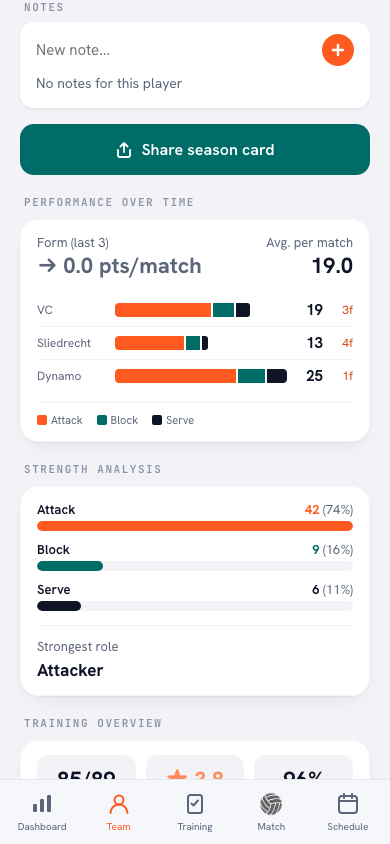
Without records this becomes a matter of feeling, and feeling is unreliable here: you remember the evening it went wrong and forget the five that went well. Note five things per session: date, score beforehand, score the next morning, number of maximal jumps, and what you adjusted. In Koach you put such a note with the player himself, next to the attendance, so that the overview travels with you to the conversation with the parents or the physiotherapist.
What you are looking for in that trend is not whether the pain has gone, but whether the ceiling can go up. If the morning score stays the same or lower for three weeks running at the same number of jumps, you raise it by five jumps at a time, no more. If it shoots up, you know at which number it went wrong. It is no more complicated than that.
Key point: you make no diagnosis and give no treatment — you adjust the dose. Have the spot pointed out, ask for the number, count the maximal jumps and check the next morning whether the score is back at its old level. If it stays higher, or if one sign from the referral list is present, it is a doctor's or physiotherapist's turn.
Frequently asked questions
Can a player with Osgood-Schlatter carry on playing volleyball?
Whether they are allowed to play is decided by the treating doctor or physiotherapist — that is not a coaching decision. What you organise is the dose within that space: the number of maximal jumps per session, which drills you swap out, and whether the pain score is back at its old level the next morning.
What is the difference between Osgood-Schlatter and jumper's knee?
Osgood-Schlatter sits on the bump of the shin bone, two to three centimetres below the kneecap, where the patellar tendon attaches to the bone, and occurs in children who are still growing. Jumper's knee sits higher, in the tendon directly below the kneecap, and occurs at any age. Have the player point at it with one finger; that separates the two faster than any question.
How long does it take before the complaint goes away?
That differs per player and can't be planned in weeks. Ladenhauf et al. (Current Opinion in Pediatrics, 2020) describe the complaint as linked to growth, resolving as the skeleton matures. So count in months and manage the load in the meantime; the bump itself can remain visible, incidentally, long after the pain has gone.
How do I know whether a session was too much?
From the score on getting up the next morning, not from how the player walks afterwards. If that morning score is higher than before the session, it was too much and you lower the jump ceiling by about a third next time. If that happens twice in a row, you stop the jumping and refer the player on.
Should I take such a player out of the squad or the first team?
No, and say so out loud. A child who thinks speaking up will cost him his place hides the pain and trains on until he can't any more — and then you lose him for far longer. Separate the place in the team from this period and only reassess once the load is back to normal.
Does a strap or tape below the kneecap help?
Anything that goes on or around the knee is a decision for the treating physiotherapist or doctor, not for the coach. Take such a question from parents seriously but pass it on, and don't invent exercises or supports of your own. Your instrument is the dose in the hall.