
From season to season: long-term development
By August nobody remembers exactly how good the new middle blocker actually was last season — let alone the season before. Human memory reaches back three months; development spans years. Only data fills that gap.
Why multi-year data is the fairest measure
Within a single season everything distorts: an injury, a strong division, a new position. Across multiple seasons those disturbances average out and the real line remains — is this player getting better every year, levelling off, or coasting on old skill? For the big decisions (team placement, promotion advice, captaincy) that is the question that counts.
What to record at every season transition
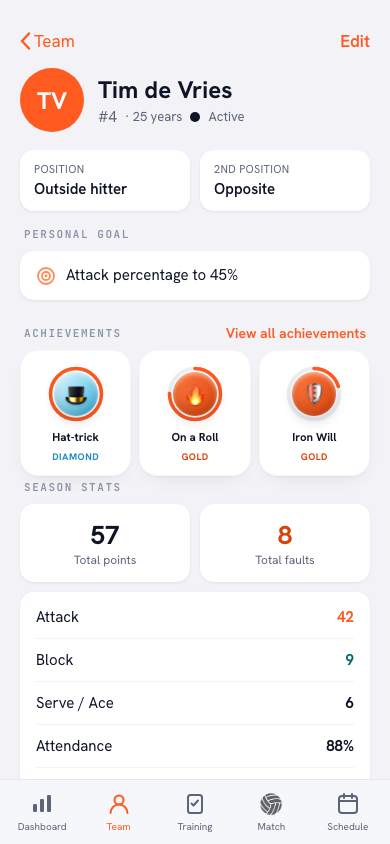
- The final numbers: points per match, the production split, attendance and effort — that year's profile.
- The goal and the outcome: did they reach their season goal? The series of goals-over-years is a development story in itself.
- One summarising note: three sentences per player at the season wrap-up — the context numbers can no longer provide two years later.
Reading the long line
The climber (better every year) deserves a challenge — a higher team, a heavier role, before they get bored. The plateau player is not 'done' but ready for something different: a new position or a new kind of goal often breaks the flatline. The decliner deserves an honest conversation about causes — age, motivation, workload — before the team has that conversation for you. In all three cases the same holds: the long line lifts the conversation out of the emotion of the last season.
Start today, harvest in two years. Multi-year data has one unforgiving property: you cannot collect it retroactively. Every consistently recorded season is a gift to the coach you will be in two years — or to your successor.
Frequently asked questions
What if a player switches teams or clubs?
If the club moves them to another team in Koach, their numbers travel along: the new coach sees them under Previously with other teams. They don't carry over to another club. A new context does mean recalibrating — numbers from the third division and the promotion division are not apples to apples. The trend stays readable, the level shifts.
How do I compare seasons with different numbers of matches?
Convert to averages per match or per set instead of totals. Twenty more points in a season with five extra matches is not growth — the same average against stronger opposition is.
Is long-term data also useful for recreational teams?
More modestly, but yes: there too you want to know whether someone is still growing or mainly along for the fun (both fine — but the conversation differs). And attendance trends over years predict who you will still have next season.
Try it yourself in Koach
Less admin, more coaching — starting at your next practice.
Get started with KoachOr read first what the volleyball coaching app does.