
Shoulder problems in volleyball: spotting and tackling them
There are sixteen shoulders in your gym and you have zero extra minutes. Almost all of those shoulders repeat the same hitting action dozens of times a session, and when one of them breaks down it happens without a moment: no fall, no bang, no player putting a hand up. Shoulder problems in volleyball therefore belong to the kind of injury you never get told about. You have to see it or measure it, or the first signal is a player dropping out in February.
You won't hear it, so you have to measure it
Two figures put this whole article in perspective. In one study among school volleyball players, more than half of the girls had non-traumatic shoulder pain — pain, in other words, that had appeared without any accident. And nearly seven out of ten of them had not told their coach. That is one research group and not a law of nature; in your gym the numbers may well be lower. But the ratio is the point: most shoulder pain in a squad is invisible to the coach.
That players stay quiet is easy to explain. There is no moment you can report: the pain sits in the hitting and disappears in the changing room, it is worse one week and better the next, so "it will go away" holds up for a while. And whoever reports it may lose the attacking role. Everything that normally gives a coach information — a player walking off, an injury report, a player pulling out of practice — is missing here.
The practical conclusion: if you don't actively ask and write it down, you don't know. Ask the same question every week at the same moment, for example at the start of the first session: does anyone have pain anywhere that comes up when hitting? Write the answer down, even if it is "a bit". Only once you keep those answers per player do you see the difference between one stiff evening and three weeks in a row of the same shoulder — which is exactly what player notes are for.
How a volleyball shoulder breaks down
The hitting action is one of the fastest movements in sport, and the hardest work is not in the hitting but in the braking. In the cocking phase the upper arm rotates far back (external rotation), at contact it whips forward at maximum speed, and then that same arm has to come to a stop within a fraction of a second. That braking is done by the small muscles around the shoulder blade and the rotator cuff — the group that holds the head of the humerus in the socket. They are not big, and they do it dozens to hundreds of times a session.
Under repeated overhead load three things shift, usually all three at once and always slowly:
- Internal rotation drops off. The hitting shoulder goes further back than the other one, but comes less far forward and inward. In sports medicine that difference is called GIRD (glenohumeral internal rotation deficit). You don't measure it as a coach, but you can see it: have a player slide a hand up their back and compare left with right. If the hitting arm stays clearly lower, that is a point of attention, not a diagnosis.
- The control of the shoulder blade changes. The shoulder blade is supposed to rotate along and stay flat against the ribcage. Once that control fatigues, the arm reaches higher than the shoulder blade can follow, and the space the tendons run through gets tighter. Visible sign: a shoulder blade that lifts off the back as the player slowly lowers the arm.
- The balance between hitting and braking tips over. Volleyball trains the hitting action hundreds of times a week and the brakes zero times: the strong side gets stronger, the protective side falls behind.
Because there is no moment, there is no clear line either. A shoulder that works under too much load for three months only speaks up once the slack is gone. With youth there is an extra factor: during a growth spurt the lever of the arm changes while the control lags behind — and that is precisely the year they want to learn the jump serve.
The four signs you can see from the sideline
You don't need a test battery. Four things are visible to the naked eye, and they usually appear in this order.
- The loosening-off between drills. The player swings the arm around, kneads the back of the shoulder, or hangs it in a doorway for a moment. Harmless in itself; three sessions in a row from the same player is a report that has not been spoken out loud.
- The hitting picture changes. The line shot disappears from the repertoire, the contact point drops, and the player starts turning more with the torso and less with the arm. A hitter who suddenly only goes cross-court is rarely choosing that tactically.
- Hits get avoided without a word. From now on the player tosses underhand, joins the back of the hitting line, lets someone else start the serving drill, or skips a round in the hitting warm-up. In a motivated player that behaviour stands out more than pain does.
- The serve gets softer or different. From jump serve back to float "because it lands better", or a float serve that no longer reaches the end line. Count the jump serve as a heavy hit: it asks clearly more of the shoulder than a float serve does.
Two signals you only get by asking, and they weigh more than everything above: pain at night and pain when putting on a coat. Those do not belong to training stiffness.
Count hits, not stretching minutes
Most teams respond to shoulder problems with stretching. That is a small part at best; the dial you really turn is the number of hard overhead hits per week — a figure almost no coach knows, while it is free to count.
First define what you count: every ball struck overhead with force, so spikes off an approach, serves and hard hitting in the warm-up. Not: setting, passing, blocking or tossing. Count it properly once for two or three players and estimate after that. A worked example for an ordinary Tuesday evening for an outside hitter:
- Hitting warm-up at the start: 10 to 20 hits.
- A 15-minute hitting block, six hitters taking turns at one net, three balls per turn: that is roughly four to six turns per player, so 12 to 18 hits.
- A 10-minute serving drill with their own balls: 30 to 50 serves — almost always the biggest block, and the block coaches underestimate most.
- 30 minutes of 6-v-6: 15 to 30 hits per attacker, depending on how many balls run through that position.
Add it up: between 65 and 120 hard hits on a midweek evening, and a match day with a hitting warm-up and four sets easily goes beyond that. On those numbers you build two agreements that cost nothing.
Agreement one: never two heavy hitting days in a row. Call a day heavy as soon as it goes above that player's average, and always treat a match day as a heavy hitting day. Between two heavy days there is at least one day with no hard overhead hitting. In practice that means: if there is a match on Saturday, Thursday's session is not an attacking session. Train passing, defence, blocking, setting and tactics on Thursday — all things you do too little of anyway.
Agreement two: after every break you start at half. After a holiday, a week of illness or an injury lay-off, the first attacking session is a half one — not because the player is weaker, but because the tissue has lost the frequency. The classic mistake is the first week after the winter break: everyone fresh, everyone keen, three hundred hits in four days.
And don't forget that technique also determines the load: a player who gets power from the arm instead of from the approach and torso rotation loads the shoulder more heavily for the same result. Working on the attack approach therefore pays off physically too.
The early warning that is already in your statistics
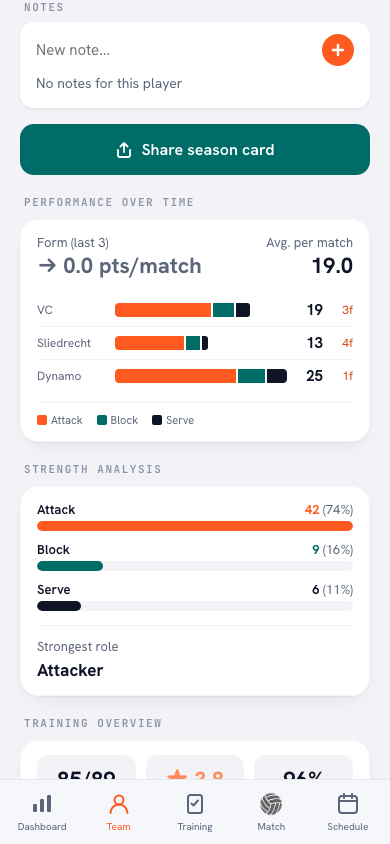
If you track matches, you have a second measuring instrument that costs nothing extra. Look per player at the hitting percentage alongside the share of tips and off-speed shots. The combination that matters: a falling hitting percentage while the share of tips goes up. That is the pattern of someone who no longer dares or is no longer able to hit the ball full. If a whole team does it at once, it is more likely fatigue or tension — that pattern is described in overload in your team. If it stays with one player over three or four matches, that one arm is the first thing you look at.
Add the serving numbers: fewer aces and more safe serves from the same player point the same way. In Koach those figures sit under each other per player, but a notebook with four columns does the job just as well — the value lies in the comparison with that player's own previous month.
That signal is not proof, it is a reason for a ten-second question: "you've been tipping a lot more than usual these last few weeks — is there something in that shoulder?" Often you get a tactical answer and your theory turns out to be wrong. In the other cases you have gained weeks.
What you change as soon as someone complains
A player with shoulder pain does not, in most cases, have to leave the court. What does have to happen is that the load goes down and that you measure the effect. For the first two weeks:
- Halve the number of hard hits rather than scrapping them. Complete rest takes the player out of the team and does not by itself make the shoulder better able to cope with hitting.
- Take out the peak. No jump serves, no "just ten more balls hit full" at the end of the session, and no hitting when already tired — the hits at the end of a session are the worst technically and the most expensive physically.
- Give the player a full session without hitting. Passing, defence, blocking, underhand tossing, coaching roles in a game drill. Someone who feels useful reports the next problem sooner.
- Use the morning test. The rule for the player: pain during hitting that has gone by the next morning is acceptable. Pain that is worse the next morning means yesterday was too much. That one rule gives the player their own yardstick and saves you ten arguments.
- Set an end date. Two weeks adjusted, then look again. Without a date, "take it easy for a bit" becomes half a season of half participation.
The eight-minute routine
There is one piece of content that genuinely belongs in a volleyball gym and that almost never happens: work for the rotator cuff and the control of the shoulder blade. Eight minutes, two to three times a week, with a resistance band. Put it before the first hard hitting, straight after the activation part of your warm-up.
- External rotation with the elbow at the side. Elbow at 90 degrees, rotate the forearm outwards against the resistance, and return under control over three counts. 2 sets of 15 per arm. That slow return is half the work: it is exactly the movement the arm has to brake with in the gym.
- External rotation at shoulder height. Elbow at shoulder height, forearm upright, rotating from the hitting position. Light resistance, 2 sets of 10 per arm. This is the position the shoulder works in during a spike, and therefore the position it has to be strong in.
- Shoulder blade down and in. Band in front of you, pull the straight arms apart at chest height while keeping the shoulder blades low, 2 sets of 12. The aim is not to train the back but to find the control again.
- Wall slide. Forearms against the wall, slide slowly upwards and let the shoulder blade rotate along, 2 sets of 10. Anyone who shrugs up towards the ears here is watching their own problem in slow motion.
- Only if internal rotation is clearly reduced: a gentle stretch of the back of the shoulder, arm straight across the chest, 3 times 30 seconds, only on the hitting arm and never into pain. Add another minute and a half for that.
Choose the resistance so that the last repetition is still clean: this is control work, not strength work. Building further on pulling strength and the trunk belongs in a proper strength programme, outside gym time. And the broader set of habits that protects ankles, knees and shoulders is in injury prevention.
Return: from pain-free to full hitting
The way back is where it most often goes wrong again: a shoulder that does not hurt in daily life is a long way from a shoulder that can hit a hundred times. Work in steps, with at least one day in between, and only move on when the previous step came through without after-effects:
- Pain-free setting and forearm passing, a full session with no hitting.
- Ten calm hits from knee height, standing still, half power.
- Twenty hits with an approach but no jump, three-quarter power.
- Thirty hits with a jump, and only now serving again — float first, jump serve last.
- Two full sessions at normal volume without after-effects; then match minutes.
That is six sessions — step five counts as two — and therefore about three weeks at two sessions a week; longer as soon as a step has to be repeated. The order is fixed, the pace is not: that is up to the physiotherapist or doctor treating the player. What you guard is that no step gets skipped because there happens to be an important match on Saturday — that temptation is the real risk.
When you refer on
There are signs where you don't adjust but refer. Send the player to a (sports) physiotherapist or doctor for: pain that comes up at night or wakes them, loss of strength (unable to hold the arm out sideways at shoulder height against light resistance), tingling or numbness in arm or hand, a shoulder that has dislocated, a shoulder blade that visibly stands off the back, or complaints that have not eased after two to three weeks of adjusted load.
How you get to such a professional differs by country: sometimes you can go straight to a physiotherapist, sometimes a referral is needed first, and reimbursement varies too. Look that up once and record it in your club agreements. This article describes what a coach can see and adjust; it is not treatment advice.
Key point: shoulder problems in volleyball are a load problem, not a stretching problem. A coach who knows the number of hard hits per player per week and applies the rule that two heavy hitting days never follow each other does more for sixteen shoulders than all the stretching exercises put together.
Frequently asked questions
Can a player with shoulder pain keep training?
Usually yes, but with fewer hard hits and without peaks such as jump serves or hitting full at the end of the session. Use the morning test: pain that is worse the next day means the load was too high. With loss of strength, night pain or tingling, stop hitting and refer the player on.
How many spikes and serves are too many per session?
There is no universal number, because it depends on what that player is used to. More practical is the comparison with their own weekly average and the rule that two heavy hitting days never follow each other — a match day counts as a heavy hitting day.
Why don't players say anything when their shoulder hurts?
Because there is no moment you can report: the pain builds up gradually, only shows up when hitting and varies from week to week. On top of that, reporting it can cost playing time. In one study among school volleyball players, nearly seven out of ten with shoulder pain had not told their coach — one group, but it gives you the ratio.
Does stretching help against shoulder problems in volleyball?
A gentle stretch of the back of the shoulder can be worthwhile if internal rotation is clearly less than on the other arm, but it does not solve too high a hitting load. Strength work for the rotator cuff and shoulder blade control, plus a lower number of hard hits, delivers more.
From what age should I watch shoulders in youth players?
As soon as players start serving and spiking overhead on a regular basis, so usually around twelve or thirteen. Pay extra attention during a growth spurt and at the moment a youth player wants to learn the jump serve — those are two jumps in load that often coincide.
What do I do if a player only complains after a tournament?
Treat a tournament day as several heavy hitting days stacked into one and lower the load in the following week, even if the complaint is mild. Complaints that have not eased after two to three weeks of adjusted load belong with a physiotherapist or doctor.