
Spotting overtraining: team trains hard, gets slower
Your team has trained twice a week since September, hardly anyone skips a session, and yet it is going worse. The pass is sloppier, the serve safer, and on Saturday it falls apart between 15 and 20. The reflex is to add a practice or to intervene harder. With a team that is no longer recovering, that is exactly the wrong direction.
Why a whole team drops off at once
For an individual endurance athlete, overload is a personal story: own schedule, own choices. In a team it works differently, because twelve players share one calendar. They do the same practices, play the same double match weeks, drive to the same tournament and come back from the same break. If the load goes up, it goes up for everyone at once. And that gives you your sharpest distinction: if one player drops off, it is about that player; if five of the twelve drop off in the same four-week block, it is about your calendar.
The sting is that the training schedule looks unchanged all the while. Still two evenings, still ninety minutes. What did change: the matches got harder, the rallies got longer, a tournament was added, and after the break the team started straight back at the level it had left off. Gabbett (2016) summed that up in the British Journal of Sports Medicine as the core of the problem: it isn't the height of the load that predicts trouble, but the jump relative to what the body is used to. The exact calculation method behind that idea has since drawn methodological criticism, but as a way of thinking it holds up: every break and every stepped-up week is a jump, and jumps cost recovery.
Distinguish three states that look identical on the gym floor. Acute fatigue comes with every hard practice and is gone after a night or two. Functional overreaching is something you seek out deliberately in a heavy block: output dips temporarily and bounces back after a lighter period, within days to a week or two. Non-functional overreaching gives the same picture, but the recovery doesn't come — weeks to months in which rest delivers nothing. Behind that lies overtraining syndrome, and that is not a coaching term but a medical diagnosis: the joint statement from the European College of Sport Science and the American College of Sports Medicine (Meeusen et al., 2013) explicitly describes it as a diagnosis of exclusion. That is liberating, because you don't have to establish what a player has. You lower the load and see whether the output comes back. If it comes back, you have done your job; if it doesn't, you hand it on. That test takes two weeks and it is the only one you can run yourself.
The four numbers that tip first
You don't need hardware to measure that jump. The signals are already in what you record, provided you put them side by side and look in four-week blocks rather than week to week. Four weeks is short enough to still intervene and long enough to average out the noise of flu, holidays and one bad evening.
- The group's attendance percentage. Not who is missing tonight, but the average across four weeks against the four weeks before. A team that is dropping off pulls out before it complains.
- The reason given when pulling out. This is the sharpest signal and the least measured. Of your last ten cancellations, count how many gave a concrete reason — work, school, injury, family — and how many just said "can't make it". If that ratio shifts towards no reason, it is the motivation disappearing, not the diary.
- Average effort across the whole group. One player drifting through one evening means nothing. Half a point of decline on a five-point scale across six or more players in the same block is rarely coincidence — how to give that score consistently enough to be useful is in average effort per player.
- Output against risk in matches. Put your hitting percentage next to the share of tipped balls. If the percentage falls while the share of tips rises, your team is choosing safety. That is rarely tactics. That is a side without the strength or the confidence to go through the ball any more.
A fifth number comes free: unforced errors per set. If those climb while the training hours stay the same, the same practice is costing more than it delivers. Everything above is already in your own records — in Koach on one practice overview per player, and just as well in a notebook.
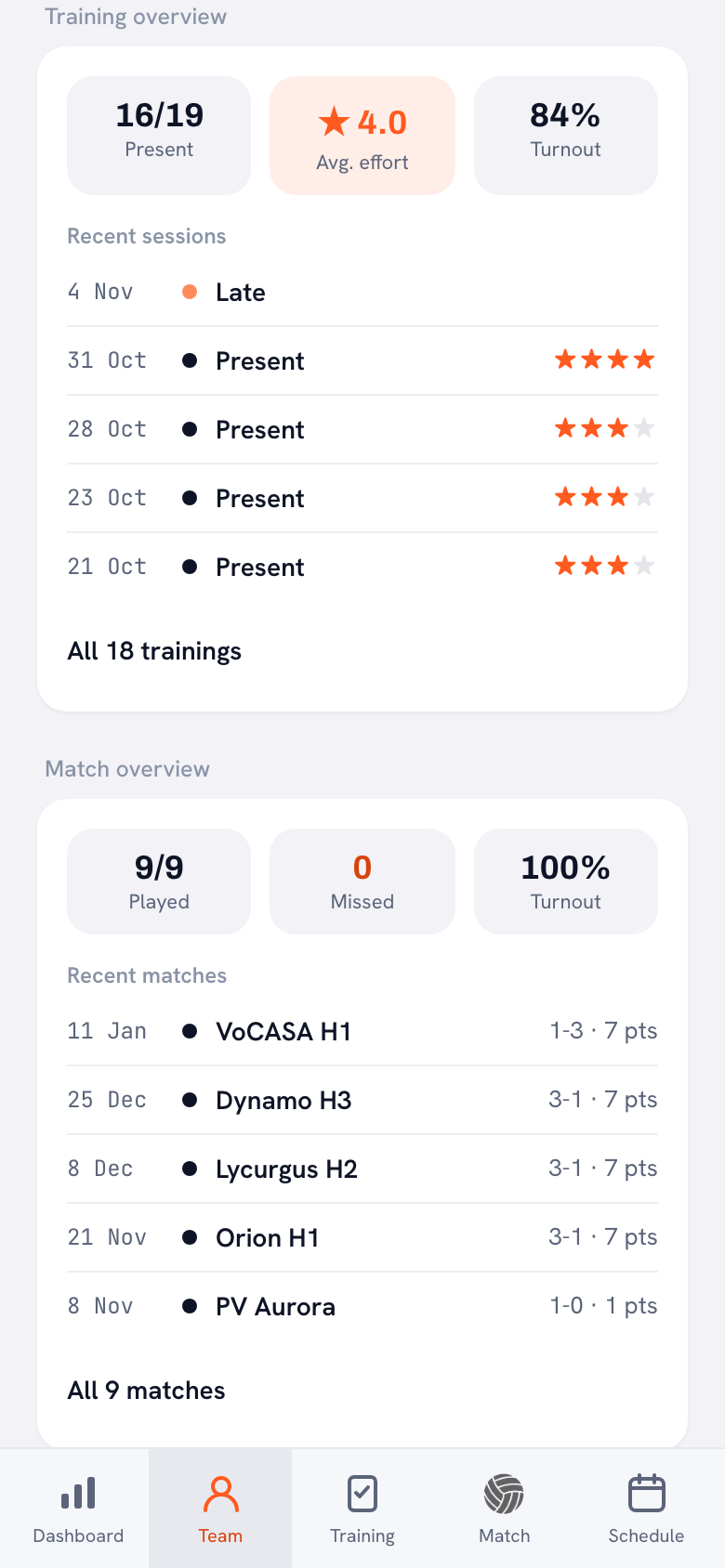
The four-week comparison, worked out
Put two blocks side by side and the picture gets hard in five minutes. By way of illustration, a team with invented but realistic figures: on the left weeks 5 to 8 of the season, on the right weeks 9 to 12.
- Attendance: 86% → 71%
- Cancellations with a concrete reason: 8 out of 10 → 3 out of 11
- Average effort: 3.9 → 3.4 (on a scale of 5)
- Hitting percentage: 32% → 25%, with the share of tipped balls going from 19% to 31%
- Unforced errors per set: 14 → 19
- Training hours per week: 3 → 3
That last line makes the story: everything drops while the input stays the same. By definition that is a recovery problem and not an effort problem. A team that trains too little also drops off, but then attendance doesn't move with it.
There are broadly three outcomes, each with a different conclusion:
- Attendance falls, effort and output hold up. This isn't a load problem but a diary and belonging problem: the players who are there are fully there. That calls for different levers, and they are in improving practice attendance.
- Attendance holds, effort and output fall across the board. This is the load-recovery balance. Everyone turns up loyally and delivers less and less. The rest of this article is for this one.
- One player falls on all four numbers, the rest don't. Then it is individual and you talk to that player instead of tearing up your planning. With youth players it is almost always the sum of club practice, regional squad and school; that calculation and the individual signals are worked out in how often 10- to 14-year-olds should train.
The weekly budget: count hard days, not hours
A training schedule says what you do. A weekly budget says what it is allowed to cost. To count that, count hard days rather than hours. A hard day is a day with maximal jumping, full hitting or blocking sets, or a match. An evening of technique, game sense and controlled-tempo game formats is not a hard day, even if it lasts an hour and a half.
- A maximum of two hard days a week for an average club team, the match included. If you play on Saturday, there is room for one heavy practice; the second evening is technical and tactical.
- Never two hard days back to back. A Friday practice before a Saturday match is not a heavy one, however much the team wants it to be.
- One to two days a week completely free of organised sport. Not lighter — nothing.
- Two to three months a year without sport-specific load, spread across the summer and one break during the season. When the league starts and where the breaks fall differs per federation — so count in weeks before and after your own season start rather than in months.
Two things sit outside this budget and count anyway. The first is the rest of life: exam weeks, a second sport, shift work. Ask about that out loud at the start of every four-week block and you know in advance which three players not to load heavily in week six. The second is the number of jumps and landings, because they weigh more than minutes — dosing that is in injury prevention in volleyball, and what happens after practice is in cool-down and recovery.
The light week: cut volume, not intensity
The temptation in a light week is to take it easy: gentle warm-up, a bit of pepper, home early. That is exactly the wrong kind of light. In a meta-analysis on tapering, Bosquet et al. (2007) concluded that performance is best maintained when training volume drops sharply while intensity and frequency stay up. Translated to a club evening: you come just as often, you stay just as long, you do fewer repetitions and those repetitions are sharp.
- Same evenings, same length. A light week is not a cancelled week.
- Halve the heaviest block. From twenty minutes of hitting and blocking sets to ten, from four sets of jump serves to two.
- Fill the time with what costs little and delivers a lot: serving and passing at match tempo, game formats on half a court, tactical work, video.
- Cut what costs jumps, not what costs sharpness. A team that half-participates for a week comes back worse than a team that played for a shorter time but played for real.
Announce that week as a plan and not as a concession. "Week four is the light week, it has been in the calendar since September" lands completely differently from "let's take it easy because it isn't going well". The first is a coach steering; the second confirms in your players exactly the feeling that something is wrong with them.
Key point: a light week is not a reward and not an emergency brake, but a fixed part of the planning — every fourth week, volume down, intensity up. Build it in only once things are already going wrong and you are weeks too late — and you have lost the explanation as well.
Double match weeks: where to take the volume out
In a week with two matches the budget gets blown automatically: the matches are fixed and the practices are still there. Take the volume out in this order.
- The day after a match is never a hard day. No jump work, no full hitting sets, not even if Saturday went badly.
- The conditioning block goes entirely. That is the first thing to drop and the least you miss; how to spread those blocks across the season is in conditioning for volleyball players.
- The practice between two matches gets shorter and tactical: sixty minutes instead of ninety, focused on serve receive, serving agreements and the lineup against the next opponent.
- Count a tournament day of four or five matches as two hard days. That is a rule of thumb rather than a law, but it prevents the classic mistake: a tournament on Sunday and then the heavy practice from the weekly plan on Tuesday as usual.
What you never cut, not even in the busiest week: the warm-up. It is the first thing to disappear when a coach is under time pressure, and with a tired team it is worth the most.
The three sentences you offer a break with
The hard part isn't the decision but the wording. "Why don't you take a rest" sounds like being dropped, certainly for the player who worked hardest to belong. An offer that does work consists of three sentences: what you see, what you propose, and what happens afterwards.
- "You haven't missed a practice in five weeks and your output is still dropping — that is exactly what fatigue does, and it isn't a question of wanting it more."
- "I'm putting you on half load for two weeks: you're there as normal, you do the technique and the game work, but you don't hit full sets and you don't jump in the blocking block."
- "Your place is safe, and in two weeks we look at the same numbers together to see whether it is back."
Three things are in there deliberately. The player stays present, because staying away is what turns it into a punishment. There is an end date, because an open-ended break feels like a drain. And there is a review point using the same number you started with, which keeps it about output rather than character. For the whole group you use the same structure in the plural. What you leave out: any suggestion that the player can't handle enough, comparisons with teammates, and promises about playing time you can't keep two weeks later.
When it is no longer training load
If the picture is unchanged after two weeks of half load, your role ends and a professional's begins. That isn't a failure but the agreed outcome of the test you set up two weeks earlier. Persistent fatigue looks exactly like causes that have nothing to do with volleyball: anaemia, a recent infection, a thyroid that isn't playing along, structurally eating too little for the amount of movement, or a low period. Which is precisely why overtraining syndrome is a diagnosis of exclusion.
In practice: advise the player to see their GP or a sports physician, describe what you have seen in facts and periods ("since mid-November, attendance unchanged, output and effort down, not back after two weeks at half load"), and say out loud that their place in the team stays open. A player who thinks a doctor's visit will cost them their spot won't go.
Put the light weeks in the calendar, not in the crisis
Everything above can be repaired after the fact, but it is far cheaper beforehand. When you set up your season, mark the light weeks straight away — every fourth week, the week after every tournament, the first week after every break — and add the points at which you run the four-week comparison. Because season starts and breaks differ per federation, count in weeks before and after your own start; how to set that framework up is in organising your volleyball season.
The nice thing about planning it in advance is that the explanation is already there. A team that heard in September that every fourth week is lighter doesn't hear an emergency measure in December, it hears an agreement.
Frequently asked questions
How do I know it's the load and not the atmosphere?
Look at the combination. With an atmosphere or belonging problem, attendance falls while the players who are there still go full tilt; with overload, attendance actually holds up and effort and output fall across a large part of the group at once. Compare two four-week blocks side by side to see it.
How often should I build in a light week?
For an average club team, every fourth week works well, plus the week after a tournament and the first week after a break. Put them in the calendar in advance rather than slotting them in when things go wrong — then they are part of the plan and not an emergency measure.
My players want to train more when it's going badly. What do I do?
Take the motivation seriously and steer the load. Offer an extra session that costs few jumps and few full swings, such as serving, game sense or video, and keep the number of hard days per week the same. That way the team gets to do more without tipping the recovery balance further.
Can a team get overtrained on two practices a week?
A genuine overtraining syndrome is unlikely on two practices a week, but a disrupted load-recovery balance is not. The sum is what decides it: matches, tournaments, a second sport, exam weeks and too little sleep all count, even when the number of practices stays low.
When do I send a player to a doctor or sports physician?
If the picture doesn't improve after two weeks at half load, or if symptoms appear that sit outside the gym: poor sleep, unwanted weight loss, persistent low mood or recurring infections. Describe factually what you have seen and over what period, and say clearly that their place in the team stays open.



Try it yourself in Koach
Less admin, more coaching.
Get started with KoachOr read first what the volleyball coaching app does.