
Increasing practice attendance: 7 tactics that work
Six players at practice, then winning a match with nine on Saturday — it can be done, but you never get used to it. Low turnout is rarely laziness; it is almost always a system nobody guards.
Measure first, grumble later
Most coaches overestimate their turnout problem ("nobody ever shows up") or underestimate it ("it is not that bad"). So start by logging: after four weeks you have facts instead of frustration, and you also see who the problem is — the team, or three specific players.
The seven tactics
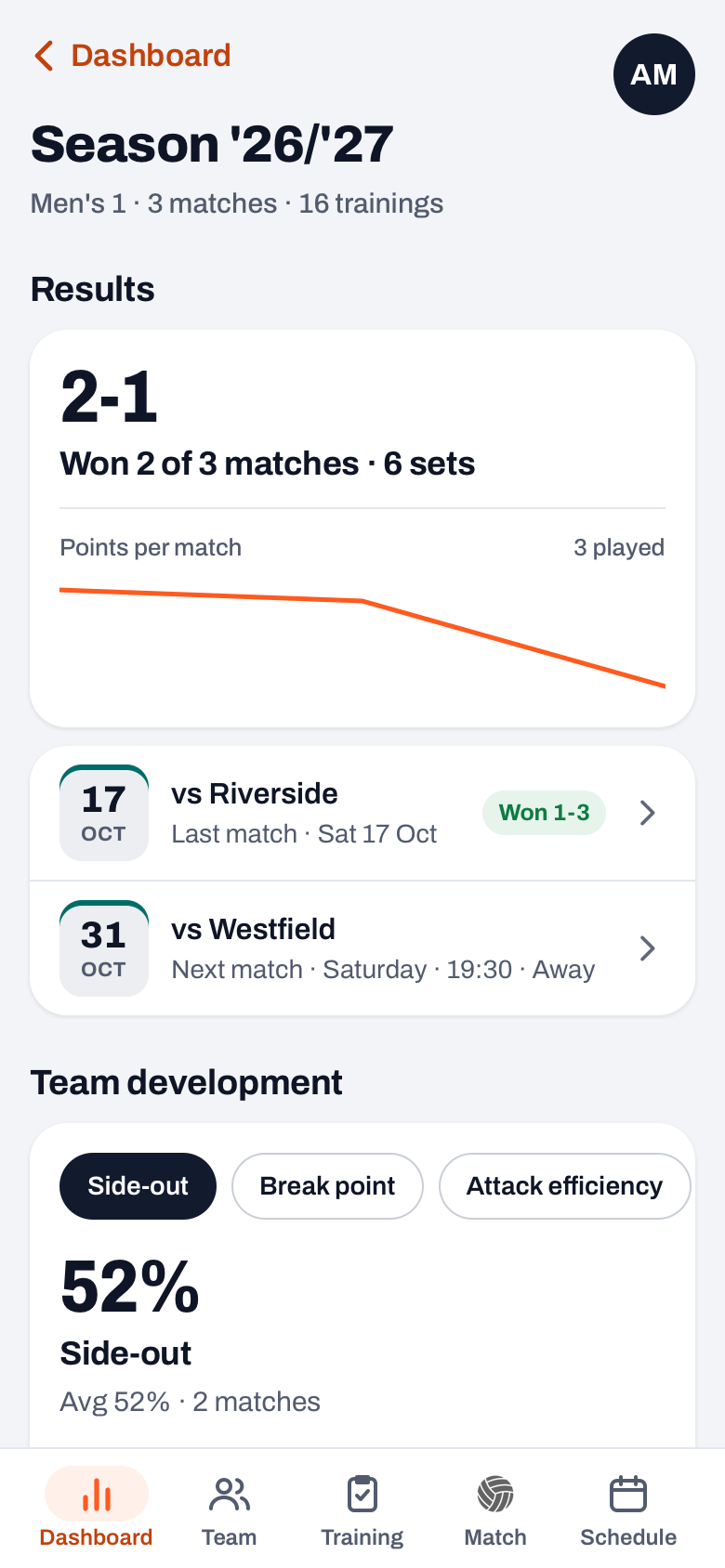
- Make turnout visible. Percentages under All season insights on your dashboard do more than sermons — share them with the group regularly, because players do not see each other's numbers in the app. Nobody wants to be the 40% bar.
- Link turnout to playing time — and mean it. The rule 'who practises, plays' only works if you also enforce it in the derby.
- Raise the practice quality. The hardest truth: people skip bad practices. Tight structure, little waiting, a recognisable focus every week.
- Make opting out cost something — socially. Calling off to the coach personally instead of a thumbs-up in the group chat; the threshold does the work.
- Celebrate those present, not those absent. Spend your energy on whoever does show up; that is more attractive than collective reproach.
- Schedule smart. Structurally seven players on Thursday? Maybe Thursday is the problem — one poll can save a season.
- Have the conversations one on one. The three players at 50% have three different reasons. Group lectures mostly hit the wrong people.
Do not expect 100%. An adult team with jobs, families and exams is doing well at 80–85%. Demand 100% and you breed excuses; value and guard 80% and you get a full court.
Frequently asked questions
What is normal practice attendance for an amateur team?
For adults, 75–85% is healthy; youth teams often reach 85–95%. Structurally below 70% is a signal that something in the system is off — scheduling, quality or culture.
Does a fine system for absence work?
Rarely for long: it makes absence purchasable and sours the atmosphere. Social agreements (calling off personally, turnout counts towards playing time) last longer than euros.
Should practising be mandatory for a starting spot?
A hard 'no practice, no play' is too rigid for most amateur teams, but the reverse agreement does work: with equal ability, the player who consistently shows up plays. Communicate that up front.

Try it yourself in Koach
Less admin, more coaching — starting at your next practice.
Get started with KoachOr read first what the volleyball coaching app does.