Volleyball Drills Against a Wall: Passing, Setting, Serving
A wall is the most patient training partner there is: it always plays back, it never gets tired and it does not judge. For anything to do with ball control, that is enough to genuinely improve on your own.
What a wall does and does not replace
A wall gives you two things that are rare: unlimited repetitions and instant feedback. Play it crooked and it comes back crooked — you do not have to ask anybody what went wrong. That makes it excellent for grooving movements: the hand shape in setting, the platform in passing, the toss on the serve.
What a wall does not do is vary. The ball always comes back in roughly the same way, on a path you determined yourself. So everything to do with reading, choosing and reacting does not get trained. Treat wall work as a supplement to practice, not a replacement — much the way homework relates to a lesson.
Setup: distance, height, markings
- Put two lines of tape on the wall: one at 2.24 meters (women's net height) or 2.43 meters (men's), and one at about four meters for setting height.
- Mark the floor at two, three and five meters from the wall. Those are your three working distances.
- Check the surface. A smooth brick wall is fine; a wall with ledges or windows is not. Gym walls with wooden panelling give an unpredictable rebound.
- Take two balls. One to work with, one to grab when the first rolls away.
Five wall drills with sets and reps
1. Overhand above the line (5 min). Three meters from the wall, every set above the four-meter line. A set of 25 without a break; on an error you start again. Watch for this: the hands form the triangle above the forehead, and the ball is pushed out with the fingers, not the palms. The shape is in overhand setting.
2. Overhand with movement (5 min). Same as 1, but after every set you touch the line behind you with one foot. Sets of 15. This is the drill that pays best, because it forces you to get underneath the ball again every time instead of reaching for it.
3. Forearm at the wall (6 min). Two meters from the wall, playing the ball into the wall at about a meter high. Sets of 20. Watch the shoulders: the platform does the steering, the arms do not swing. See forearm passing for the exact posture.
4. Alternating overhand and forearm (6 min). At three meters: one set above the four-meter line, the next ball forearm, then overhand again. A set of 20 switches. Trains switching between two techniques, which happens continuously in a rally.
5. Hitting and digging at the wall (8 min). Five meters from the wall, hit the ball off the floor into the wall above the net-height line and dig the rebound up with your forearms. Sets of 10. Hard, loud and the best way to train defensive posture on your own.
Serving at a wall without getting bored
Serving at a wall is useful as long as you have a target. Tape a square of one meter by one meter with its bottom edge at net height, and serve at it ten times from six meters away. Scoring: how many land inside the square. Then move back two meters and do it again. What you are really training is the toss, and that is exactly where most players' service errors come from: an inconsistent toss gives an inconsistent swing. The build-up of the movement is in learning the overhand serve.
A ten-minutes-a-day schedule
| Day | Drill | Volume |
|---|---|---|
| Monday | Overhand above the line + with movement | 3 sets of 25 and 3 of 15 |
| Tuesday | Forearm at the wall | 5 sets of 20 |
| Wednesday | Alternating overhand and forearm | 4 sets of 20 |
| Thursday | Rest or light overhand | 2 sets of 25 |
| Friday | Serving at the square | 4 sets of 10 from 6 and 8 m |
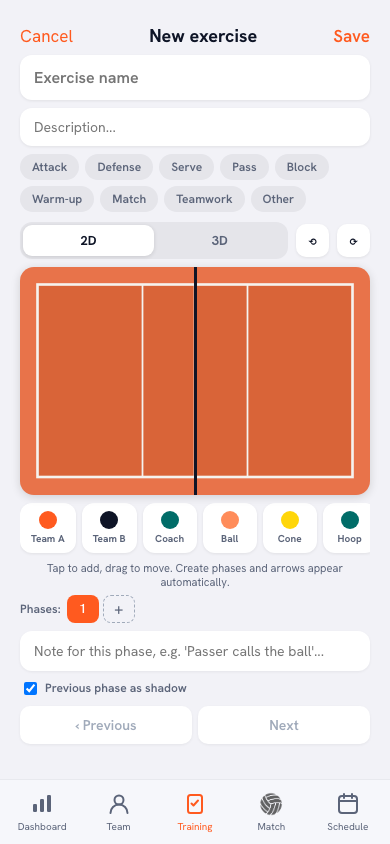
Ten minutes a day sounds like nothing, but it is well over two hundred extra contacts per week per player — more than a whole team session delivers for most of them. Store a sequence like that as your own drill with a phase per week, as described in building your own drills in the editor, and you can hand it to several players without explaining it again each time.
Quality over quantity. Fifteen good sets are worth more than a hundred where you are constantly chasing the ball. Stop a set the moment the technique slips — otherwise you are grooving in the very fault you set out to remove.
Frequently asked questions
What distance from the wall should you practise at?
Two meters for forearm passing, three meters for setting and five meters for hitting and digging. Closer turns it into reflex work; further away and you can no longer control the rebound.
Can you really improve with wall drills?
For ball control, hand shape and the serving toss, certainly: those are all movements that improve with repetition. Reading, choosing and reacting are not trained by a wall, so it remains a supplement to team practice.
Is a wall suitable as homework for young players?
Yes, provided you give them a concrete sequence with a number and a target — three sets of twenty-five sets above a marking, for example. "Go and practise at the wall" produces nothing for practically anyone.