Volleyball Drills for 2 People: A Full Partner Session
Two players and a gym booked until nine: plenty of coaches write that off as a lost evening. Wrongly. With two people you get more contacts per person than in any team session, provided you pick formats that do not need a third.
What actually gets better with two players
In an ordinary session a player touches a few hundred balls in an hour and a half. With two of you, four balls on the side and no lines, you reach that same number in forty minutes. Everything that depends on repetition — the platform in passing, the hand shape in setting, the toss on the serve — benefits enormously.
There is something else too: correction time. With two players you can talk for half a minute after every set of reps without ten people standing around waiting. That makes a two-person session ideal for teaching or repairing technique, and much less suitable for game sense or team agreements.
The hour in five blocks
| Block | Time | Content |
|---|---|---|
| 1. Warm-up with a ball | 10 min | Building up back and forth, short to long |
| 2. Passing and control | 15 min | Toss-and-pass, platform control, movement |
| 3. Setting | 10 min | Setting in pairs, wall setting, height requirement |
| 4. Hitting and defence | 15 min | Hitting off your own toss, digging at each other |
| 5. Serving and finish | 10 min | Serving with scoring, target zones |
The drills block by block
Block 1 — building up back and forth. Start three meters apart overhand, move to six meters after two minutes, then forearm, then alternating overhand and forearm. Finish over the net at nine meters. Scoring: sets of twenty without an error; note the longest set of the evening.
Block 2 — toss-and-pass with movement. A tosses firmly, left and right of B, who passes to the target where A is standing. Twenty-five balls, then switch. Phase 2: A tosses over the net from the other side, so the ball has a genuine trajectory. Correction: passers who steer with their arms instead of with their shoulders and legs — see forearm passing.
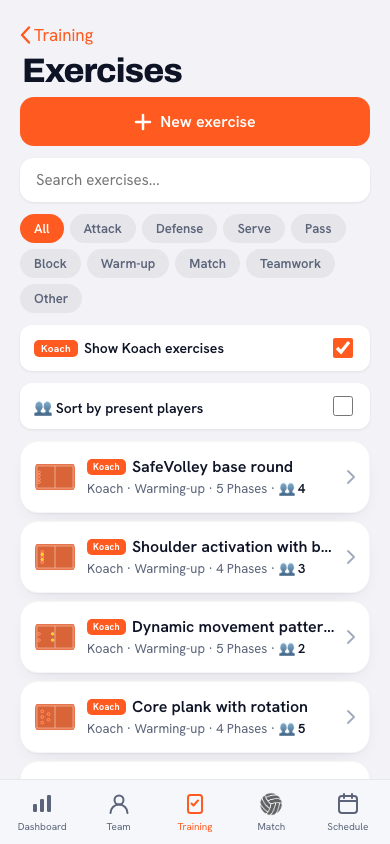
Block 3 — setting with a height requirement. Six meters apart, every set at least four meters high. A set of fifteen. Phase 2: one player sets at the wall above a marking and the other counts. Every drill here also sits in Koach's library of 200+ animated drills, so you can pull one up on your phone at the net.
Block 4 — hitting off your own toss and digging. A stands at the net and swings off the floor or off a half jump at B, who defends from six meters and plays the ball back to A. Ten balls, then switch. Phase 2: A varies between hard, tip and deep. This is the core of pepper, but with clear scoring: how many of the ten can B return playable.
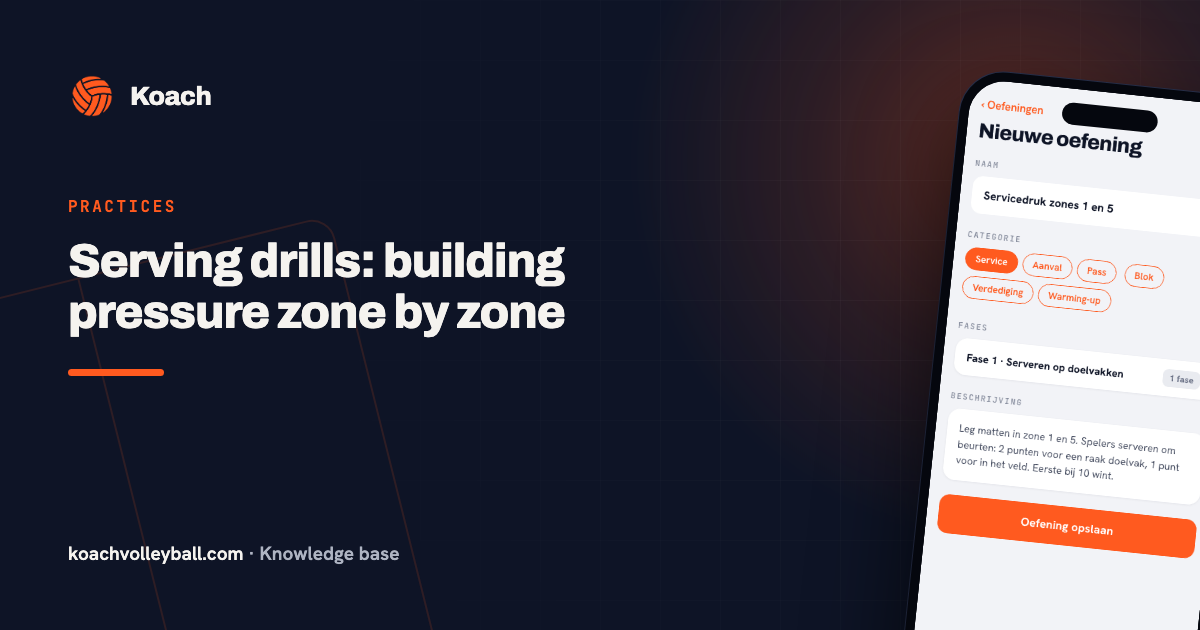
Block 5 — serving to target zones. Both serve at the same time from opposite ends towards a mat in zones 1 and 5. Scoring: 2 points on the mat, 1 point in the court, 0 for a miss; first to 15. Nobody has to shag balls in between — the opponent picks them up. More variations in serving drills.
Making it harder without a third player
- Tempo. Shorten the gap between balls: the tosser sends the next ball as soon as the previous one lands.
- Movement. Make the working player touch a line after every contact. Twenty balls with a shuttle in between is physically harder than forty without.
- Sets with a consequence. A set of ten; on an error the set restarts. That brings tension into a drill with no opponent in it.
- More balls. Four balls on the side means not a single interruption for shagging — the biggest time saving available with two players.
What you cannot train with two players
Be honest about the limits. Blocking against a real attack, receive formations, rotations, game sense and everything to do with communication between three or more players all drop out. So do not schedule those, and do not try to approximate them with a toss either; what you train then is mostly an imitation. If a handful of players is a regular occurrence, also look at training with a small squad, where the same logic applies for four to six players.
Make it a technique evening, not half a team session. Announce it that way and the evening gets a value of its own. Two players who know they are working on their passing train better than two players wondering where everyone else is.
Frequently asked questions
Can you run a worthwhile volleyball session with two players?
Definitely, as long as you set it up as a technique evening. Passing, setting, serving and defence can all be trained in pairs with plenty of repetitions. Blocking, rotation and game sense you deliberately leave for another night.
How many balls do you need for a two-person session?
Four to six. That sounds like a lot for two players, but the difference is in shagging time: with one ball you lose a third of the evening chasing it.
Is pepper enough when there are two of you?
As a warm-up, fine; as a whole session, no. Pepper has no target, no scoring and no movement, so after ten minutes it mostly becomes a routine. Put a score and a height requirement on it, or alternate it with the blocks above.