
What Happens If the Ball Hits the Ceiling in Volleyball?
A high pass disappears towards the ceiling, clips a beam and drops back into the court. One referee whistles, another lets play continue — and both are right in their own gym. This is one of the few volleyball situations where the official rule and everyday practice pull apart.
The official rule: the ceiling makes the ball out
The FIVB rule is unambiguous. The ball is out as soon as it touches an object outside the court, the ceiling, or a person out of play (rule 8.4.2). There is no exception for your own side of the net, no exception for low-roofed halls and no exception for the first team touch. If the ball touches the ceiling, the referee whistles and the point goes to the opponent — regardless of who sent it up there or where it lands afterwards.
The same goes for everything hanging above the court: basketball hoops, suspension cables, air-handling ducts, spotlights and scoreboards. They are not part of the playing area, so contact with them means the ball is out. That is also why the rules prescribe a free playing space of at least 7 metres above the court (12.5 metres for international competition) — precisely to avoid this situation. The complete court layout with all the measurements is in the dimensions of a volleyball court.
Why you still hear other rules
The reality of club gyms looks different. In school halls and older sports centres the ceiling sits at six metres, there are hoops hanging over the court and a cable runs straight across one side. To stop every second rally dying on the architecture, local ground rules are agreed: house rules established before the match between the two captains and the referee, and noted on the scoresheet.
The most common house rule runs: a ball that touches the ceiling or an obstacle above your own side stays in play as long as your team has touches left; a ball that touches the ceiling above the opponent's side, or that crosses the net after touching the ceiling, is a fault. That is an agreement, not a rule of the game — it only applies if it was established before the match, and only in that gym.
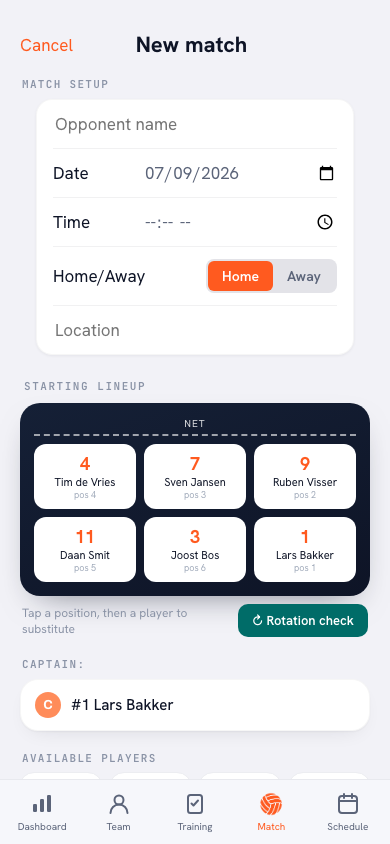
Ceiling rules are a house rule, so note the local agreement with the match details in Koach when you play at home — then it is still there when you host the same opponent three months later.
What to sort out before the match
- Point out the obstacles without being asked. As the home side you tell the referee and the opponent before the warm-up what is hanging above the court and which agreement your gym uses.
- Have it written down. A house rule that is not on the scoresheet cannot be enforced afterwards. In a protest, only what was recorded in advance counts.
- Agree the edge cases. A basketball hoop just above the attack line needs a more specific agreement than the word "ceiling": does it cover the net attached to it, and the cable?
- When in doubt: the official rule. If nothing has been agreed, the ceiling is simply out. That is the fallback, low roof or not.
Common edge cases
The ball touches the ceiling and lands in the opponent's court. Without a house rule: out, point to the opponent. With the usual house rule: also a fault, because it crossed the net after ceiling contact.
The serve touches the ceiling. Service fault, point to the receiving team. House rules almost never make an exception here — a serve that touches the ceiling is never a valid serve.
The ball hits the referee on the stand. The first referee is part of the playing environment; the ball stays in play in principle if it touches the referee or the stand within the playing area. If it touches a person out of play — a scorer, a substitute behind the line — it is out.
Beach volleyball. On the sand the problem does not exist; the other differences between the two variants are in indoor volleyball vs beach volleyball.
What this means for your training
If you train permanently in a low-roofed hall, that changes your game more than you think. High emergency balls are not an option, so your defenders have to learn to take the ball flatter and your passers have to play tighter to the setter. Build that in deliberately: hang a ribbon or use the ceiling itself as a limit and have players practise a low, fast build-up. Then, when you play away in a high hall, warn your team explicitly — a team used to six metres plays the first set systematically too flat in a hall of twelve. The complete rules overview is in all the volleyball rules at a glance.
Frequently asked questions
Is a ball that hits the ceiling out?
Under the official FIVB rules, yes: the ball is out as soon as it touches the ceiling or an object above the court, and the point goes to the opponent. Only a house rule agreed in advance can deviate from that.
Can you play on after ceiling contact above your own side?
Only if that was agreed and recorded before the match as a local ground rule. That house rule is common in low halls, but it does not apply automatically and not in every gym.
What if the serve hits the ceiling?
Then it is a service fault and the point and the serve go to the receiving team. House rules virtually never make an exception: a serve that touches the ceiling is never valid.
Who decides the house rule?
The first referee establishes the local ground rules before the match, in consultation with both captains, and has them noted on the scoresheet. If nothing is agreed, the official rule simply applies.