
When a child can't stand losing: what to do in the hall
The ball is lying against the wall, one child is standing with his back to the hall and eleven others are looking at you. You have twenty-five minutes of court time left and the drill has ground to a halt. Advice about bad losers is usually about the conversation afterwards. This is about the moment itself, about what sits underneath it, and about the formats that make it happen less often.
Fifty defeats in a single session
Start with the arithmetic, because it explains more than any character sketch. In volleyball every rally produces a point: there is no midfield where nothing happens for a while, and every time the ball hits the floor there is a winner and a loser. A twelve-minute game format produces thirty to forty rallies if it keeps flowing, and with three of those formats you get close to a hundred completed moments. A child loses roughly half of them. Fifty times, on one Tuesday evening.
On top of that, a mistake in volleyball almost always has an address. Whoever serves into the net, whoever lets the ball drop, whoever hits it out — the whole hall saw who it was, including the child himself. And because you rotate, every player ends up in the position where it goes wrong for him.
That makes this a volleyball problem and not only a parenting problem. The child who kicks the ball away at your practice needn't be any worse at losing than his classmate at football; he just gets the bill presented far more often. It is also why talking alone doesn't fix it: you can't hold fifty good conversations in one evening.
First work out: his own mistakes, or other people's?
Establish first which of the three you have in front of you. They look alike in the hall and they ask something completely different of you.
- He reacts to the score. The behaviour only shows up when the scoreboard is against him, regardless of who made the error. That is the real losing problem, and that is what this article is about.
- He reacts to his own mistakes. Even after a rally he wins he is annoyed, because his pass wasn't good enough. That is an error problem. The toolkit for it — a reset ritual, a language rule after a mistake, task goals — is in mental training.
- He reacts to other people's mistakes. Sighing, looks, "come ON" when a teammate lets the ball drop. Then you don't have a bad loser but a critic, and that calls for a conversation rather than a different drill: see handling a dominant player.
The test costs you one session: take the scoring away. Play the same formats without a score, or against the clock. If the behaviour disappears completely, it sits in the scoreboard. If it stays just as fierce, it is about his own execution.
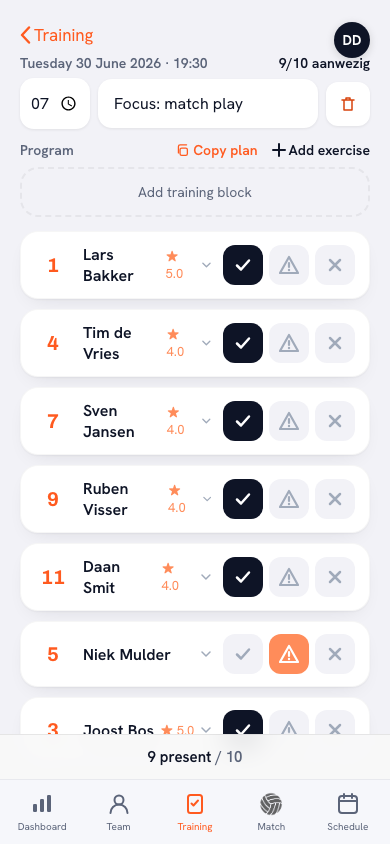
Then log it briefly for three weeks, for example as a player note in Koach: the date, what happened just before, and how many minutes it took before he joined in again. That shows you what your memory doesn't: whether it always happens in the same format, or always in the last quarter of an hour when he is tired.
Eight, eleven or fourteen: the same behaviour, three causes
The same outburst means something different at every age — and that decides whether you support or set a limit.
Six to eight years old. Most children of this age can barely separate the outcome from themselves: losing isn't "that went wrong" but "I am the loser". Rules are absolute as well, so a ball he thought was in feels like an injustice. The reaction is usually fierce, loud and over within a couple of minutes. What you do here is not explain but bridge.
Nine to eleven. This is where comparison arrives. The child starts to understand that skill is something you have or don't have, and that teammates have more or less of it. Losing becomes information about his place in the group, and the behaviour changes with it: less explosion, more giving up. "Don't care anyway", no longer chasing balls, serving deliberately sloppily. That is the same emotion in a different coat, and more dangerous, because it looks like indifference and therefore usually gets punished.
Twelve to fourteen. The emotion has grown fiercer and the brakes don't always work yet. What is new is the audience: at this age an outburst is partly a message to the group — look, I'm not accepting this. That shifts it from "can't do it yet" to "is also choosing it", and for the first time a real limit belongs with it.
The rule of thumb from the sideline: with young children watch the duration — is the period in which he doesn't join in getting shorter over the months? With older children watch the direction — does it go inwards, at the ball, or at a teammate?
The thirty-second script
In the moment itself you have no time to think, so fix it in advance. You can say this script word for word.
- Second 0 to 5: do nothing. You don't walk over, you say nothing, you don't stop the drill. The rest play on. This is the hardest step, because eleven children are expecting a reaction. That is exactly what you don't want to give: attention makes the outburst worth having.
- Second 5 to 15: stand beside him, not opposite him. Shoulder to shoulder, both looking out into the hall. One sentence: "That was rubbish." Full stop. No "but", no explanation. All you are doing is confirming that you see what he feels.
- Second 15 to 25: give a choice, not a question. "You're going back in shortly, or you get some water first. Which is it?" Two options that both end in joining in. A choice gives him back control, and control is exactly what he has lost. Don't ask "what's wrong?" — he has no words for that right now.
- Second 25 to 30: name the next task and walk away. "You're serving first in a minute." Then you turn around. Walking away isn't indifference but technique: stay standing and waiting, and it becomes a negotiation with an audience.
What you don't say in these thirty seconds: "don't be silly", "everybody loses sometimes", "it's only practice". All three are true, and all three tell the child that his reaction isn't allowed. Shame then joins the anger, and next time that is a reason to do it bigger. How to correct without raising your voice is in correcting without shouting.
Kicking the ball away, walking off, tears
The script stays the same; the three most common variants each need one adjustment.
- Kicking or throwing the ball away. The only variant with a hard limit, and not for educational reasons: a ball flying through the hall lands on somebody's ankle. Say it matter-of-factly and briefly, as a rule of play and not as a judgement: "The ball stays in the hall. That's the agreement." You discuss the behaviour itself later, and separately from the losing — the problem is the ball, not his upset.
- Walking off. Let him walk; he is looking for space and usually comes back within a few minutes. Agree in advance where the limit is: along the sideline is fine, the changing room or the corridor is not — you can't see him there. Don't go after him to talk him round; that makes walking off effective.
- Tears. Don't talk. Crying passes on its own; talking often keeps it going. Give him something physical to do: wheel the ball cart together, tighten the net, move the cones. A job that keeps him with the group without having to join in is the shortest route back.
Two things you never do as a first reaction: send him off court, and stop the group to say something about it. For a child who has already given up, being sent off isn't a punishment but a way out — you then reward exactly the behaviour you want less of. And stopping the group turns a private moment into a team matter.
The real fix is in the drill design
This is where the gain is: you can steer how often anybody loses at all. Five changes for your next session:
- Score in wash formats. A point only exists once a team wins two rallies in a row; if one goes each way, the score cancels out. Most rallies then end without anything appearing on the board. How to count that is in wash drills.
- Redraw the teams every four minutes. Three blocks of four minutes instead of one game of twelve. Bibs off, draw numbers, carry on. No scoreline then lasts long enough to become an identity, and nobody spends half an hour in the losing team.
- Play against a number instead of against each other. "Twenty balls over the net together within four minutes." There is an outcome, there is tension, and there is no losing side.
- Score behaviour, not only the ball. A point for the rally, plus a point if somebody called for it. He can then lose the rally and still have done something right.
- Give the strongest team a deficit. Start at 0-3 down. That makes the result unpredictable, and unpredictable is exactly what a child who loses week in week out isn't used to.
And one rule that costs nothing: never finish with a format that points at a loser. The last format of the session goes home with them. So don't put on a game with a final score, but something without a loser — a team score against the clock, a serving run where the group reaches a total together, or five minutes of free play.
Then do the arithmetic again with your own programme in front of you. Three twelve-minute game formats is already a good half hour of your ninety minutes in which there is always a winner and a loser. Convert half of that to wash or team score and you halve the number of losing moments without exchanging a single word about it. That isn't looking away: he is still learning to lose, in portions he can handle.
The drive home
What happens in the car weighs more heavily than what you do; you have him a couple of hours a week. So make one agreement about it with the parents, at the start of the season and for the whole group, so that it doesn't feel like a correction aimed at one family. Three rules will do:
- No evaluation in the first twenty minutes afterwards. No "what did you make of it", no "you were standing a long way back". In those twenty minutes every question about the match lands as an assessment.
- The first question isn't about the result. "Was it fun?" or "what do you want to eat?" is enough. If the child brings it up himself that is always fine — then it is his subject.
- Don't hang a reward on the result. Chips after the match is fine; chips after the won match makes losing literally more expensive.
And then the sensitive one, which you have to name once: a child who can't stand losing has often learned it somewhere. A parent who gets into the car annoyed, who argues back at the referee, or who deliberately loses a board game at home so the child wins, hands out a lesson every week. So ask parents to simply play honestly at home — losing in the living room is the cheapest practice there is. The broader agreements with parents are in parents on the sideline, and this point belongs in your team agreements, so that it belongs to the group and not to you alone. If the match itself was heavily lost, something else applies in the changing room than with this one child: that is in what to say after a heavy defeat.
Winning mentality, or something else
"He's just competitive" is sometimes true and sometimes a flag of convenience. Three questions make the distinction, and all three are observable from the sideline.
- How long does it last? A competitive child is furious and joins in again on the next rally. If it lasts longer than one rotation, it is an emotion he can't get out of.
- Where does it go? Inwards — quiet, trying harder — is one thing. At the ball, the wall or a teammate touches everybody around him.
- Does he come back on his own? Or do you have to fetch him? Coming back by himself is the clearest sign that he is learning it.
An eight-year-old who blows up briefly three times a session and then simply joins in sits within what you can expect at that age — provided those periods get shorter over six months. A fourteen-year-old who deliberately stops chasing balls at 10-15, or gives a set away on purpose, is doing something else: that is not an emotion happening to him but behaviour with a choice in it, and it asks for a limit and a conversation. That build-up is worked out under the dominant player.
Look beyond volleyball when three things coincide: it also happens at school and at home, it hasn't eased after six months, and the child is unhappy about it himself once it has passed. Say that honestly to the parents — as an observation, not a diagnosis — and let them decide whether to involve somebody. If it ends in absences and the sentence "I don't want to any more", read my child wants to quit volleyball.
Key point: you don't change this behaviour with conversations but with a different way of scoring. A thirty-second script for the moment itself, and a session in which half the formats have no losing side. The conversation comes afterwards, and by then it is a good deal shorter.
Frequently asked questions
My eight-year-old cries at almost every defeat. Is that normal?
At that age it is common: many eight-year-olds can barely separate the outcome from themselves, so losing feels like a verdict on who they are. Don't watch how fierce it is but how long it lasts, and whether that period gets shorter over the months. If he is still upset for just as long after six months, it is worth discussing with the parents.
Should I send a child who kicks the ball away out of practice?
Not as a first reaction. For a child who has already given up at that moment, being sent off isn't a punishment but a way out, and you then reward exactly the behaviour you want less of. Do set the limit about the ball itself, briefly and matter-of-factly, because a ball flying through the hall is a safety issue.
Does it help to let him win more often on purpose?
No, and certainly not at home. What does work is making the outcome less predictable: teams redrawn every four minutes, a handicap for the strongest team, or formats where the score cancels out. The difference is that he then genuinely wins now and then instead of being given a present he sees through sooner or later.
What do I say to parents who think he should just learn to lose?
That you agree with them, and that in volleyball he practises it around fifty times per session. Explain that you are temporarily lowering the number of losing moments so that he can actually process them, and that you will build it back up as soon as that works. That is not sparing him, it is dosing.
How do I know whether it is down to my drills?
Take the scoring away for one session and play the same formats against the clock or without a score. If the behaviour disappears completely, it sat in the scoreboard and you can go to work on the drill design. If it stays just as fierce, it is about his own mistakes and you have a different problem in front of you.
Should I raise it with the group?
Not the incident and not the player. What you do agree with everyone is how you as a team react to defeat and to each other's mistakes — then it applies to everybody and nobody is the example. An agreement the team formulates itself is also enforced by the team itself.