
Your team says nothing: volleyball communication drills
You say it every time-out: you have to communicate more. Nothing changes, because a team that is silent is not silent by character. It is silent because there is nothing to call in your drills and because saying nothing costs nothing. That is fixable — with six words and a scoring system.
Silence is not a character trait, it is a design flaw
A player does not call because he is a talker. He calls when three things are true at once: there is a choice to be made, there is too little time to settle it silently, and not calling costs something. If all three are present, even the quietest player in your squad calls. Take one away and even your captain says nothing — and rightly so.
Now hold those three conditions up against an average practice. For an hour there are lines: the coach tosses, the ball belongs to whoever is at the front, everyone knows who takes it. No choice, so nothing to call. Then in the last twenty minutes comes the scrimmage, where the choices suddenly do exist — but by then silence is a habit. The team is not silent despite your practice. It is silent because of your practice.
So the solution is not a lecture but a design: a small fixed dictionary, and formats in which a rally without a call simply does not count. Scrap the phrase "communicate more" and replace it with one word you are going to score.
The dictionary: six calls, no more
Most teams not only call too little, they also call too many different things. In one rally you hear "mine", "got it", "yep", "that one's mine" and "leave it" — five variants for two messages. Under time pressure a player then has to translate first, and that costs exactly the tenth of a second you do not have. Keep it to six words and agree them with your whole staff.
- "Mine" — the only permitted claim. Called by the player taking the ball, before the ball crosses the net. The player letting it go confirms with a raised hand. Which of two players should claim a ball falling exactly between them is a separate agreement: that one is in the seam in serve receive and does not need reinventing here.
- "Out" — let it drop, this one is going out. Called by the player with the best view who is not playing the ball himself: the blocker behind a ball sailing past the sideline, the back player behind the end line. Two hard restrictions: never as an answer to "mine" (the claim already stands), and never as an announcement of an easy ball — whoever calls "out" is only saying what he is not doing.
- "Tip" — the hitter is not getting fully under it and is going to place the ball. Called by the blocker while he is still in the air. It triggers the defence to step in so nobody stands waiting for a ball that is not coming deep.
- "Block" — information for your own hitter. Called by a back player with a clear view of the other side, at the moment your own setter releases the ball: "one block" or "two, line is closed". Your hitter is watching the ball and sees the block late; somebody else sees it earlier. On the blocking side itself other agreements apply, see organising the block.
- "Free" — no attack is coming, the ball is being played back gently. One word that starts a handful of jobs at once: the block comes down, the court shifts, the setter releases. What has to happen next, and why a down ball asks for something different, is in free ball and down ball.
- "Cover" — our hitter is going to swing, everyone not attacking drops into the cover. Called during the approach, not after it: once the ball is hit it is too late to move. Who belongs where is in covering the hitter.
Two categories you deliberately scrap. The first is encouragement during the rally: "come on", "let's go", "focus". Those words carry no information, they do demand attention, and on top of that they make a real call harder to hear. Encouragement belongs between rallies. The second is the apology: a player calling "sorry" after every error is busy with his last ball while the next one is already on its way.
The words themselves are not sacred. If not everyone in your team speaks the same language — increasingly common — pick one language for all six and stick to it all season. More important than which word you choose is that there is only one word per situation.
Calling is scored, not requested
This is the heart of the whole article. Asking for communication changes nothing, because a request has no consequence. A score does. So in every format below it is not only who wins the rally that counts, but also whether the compulsory call was made. Build that up in three levels:
- Level 1 — the rally is void. If the word was not called, the rally does not count, for anybody. Again. No punishment, no lecture, but no reward either. This is the level for the first two weeks and for youth teams.
- Level 2 — the point goes to the other side. Win a rally without a call and you give the point away. This is uncomfortable and works precisely because of it: players start calling each other out at the first silence, which is exactly the point.
- Level 3 — the team counter. Normal scoring, with a second score alongside it: the number of "clean" rallies, ones you win and in which the call was made. Target: fifteen clean rallies in twenty minutes, otherwise the format runs another five.
Who judges that? Not you. Put a referee on it: an injured player, a substitute, a parent standing there watching anyway. He has exactly one question to answer — was the word called, and was it in time? — and one action: hand up if the answer is no. The moment you become the referee of the calling, players start looking at you instead of at each other.
One hard limit: at most one compulsory call per drill. A format in which "mine", "cover" and "block" are all compulsory at once is guaranteed to produce zero calls, because nobody knows any more what is expected of him. Only stack once the first word comes out without thinking.
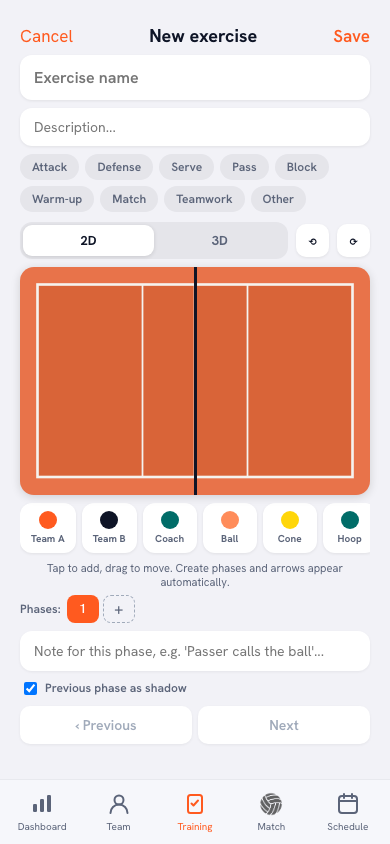
So do write that dictionary and that scoring down somewhere — in the description of the drill in Koach, for instance — so that the second coach, the stand-in and the coach of the team below you use the same six words and the same rule. A dictionary that differs per coach is not a dictionary.
Six formats in which silence has a price
1. Claim or nothing (4 vs 4 serve receive, 12 minutes). Two servers serve alternately, each time aimed between two passers. The rally only counts if "mine" was called before the ball crossed the net. Compulsory call: "mine". What you will see: at first nobody claims in time, then everybody claims too early and too often — that is fine, that is the right direction. Only correct the timing in the second half.
2. Out is a decision (6 vs 6, 10 minutes). The coach deliberately serves or throws balls that land just in or just out. Every ball that hits the floor without "mine" or "out" being called is a point for the opponent — even if it really was out. Compulsory call: "out". This format removes one of the cheapest points you give away: two players silently watching a ball on the line.
3. Cover on call (6 vs 6 with a fixed attacking side, 15 minutes). Every rally starts with a free ball on one side. If the hitter swings without "cover" being called during his approach, the point is void — even on a kill. Compulsory call: "cover". What you will see: the team quickly discovers that the call does not have to come from the hitter but from the players behind him, and that is exactly the insight you are after.
4. Block info (6 vs 6, 15 minutes). On the attacking side only a back player may call the block: "one block" or "two block". An attacking point counts double if the ball goes where the call said there was space. Compulsory call: "block". Straight away a test of your defence: a player who cannot name the block spends the whole match watching the ball instead of the other side.
5. The silent set (6 vs 6, 8 minutes). Only the six words may be spoken, nothing else at all — no "come on", no "sorry", no discussion. This format comes from the team-building formats and does one thing very well here: it makes audible who normally says nothing, because there is no noise on top of it any more. Keep it short; as a punishment it does not work, as a mirror it does.
6. Chaos alarm (6 vs 6, 15 minutes). The coach disrupts every third rally: he knocks the pass away, throws a ball far into the corner or makes the setter dig the first ball. As soon as the script falls apart, somebody has to call that the emergency agreements apply; otherwise the rally does not count. Which emergency agreements should be sitting behind that is in playing out of system.
Run two per practice, not six. Ten to fifteen minutes per format is enough, and they only work as long as it is genuinely being played for: a format in which the opponent is not trying to win produces no real calls either.
The coach who fills the silence himself
There is one cause of silent teams that is rarely mentioned, and it stands on the sideline. Coaches, after all, like to shout: "out!", "that's going out!", "cover him!", "two block!". Every one of them correct information, at the right moment — and precisely for that reason a problem. A team that gets every call from the coach does not have to read the situation itself. Players start waiting for your voice, and in the match where you happen to say nothing or see nothing, the ball drops.
The test is simple and uncomfortable: have somebody tally who calls for one whole set. Two columns, you and them. If there are more marks in your column, you do not have a silent team, you have a talking coach. Count on a shock at the first measurement.
The remedy is a silence block: one scrimmage per practice in which you say nothing during the rallies. Between rallies anything goes — that is where your feedback belongs anyway, as in correcting without shouting. If you do it in a match, pick one set and say beforehand that you are leaving the calls to them for that set. Otherwise it reads as indifference.
What does not work
- A fines pot. Money for silence turns calling into a punishment you can buy off, and whoever finds it hardest pays the most. Exactly the wrong way round.
- "Communicate more" as a team goal. Unmeasurable, so forgotten after three weeks. Phrase it as a number: fifteen clean rallies, or zero balls dropping between two players.
- Punishing the wrong claim. A player who calls "mine" and then misses the ball did one thing right and one thing wrong. Name only the right part — punish the claim and in two weeks your team claims nothing at all.
- Introducing everything at once. Six new words in one practice means six words nobody uses.
With youth teams one more thing comes on top. A twelve-year-old often does not call because he is afraid of botching the ball afterwards in front of everybody. You do not solve that by insisting but with the rule above: claiming counts, even if the ball goes wrong. Pay extra attention to the players who withdraw anyway; making quiet players visible explains how to reach that group without putting them in front of the team.
Four weeks of build-up
- Week 1 — two words. Only "mine" and "out". Formats 1 and 2, scoring at level 1 (rally is void). The goal this week is not quality but volume: there has to be noise.
- Week 2 — timing. The same two words, now with the requirement that the call comes before the ball crosses the net. Appoint a referee, scoring up to level 2.
- Week 3 — the second pair. Add "free" and "cover" with format 3, and keep "mine" only in the warm-up. Still one compulsory call per format.
- Week 4 — without the coach's voice. All six words are available, you say nothing during the rallies, and a team counter runs alongside (level 3). This is the week in which you find out whether it is really theirs.
Count on a number of weeks before a word comes out by itself in a match, and on a relapse after every holiday. That is not failure but maintenance: two formats a month keep it alive.
Measuring whether it survives into the match
What you count at practice disappears on Saturday if you do not count it there too. Give a substitute two tally columns for one set: rallies that started with an audible claim and balls that dropped between two players. Expect that second column to come out higher at the first measurement than you would have guessed yourself — that is the value of tallying instead of estimating.
Note those two numbers afterwards with your match notes in Koach. After a handful of matches you have a trend instead of an impression. If the number of silent balls per set drops, you win points back without a single player having become technically better.
Key point: a team does not start calling because you ask for it, but because silence costs something. Pick six words, make one of them compulsory per drill and void the rally if it was not called. After a few practices you will hear the difference — and with the build-up from this article you will eventually hear it on Saturday too.
Frequently asked questions
Which calls does a volleyball team need as a minimum?
Six is enough: 'mine' (I am taking it), 'out' (let it drop, it is going out), 'tip' (the hitter is placing it), 'block' (how many hands are up), 'free' (no attack is coming) and 'cover' (drop into the cover behind our hitter). More important than which word you pick is that there is only one word per situation and that the whole staff uses the same one.
How do I get a team talking that is quiet by nature?
Not by asking for it, but by giving silence a consequence. Make one call compulsory in one format and void the rally if it was not made. Put a referee on it who only judges whether the word was called and whether it was in time, so that you do not become the referee of the calling.
Can you call 'out' on the court?
Yes, but only as an instruction to a team-mate who has to let a ball drop that is going out, and only from somebody who is not playing the ball and has a clear view. Never as an answer to a claim, and never to announce that an easy ball is coming — then you are only saying what you are not doing and nobody knows what should happen instead.
When should a claim be called?
Before the ball crosses the net. A call that only comes once the ball is already on your side is too late to stop a team-mate. The player letting it go confirms briefly with a raised hand, so that no doubt is left.
Does this work with youth teams as well?
Yes, with two adjustments. Keep the scoring at the lightest level — the rally is void, no point goes to the opponent — and never punish a wrong claim. A child who calls 'mine' and misses the ball did exactly what you asked; punish that and in two weeks you have a silent team again.
How many calls can I introduce at once?
One per drill and two per two-week period. A format with three compulsory calls produces zero calls in practice, because players no longer know what is expected of them. Only stack once the first word comes without thinking.