
Can You Block a Serve in Volleyball? And Can You Spike It?
A soft serve floats over high and slow. A front-row player jumps and stops it above the net. Point, thinks the gym. Point to the opponent, says the whistle. Almost everybody knows you cannot block a serve; almost nobody knows that attacking one is sometimes perfectly legal.
Blocking: always a fault
The rule leaves no room: blocking the opponent's serve is a blocking fault (rule 14.6.3). Where you stand, how hard the serve is, whether the ball would have landed in or out — none of it matters. Point and serve to the serving team.
And note what 'blocking' means: reaching higher than the top of the net to intercept a ball coming from the opponent. A front-row player who puts their hands above the tape and taps a high serve is therefore blocking — even if all they meant to do was 'get the ball out of the way' because it was going out anyway. That is the most common version of this fault, and it hands over a free point.
Attacking: only a fault under one condition
Here it gets more interesting. The rule on attacking a serve (13.3.5) reads: it is a fault to complete an attack hit on the opponent's serve when the ball is in the front zone and entirely higher than the top of the net.
Both conditions have to be true. Take one away and the attack is allowed:
- Ball in the front zone, but not entirely above the tape. Legal. A front-row player who drives a low serve straight back does nothing wrong.
- Ball entirely above the tape, but outside the front zone. Legal, provided the attacker respects the ordinary back-row rules: a back-row player must take off behind the three-metre line. See the three-metre line rules.
- Both conditions at once. Fault: point and serve to the opponent.
The libero has it stricter: they may attack a ball that is entirely above the tape from nowhere at all, including a serve — see the net rules for liberos.
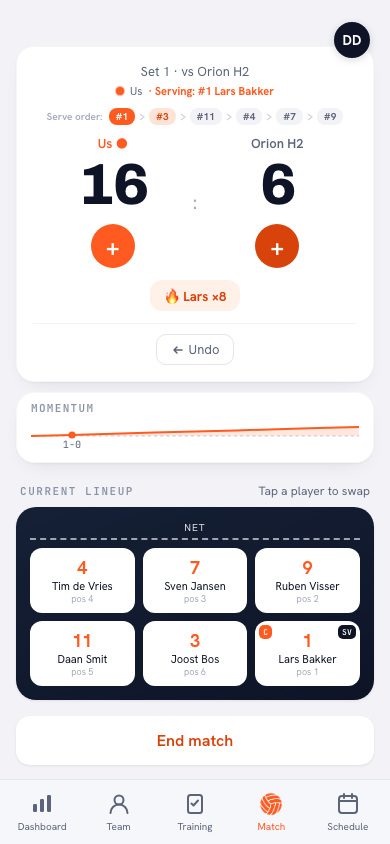
Because you can never really attack a serve, everything starts with the pass — and in Koach you rate reception per player on a scale of 0 to 3.
Why these rules exist
Without them the serve as an opening shot would become pointless. A team with three tall front-row players would simply block or smash back every high serve, and rallies would end on the first contact. The rules guarantee that the receiving team gets to build: pass, set, attack. That is the foundation of volleyball as a rally sport.
It is also a safety rule. A server is often still off balance on or behind the end line after their serve; a smash straight back from close to the net would give them no chance at all.
The situations where it goes wrong
- The serve going long that gets touched anyway. A front-row player puts their hands up on a serve that is clearly sailing out. Blocking fault — and a point you would otherwise have had for free. Teach your front-row players to keep their hands down on a high serve and step aside.
- The overpass that tempts a blocker. This is no longer a serve; as soon as the ball has been touched by a team-mate, the ordinary rules apply and you may block it.
- The high, soft youth serve. In youth volleyball a serve regularly floats over the tape high and slow. The urge to tap it down is strong, but the ban applies there too.
- The opponent's overpass. Again: once the ball has been touched by another player on their team, it is no longer a serve and anything goes.
Youth, mini volleyball and beach
From under-15 upwards the rules are identical to the senior game. In mini volleyball the lowest levels do not block and do not spike, so the situation does not arise; at the highest mini levels the same ban applies. In beach volleyball the rule is the same as well: the serve may not be blocked and may not be attacked from the front zone above net height.
What to do with this as a coach
Practically it comes down to one instruction for your front-row players: hands low on the serve. Build it into your reception training by deliberately having long, high serves thrown in and letting players judge whether they are out — with their arms by their sides. Spend the rest of your time on the pass itself: because you can never punish a serve, the quality of the first contact determines the whole rally. The formation you organise that with is in serve receive formations, and the technique in forearm passing.
Frequently asked questions
Can you block a serve in volleyball?
No, never. Blocking the serve is always a blocking fault, wherever you stand and however the serve comes over. The point and the serve go to the serving team.
Can you hit a serve straight back?
Only if the two conditions are not met at the same time: it is a fault when the ball is in the front zone and entirely above the top of the net. So driving a low serve back is allowed, as is an attack from behind the three-metre line.
Can you touch a serve that is clearly going out?
Not with a blocking action above the tape — that is a blocking fault and you lose a point you would otherwise have got for free. Tapping it away low is allowed, but the touch then counts as your first team contact and the ball stays in play.
Does this apply to an overpass as well?
No. As soon as the ball has been touched by a player on the receiving team, it is no longer a serve. You may block and attack such an overpass under the normal rules.