
Coaching your own child in volleyball: the rules that help
Most youth coaches are standing in front of the group because their own child plays in it. That is the most normal thing in the world and at the same time the hardest coaching situation there is: you are assessing someone you will be sitting in the car with afterwards. These are the agreements that keep it workable.
Two traps, equally damaging
Parent-coaches almost always fall to one of two sides. The strict side: you come down harder on your own child to prove you aren't playing favourites. The result is a kid who gets extra criticism at every practice and at some point simply stops playing volleyball. The favouring side: you give your child that serving turn or that starting spot just a little more often. Teammates notice that faster than you think, and it costs you authority with the whole group. Neither happens deliberately — which is exactly why agreements up front work better than good intentions.
There is a third effect that gets mentioned less: your child no longer has a coach-free zone. Where teammates go home after practice and let it go, your child sits at the dinner table with someone who is still turning the match over. For a lot of kids that is the reason they drop out, not the coaching itself.
Make the roles explicit
Talk about it with your child before the season, and keep it concrete: "In the hall I'm the coach and you call me by my first name, like everyone else. Outside the hall I'm just your dad." Also agree how you handle criticism: does he get it in the group or separately? Some kids specifically do not want to be taken aside because it stands out; just ask. And agree what is not discussed at home — next week's lineup, for example, or what other players are or aren't doing well. Your child shouldn't have information his teammates don't have; that is a burden, not a privilege.
The car ride home
The ride after the match is where it goes wrong most often, and the solution is surprisingly simple: give your child the controls. One fixed opening line — "do you want to talk about it or not?" — and you accept the answer. If not, the radio goes on. If yes, you listen as a parent and not as an analyst. What you save for practice: technical corrections, tactical explanations and everything that starts with "you should have". Youth-sport research has pointed for years to the sentence children most want to hear from their parents after a match, and it is the simplest one: I loved watching you play. That still holds when you happen to be the coach as well. More about the role of parents around the court is in parents on the sideline.
Make your choices checkable
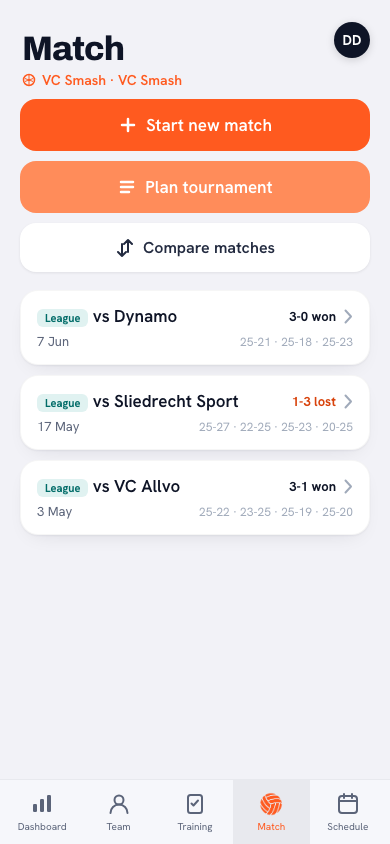
The best antidote to the accusation of favouritism is transparency. The playing-time meter in Koach shows in minutes who actually played, which ends the discussion about whether the coach's kid gets more court time. Don't keep that information secret: say at the start of the season that you track playing time and that any parent may ask about it. The same goes for your selection criteria — how to divide playing time without weakening your team is in dividing playing time fairly. Ask for a second pair of eyes as well: an assistant, a fellow parent or a coaching colleague who watches once a month and says honestly whether your child gets too much or too little attention. You can't see it yourself.
What to agree with team and parents beforehand
- Just say it. Mention at the first parents' meeting that your child is in the team and how you deal with that. What you say out loud is rarely discussed behind your back.
- Give one point of contact for objections that isn't you — the team manager or someone from the club's technical committee. A parent who thinks you are playing favourites needs somewhere to go.
- Don't let your child have a special role. No automatic captain's armband, no extra key to the ball cupboard. How you do make that choice is in choosing a captain.
- Agree who coaches if your child has to come off in a tight finish. Some parent-coaches deliberately let their assistant make that call.
When to let go
There is often a moment when the combination stops working: your child gets older, wants his own space, or the level gap with the group becomes a topic. Signals worth taking seriously: your child no longer talks about volleyball at home, goes to practice reluctantly where he used to enjoy it, or asks whether he can play in another team. That last one isn't a rejection of you but a normal developmental step. Hand over then — or go and coach a different group yourself. Better to stop a season early than a season late; your child's volleyball lasts longer than your coaching stint.
The simplest yardstick: would you take exactly the same decision if this player weren't your child? If you can't answer yes to that immediately on a substitution or a lineup, it is worth having someone else look at it.
Frequently asked questions
Should my child call me coach in the hall?
Not necessarily coach, but the same as the rest of the team — usually your first name. It is about the signal to the group that there is no separate relationship in the hall; at home everything can be normal again.
How do I stop myself being harder on my own child?
Count it literally: have an assistant tally during one practice how often you correct each player. Almost every parent-coach is shocked by the result, and that number corrects your behaviour faster than any resolution.
What if other parents think I am playing favourites?
Invite the conversation instead of defending yourself, and bring facts: playing time per player, your criteria and where they were agreed. Also make sure there is someone else in the club where they can take their objection.