How to Pass a Float Serve in Volleyball: Reading the Ball
A float does not even arrive hard, and still you see good passers fumble it. That is because the ball changes its mind on the way over: it drifts sideways, drops suddenly, or floats an extra meter. Passing turns into a reading exercise - and reading can be trained.
Why a float is so hard
A ball with rotation holds its course. A ball without rotation does not: the airflow separates on alternating sides, helped along by the seams and the valve, which makes the ball drift sideways or drop unexpectedly. The explanation behind it is in the float serve. What you need to know as a passer is mainly this: the ball changes most in the last two meters, exactly when you have already decided where to stand.
From which follows the core of this whole article: against a float you cannot move early to a final position and wait there. You have to be able to adjust until the very last moment.
Start shallow and step in
Most passers stand too deep against a float. Floats lack the speed of a topspin serve and often drop earlier than expected, so the classic error is a ball that lands in front of you while you are still reaching. Start one to two meters shallower than you would against a hard serve, and accept that now and then you have to move back.
The reason is mechanical: adjusting forward works until very late, adjusting backward does not. Someone who has to move half a meter forward does it with two quick steps while the ball is still traveling. Half a meter back is doable too - but a full meter back means passing over your shoulder, and that goes nowhere.
Move small, and move late
Against a topspin serve you pick your spot early and stand still. Against a float you do almost the opposite: you keep shuffling in small steps until the ball is about three meters away. Concretely:
- Hands apart. Form your platform only at the last moment. Fold your arms early and all you can do is reach.
- Small steps. No big lunges; they lock you in place. Keep shuffling on the balls of your feet.
- Be still at contact. Moving during contact sends the ball anywhere - that stays the holy rule on a float too.
- Platform still. The ball arrives softly, so the temptation to swing is strong. Do not: a float still carries plenty of speed, and swinging turns an unpredictable ball into a completely unpredictable one.
The base platform technique is in the forearm pass; how to aim it without swinging is in angling your platform.
Read the server, not just the ball
You can predict the first half of the flight just by watching the server's hand:
- Hand dead center on the ball, short punch: a genuine float. Expect drift and an early drop.
- Hand slightly to the side: sidespin - the ball will drift consistently the same way. Two serves and you know which.
- Wrist follow-through: not a float but topspin. Move a meter deeper right away.
- Low toss and compact swing: often a short float. Slide forward.
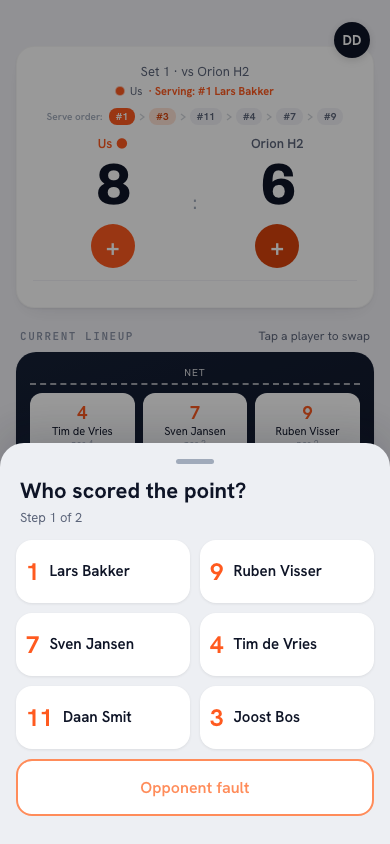
Share it out loud on court. One passer calling "it drifts left" after the first serve saves the whole receiving trio three bad passes. And keep a record: rate every pass 0-3 in Koach and you will quickly see which servers your team keeps struggling to read - a far more useful practice brief than "pass better".
Play it higher and safer than you would like
Against a float, a tight, fast pass is rarely worth it. Because you are never quite sure what the ball does in the last meter, your margin is smaller. So play the ball deliberately half a meter higher and a little more toward the middle of the court than you would against a normal serve. Your setter loses some tempo, but gets a ball instead of an emergency. What counts as a usable target depends on your serve receive formation.
The seam between two passers
Floats land right between two players more than any other serve. The agreement that works best: the player the ball drifts toward takes it, not the player who was closest when it left the server's hand. Call late, not early - a claim from four meters away is worthless on a drifting ball. And have the player who is not taking it actively turn away instead of standing and watching; that prevents collisions and makes the decision visible to everyone else.
How to train it
- Floats only, ten minutes: one server hitting nothing but floats, alternating short and deep, with the same motion every time.
- Catch instead of pass: the passer has to catch the ball with two hands at the spot where they would have passed it. Reading errors become visible instantly.
- Passing with a restriction: small steps only, no lunges. If you have to reach, you were standing in the wrong place.
- Grade every ball: give each pass an immediate score from 0 to 3 - unplayable, over the net, playable, perfect.
That last one is worth more than it looks: a passer who hears after every ball whether they played a 1 or a 2 learns much faster to tell the difference between "touched it" and "usable". How to follow your serve receive across a whole season is in tracking serve receive.
Frequently asked questions
Why do I keep shanking float serves?
Usually because you move to your spot too early and then stand still. A float changes course mainly in the last two meters. Keep adjusting in small steps until late and form your platform only once you know where the ball is going.
Should you stand deeper or shallower against a float?
Shallower. Floats carry less speed and often drop earlier than expected. You can adjust forward until the last moment but you cannot run backward, so give yourself room behind you, not in front of you.
Why does my pass off a float fly everywhere?
Because you are moving your arms at the ball. A float arrives softly, which creates the urge to swing. Keep the platform still, play from your legs and accept a slightly higher, safer pass.
Who takes the ball that lands between two passers?
The player the ball drifts toward, not the one who was closest when it was served. Call late - a claim from four meters away means nothing on a drifting ball - and have the other player actively turn away.


