
Season plan for volleyball training: 34 weeks, five blocks
Most teams don't have a season plan, they have a run of separate practices that happen to sit one after the other. You only notice in March, when it turns out you never finished the block and nobody can say whether the serve receive actually got better. A season plan fixes that with one agreement: you decide in advance which theme is up in which week, and at the end of every block you measure whether it worked.
Count in weeks, not in months
Almost every season plan you find online talks in months: "in September you lay the foundation, in January you go deeper." That only works if your league starts in September. The start date, the number of playing weeks and the length of the mid-season break differ per federation and sometimes per division — always check those three in your own league calendar before you plan anything.
So this plan counts in weeks around one fixed anchor: the week of your first league match is week 1. Before that sits the pre-season (week -6 through week -1), after it the league season (week 1 through week 28). Thirty-four weeks in total. Whether your season starts in August, in October or in February, the plan simply slides along with it.
This article is only about the content of those 34 weeks: which theme is up when. The organisational year — registration, filling the calendar, review conversations, handover — is in organising your volleyball season. The physical layer (strength, jump loading, testing points) has its own build-up across the year and that lives in conditioning for volleyball players; that schedule doesn't belong here twice. And how you build one session out of blocks is in structuring a practice.
From season goal to week theme: four links in a chain
A season plan is nothing more than a chain of four links, each one following from the last. Let one come loose and you are training into thin air.
- The season goal — one sentence, set with the team at the start of the year. See setting a team goal. Example: "we don't want to fall apart the moment we come under pressure any more".
- The countable marker — translate that sentence into one thing you can count. "Falling apart under pressure" becomes, for instance: how often do we win the rally on our own serve receive? That is your side-out percentage, and it is the number that runs through the whole year.
- The block goal — one part of that game per seven-week block. One block goal, not two. In practice two block goals are zero block goals, because in week four you end up choosing anyway.
- The week theme — three per block, each running two weeks. The week theme is what goes into the focus field of your practices; how to phrase that sharply is in setting the focus of your practice.
So a block always looks the same: three week themes of two weeks each, plus one measurement week. Seven weeks per block, five blocks per year — only block A counts six, because the pre-season is shorter. A season plan needs no more rules than that.
Blocks A and B: from foundation to side-out (week -6 to 7)
Block A — Foundation (week -6 to -1). Block goal: everyone can perform the basic skills without match pressure, and the lineup is settled. This is the only block of the year in which you may introduce a lot of new material, because nothing is at stake.
- Weeks -6 and -5: serve and serve receive, separately. Lots of repetitions, little explanation. Aim for fifty to sixty serves per player per session — which only works if you use two balls per player and nobody is standing in line.
- Weeks -4 and -3: the pass-set-attack chain. The same three skills, now glued together. This is also where you pick your lineup — and after that you leave it alone until the mid-season break.
- Weeks -2 and -1: everything six-on-six. Two friendlies, each with one explicit question to answer ("does the reception triangle hold up against a jump serve?"). Not a general impression — one question.
Measurement point: the last friendly is your baseline for the number from link two.
Block B — Side-out (week 1 to 7). Block goal: win the rally on your own serve receive. This is nearly always the first league block, for the simple reason that every rally the opponent serves starts with your reception: it is the phase that comes back most often in a set.
- Weeks 1-2: the reception triangle. Who takes the ball between two players, and who calls. One agreement, repeated a hundred times.
- Weeks 3-4: the standard second ball. Which attack does the setter run by default after a good pass? As long as that choice isn't fixed, every rally stays improvisation.
- Weeks 5-6: the emergency ball. What do we do when the pass drops outside three metres? This theme is rarely trained separately even though the situation comes up in every set — so that is where the gains are.
- Week 7: measurement week.
Blocks C, D and E: apply pressure, close out, stay sharp (week 8 to 28)
Block C — Applying pressure (week 8 to 14). Block goal: take points on your own serve. Weeks 8-9: serving at a zone or at a player instead of safely inside the lines. Weeks 10-11: one block-and-defence agreement (for example: the block takes the line, the defence takes the rest) — one agreement, not a whole system. Weeks 12-13: the second chance, meaning the ball after a blocked or dug attack. Week 14 is the measurement week, and at the same time the last week before the mid-season break.
Block D — Closing out (week 15 to 21). Block goal: finishing sets you are already winning. Weeks 15-16: attacking against a set block, so tempo and direction instead of power. Weeks 17-18: the third ball after a long rally, when everyone is out of position. Weeks 19-20: playing out 20-20 scores, at least four times in every practice. Week 21: measurement week. This is also the block your second rest week falls in — more on that below.
Block E — Staying sharp (week 22 to 28). Block goal: nothing new, everything faster. In weeks 22-23 and 24-25, take the two worst measurements of the year and train them again, now straight in match form. Week 26: measurement week. In the final two weeks you are allowed to experiment — try someone in a second position, run a different lineup — precisely because the result usually matters less by then. A coach who does that in November loses matches; a coach who does it in week 27 knows more come August.
Five blocks, fourteen week themes, five measurement points. Nothing more fits in a year, and that is exactly the point: a list of thirty themes is not a plan but a wish list.
The load curve inside the week: one learning day, one sharpening day
The week theme is one thing; when you deliver it is another. With the usual rhythm of two practices and a match at the weekend, those two practices get different jobs. Note: this is about learning load — the amount of new material and decision pressure — not physical load.
- The learning day is the practice furthest from the match (usually Tuesday). This is where you introduce the week theme, at low pressure and with lots of repetitions. Roughly two thirds of your theme time sits in this session.
- The sharpening day is the practice just before the match (usually Thursday). Same theme, but only in match form now. No new drill, no new agreement. Whatever you introduce on Thursday isn't there on Saturday.
Two practical rules follow from that. One: you no longer bring in new material in the last practice before a match. Two: in a week with two matches the learning day drops out, not the sharpening day — the week theme then shifts a week and your block simply becomes eight weeks. And a week without a match isn't a free week but your best learning week of the block; put the heaviest theme there.
The two weeks you deliberately don't train
In a plan of 34 weeks, two weeks carry no theme but the word "nothing". That isn't a leftover — it is the only way to avoid coaching half an empty gym in March with a group that is simply spent.
Rest week 1 falls in the mid-season break, straight after the measurement week of block C. One week without a ball, announced explicitly ("I won't see you until Monday the whatever"), so nobody sits at home feeling guilty. What to do with the rest of the break — a mid-season stocktake, individual conversations, the focus for the second half — is in making use of the mid-season break. If the break at your federation lasts longer than two weeks, stick the extra weeks in front of block D as build-up weeks: one practice a week, old themes, no new material.
Rest week 2 you plan yourself, somewhere in block D, and that is the hard one. The second half of the season has no natural interruption, while it does contain the holiday week where you turn up with five players. Pick that week in advance and put it in the calendar before anyone pulls out. The rule of thumb: if you can't run a decent team drill with the players you expect that week, a planned rest week beats half a practice that helps nobody. The block then becomes eight weeks instead of seven. That's fine.
Every block ends with a measurement week
Without a measurement week a block is a feeling. The measurement week is one practice in which you run exactly the same test drill as in the first week of the block, so you can put two numbers side by side. Three examples you can copy word for word:
- Serve receive: twenty serves per passer, every pass scored 3-2-1-0. Note down the number of threes only.
- Side-out: fifteen minutes of six-on-six, count how often you win the rally on your own reception and divide that by the number of receptions. What counts as a normal value at club level depends heavily on the standard you play at — the direction across seven weeks tells you more than the number itself.
- Serve: thirty serves per player at a three-by-three-metre target zone. Count the hits and count the errors, both.
Four conditions make a measurement like this usable: the same drill, the same number of balls, the same order of players, and always at the start of the practice. Measure fresh one time and after fifty minutes the next, and you are measuring fatigue instead of progress. Write the two numbers in the same place as your practices, so you can find them again in May.
And keep it small: one measurement per block, three minutes of writing. A measurement week that costs half an hour is one you skip the third time round.
When the calendar goes sideways: tournament, holidays, no gym
Every season plan gets overtaken by reality somewhere around week nine. The question isn't whether it happens but what you cut when it does. Five decision rules:
- A practice is cancelled (no gym, public holiday): extend the block by a week. Don't compress the theme into a single session — then you have touched the theme but not trained it.
- Tournament at the weekend: don't start a new theme the week before, repeat the current one. A tournament is three to five short matches and therefore a fine test, not a learning moment.
- Holiday week with half the group: no new theme, but a maintenance session from a fixed template built around small-group drills. See reusing practice templates — build it once, use it four times a season.
- Two matches in one week: the learning day drops out (see above), the theme shifts along.
- A block overruns: let it overrun. Move the measurement week with it and shorten block E if you must. The order of the blocks matters more than their length.
What you never do is squeeze two week themes into one week to "keep up with the plan". A plan you aren't allowed to deviate from is one coaches throw away in November; a plan that is allowed to shift survives the season.
Seeing afterwards whether the plan was actually run
The difference between a season plan and a good intention is that you can check a season plan. That costs you nothing extra if you do two things during the season.
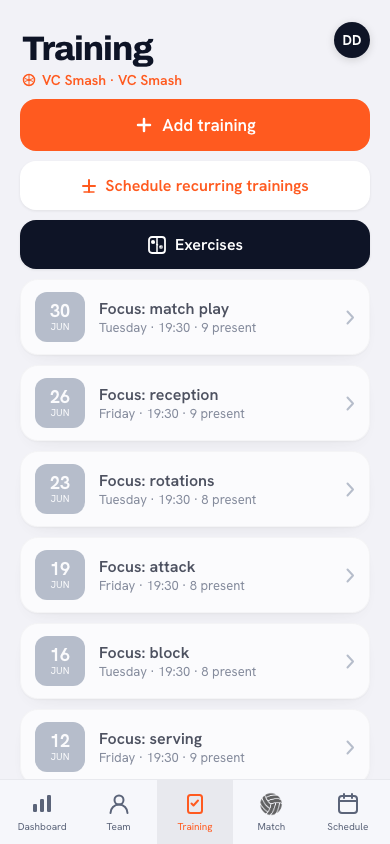
Put the week theme in the focus field of every practice. Two practices with the same focus, two weeks in a row — that is your week theme, and it is there in black and white. Scroll back through your practices in May and within a minute you can see whether block C really lasted six weeks or quietly died after three. In Koach that focus sits on every practice and you keep one template per block, so the outline is already there next time.
Look at attendance per block, not per season. This is the bit almost everyone skips. A player sitting at 75 percent across the year looks perfectly present — but if he was at 50 percent during block B, he simply didn't see half of your side-out work. Not seeing that improvement in him is then not a matter of unwillingness or talent but a matter of attendance. So work out, per block, what percentage of the practices each player was part of, and judge their development against that number.
At the end of the year you ask three questions: was every block run as planned, do the five start and end measurements sit side by side, and who was there during which block? Together the answers form the basis for next year's plan — how to set up that review is in evaluating the training season.
Key point: a season plan isn't a ten-page document but one line per week — five block goals, fourteen week themes, five measurement points and two weeks in which you do nothing. If it doesn't fit on one sheet of A4, you won't keep it up for a season.
Frequently asked questions
My league only has 22 playing weeks. How do I adapt this plan?
Don't drop a whole block, shorten every block to five weeks: two week themes of two weeks plus the measurement week. The order — foundation, side-out, serving pressure, closing out and sharpness — then stays intact. Below four weeks a block stops making sense, because then you are training loose themes without repetition.
How many week themes can I fit into a season?
Twelve to fourteen, and while you are planning that always feels like too few. Every theme needs two weeks of repetition before players dare to carry it out in a match, so more themes means less learned in practice. Whatever is left over is material for next season.
Saturday's match showed something completely different from my block theme. Now what?
Note it down and work it into the sharpening day, but don't tear up your block — coaches who react to the last match every week never get to three weeks of repetition. If the same problem comes back three matches in a row, it isn't an incident, it is your next block goal.
Should I share the season plan with my team?
The five block goals yes, at the start of the season, in five sentences. The week theme you share weekly, for example in the practice announcement. Nobody reads a full 34-week plan sent round in advance, and it turns every later deviation into a broken promise.
Do strength and conditioning belong in this season plan too?
Yes, but as their own layer with their own build-up; that is described in the article on conditioning for volleyball players. The only link you make in this plan is to schedule the heaviest physical weeks in the weeks without a match — the same weeks that are your best learning weeks above.
When do I write the season plan?
Before the first practice of the pre-season, in roughly two hours: league calendar in front of you, block boundaries set, block goals chosen. Fill in the week themes for block A straight away; the rest you add block by block, always about seven weeks ahead.